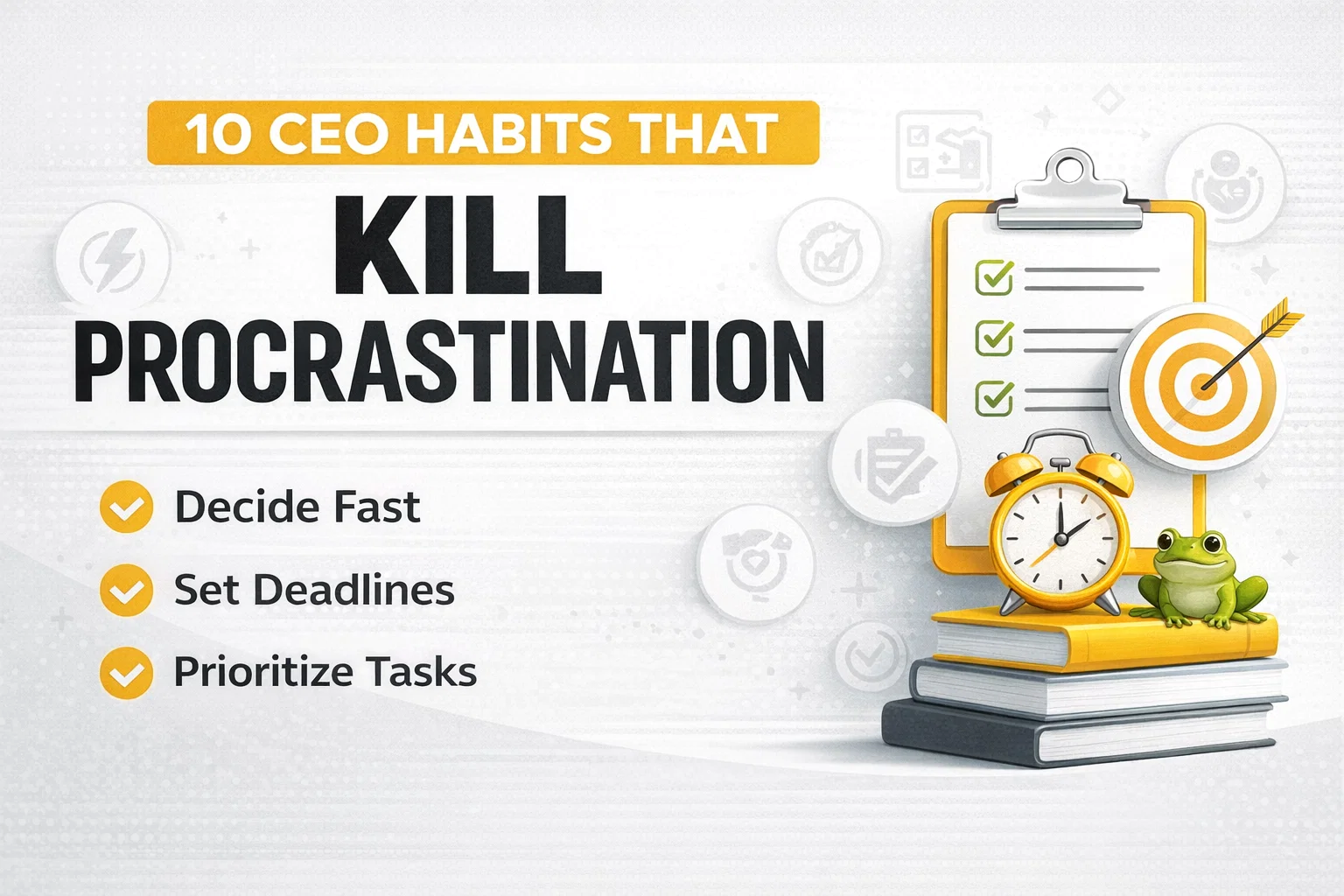
10 CEO Productivity Habits to Stop Procrastination and Boost Your Focus Every Day
Procrastination is often dismissed as a simple lack of willpower or a character flaw, but for those operating at a high level, it is actually a complex emotional and cognitive hurdle. When you are managing multiple projects, leading a team, or trying to scale a digital empire, the weight of decision-making can become paralyzing. This is why the world’s most successful executives do not rely on motivation alone; they rely on systems. By adopting specific habits used by top-tier CEOs, you can transition from a state of constant catching up to a state of proactive leadership. Understanding how to kill procrastination is not just about doing more work, it is about doing the right work at the right time with unshakeable focus.
The Psychology of High-Level Execution
To solve the problem of procrastination, we first have to understand why it happens in a professional context. Most high achievers procrastinate not because they are lazy, but because they are perfectionists or because the task at hand feels overwhelmingly significant. When a task is high-stakes, the brain’s amygdala triggers a fear response, leading us to seek comfort in low-value activities like checking emails or scrolling through social media. CEOs bypass this biological trap by creating “forcing functions” and mental frameworks that make starting a task easier than avoiding it.
The habits outlined in the recent CEO Accelerator framework provide a roadmap for this mental shift. By focusing on speed, delegation, and ruthless prioritization, you remove the friction that typically leads to delay. When you decide fast and move with intention, you do not give your brain enough time to talk you out of taking action. This momentum is the ultimate enemy of procrastination.
Decide Fast to Build Unstoppable Momentum
Overthinking is one of the most common forms of “productive procrastination.” We tell ourselves we need more data, more opinions, or more time to reflect, but in reality, we are just delaying the discomfort of making a choice. Speed is a competitive advantage. Successful leaders follow the 70 percent rule: if you have 70 percent of the information you need, make the decision. Waiting for 100 percent certainty usually means you have waited too long and lost your momentum.
The Power of Iteration Over Perfection
When you decide fast, you allow yourself the grace to adjust as you go. Perfectionism is a primary driver of procrastination because it makes the starting line feel like a cliff. Instead of aiming for the perfect launch, aim for the fastest launch. Once you are in motion, it is much easier to steer the ship. Action provides the data that reflection never could, so gather your core insights, make the call, and refine your strategy based on real-world feedback.
Mastering the Art of Relentless Delegation
You cannot reach the next level of success if you are still doing the tasks that got you to your current level. Many entrepreneurs fall into the trap of thinking they are the only ones who can do a job “the right way.” This mindset leads to burnout and a massive backlog of tasks that eventually cause you to freeze. Delegation is not just about offloading work; it is about protecting your cognitive bandwidth for high-impact strategy and big-picture decisions.
Identifying Your High-Value Zone
To delegate effectively, you must first identify which tasks move the needle and which ones are simply maintenance. If a task can be handled by someone else to a 70 or 80 percent standard of your own, you should pass it off. This clears your plate of the “busy work” that often serves as a distraction from the harder, more important work you should be doing. By empowering your team or using automation, you ensure that the business moves forward even when you are focused elsewhere.
Blocking Focus Time for Deep Productive Work
We live in an era of constant interruption. Notifications, “quick” questions, and back-to-back meetings are the enemies of deep work. If your day is fragmented into fifteen-minute chunks, you will never have the mental space required to solve complex problems. CEO productivity hinges on the ability to protect focus hours. This means carving out non-negotiable blocks of time where the world is shut out.
Creating a Distraction-Free Environment
During your focus blocks, you must implement a zero-tolerance policy for interruptions. No emails, no Slack messages, and no phone calls. This is the time for work that requires intense concentration. Most people find that their peak energy occurs in the morning, making it the ideal time for these deep work sessions. By moving the needle on your most important project before the rest of the world wakes up or starts demanding your attention, you guarantee a productive day regardless of what happens later.
Prioritizing Ruthlessly with the Pareto Principle
Not all tasks are created equal. The 80/20 rule suggests that 80 percent of your results come from 20 percent of your activities. Procrastination often hides in the “other” 80 percent. We spend all day being busy with minor tasks while the truly transformative projects sit untouched on our list. Ruthless prioritization means looking at your to-do list and identifying the one or two items that will actually change your trajectory.
The Clarity of Saying No
Prioritization is as much about what you don’t do as it is about what you do. To stay focused on high-impact tasks, you must become comfortable saying no to good opportunities so that you can say yes to great ones. Clarity is the foundation of progress. When you know exactly what needs to be done first, the path forward becomes clear, and the urge to procrastinate diminishes because the “next step” is no longer a mystery.
Setting Hard Deadlines to Drive Accountability
Parkinson’s Law states that work expands to fill the time available for its completion. If you give yourself a month to finish a project, it will take a month. If you give yourself three days, you will find a way to get it done in three. Open-ended timelines are a breeding ground for procrastination because there is no sense of urgency. Hard deadlines create a healthy level of pressure that forces you to simplify and execute.
Public Commitments and Social Pressure
One of the most effective ways to ensure a deadline is met is to make it public. Commit to a launch date with your audience or set a firm delivery time with a trusted advisor. When your reputation is on the line, you are far less likely to push a task to the next day. Accountability turns a private goal into a professional obligation, providing that extra push needed to overcome the initial resistance to a difficult task.
The Strategy of Eating Your Frogs
The “Eat Your Frog” technique, popularized by Brian Tracy, is a staple of executive productivity. The concept is simple: if you have to eat a live frog, do it first thing in the morning. If you have to eat two, eat the big one first. Your “frog” is your biggest, most important, and most daunting task. It is the one you are most likely to procrastinate on, yet it is also the one that offers the greatest reward.
Tackling the Toughest Tasks First
Our willpower is like a battery that drains throughout the day. If you leave your hardest task for the afternoon, you will be trying to tackle it with a low mental charge. By handling your toughest challenge first, you experience an immediate sense of accomplishment and a “dopamine hit” that carries you through the rest of your day. Everything else will seem easy by comparison once the frog is gone.
Slashing Meetings and Reducing Decision Fatigue
Meetings are often the ultimate form of corporate procrastination. They give the illusion of progress while actually preventing people from doing the work discussed. To reclaim your time, you must slash unnecessary meetings and keep the remaining ones short, sharp, and action-driven. Every meeting should have a clear agenda and a defined outcome.
Streamlining Small Decisions
Decision fatigue occurs when the quality of our choices deteriorates after a long session of decision-making. CEOs like Steve Jobs or Mark Zuckerberg famously wore the same outfit every day to eliminate one small decision. By automating and streamlining the “small stuff” in your life and business, you preserve your mental energy for the “big moves.” The more you can put on autopilot, the more focus you have for the challenges that truly matter.
Staying Accountable and Tracking Progress
What gets measured gets managed. If you do not track your progress, it is easy to slip back into old habits of distraction. High-level execution requires a feedback loop where you regularly assess your performance. Whether it is a weekly review or a daily check-in with a coach, staying accountable ensures that you remain conscious of how you are spending your time.
The Role of a Trusted Advisor
Sometimes we are too close to our own work to see where we are stalling. A trusted advisor or a mastermind group can provide the external perspective needed to call out your procrastination. They can help you identify when you are overcomplicating a process or when you are avoiding a hard decision. This external layer of accountability is often the difference between a stagnating business and a rapidly scaling one.
Conclusion: Transforming Habits into Results
Killing procrastination is not an overnight event; it is a discipline that is built through daily practice. By adopting these ten CEO habits, you are not just managing your time more effectively, you are fundamentally changing your relationship with work. You are choosing speed over perfection, impact over busyness, and discipline over distraction. Remember that progress starts with clarity and is sustained by momentum.
As you begin to implement these strategies, start small. Perhaps you begin by blocking out just one hour of focus time or by committing to “eat your frog” every Monday morning. Over time, these small shifts will compound into a powerful system of execution that allows you to handle even the greatest challenges with ease. The road to success is paved with the tasks we formerly wanted to avoid. By facing them head-on today, you secure your growth for tomorrow.