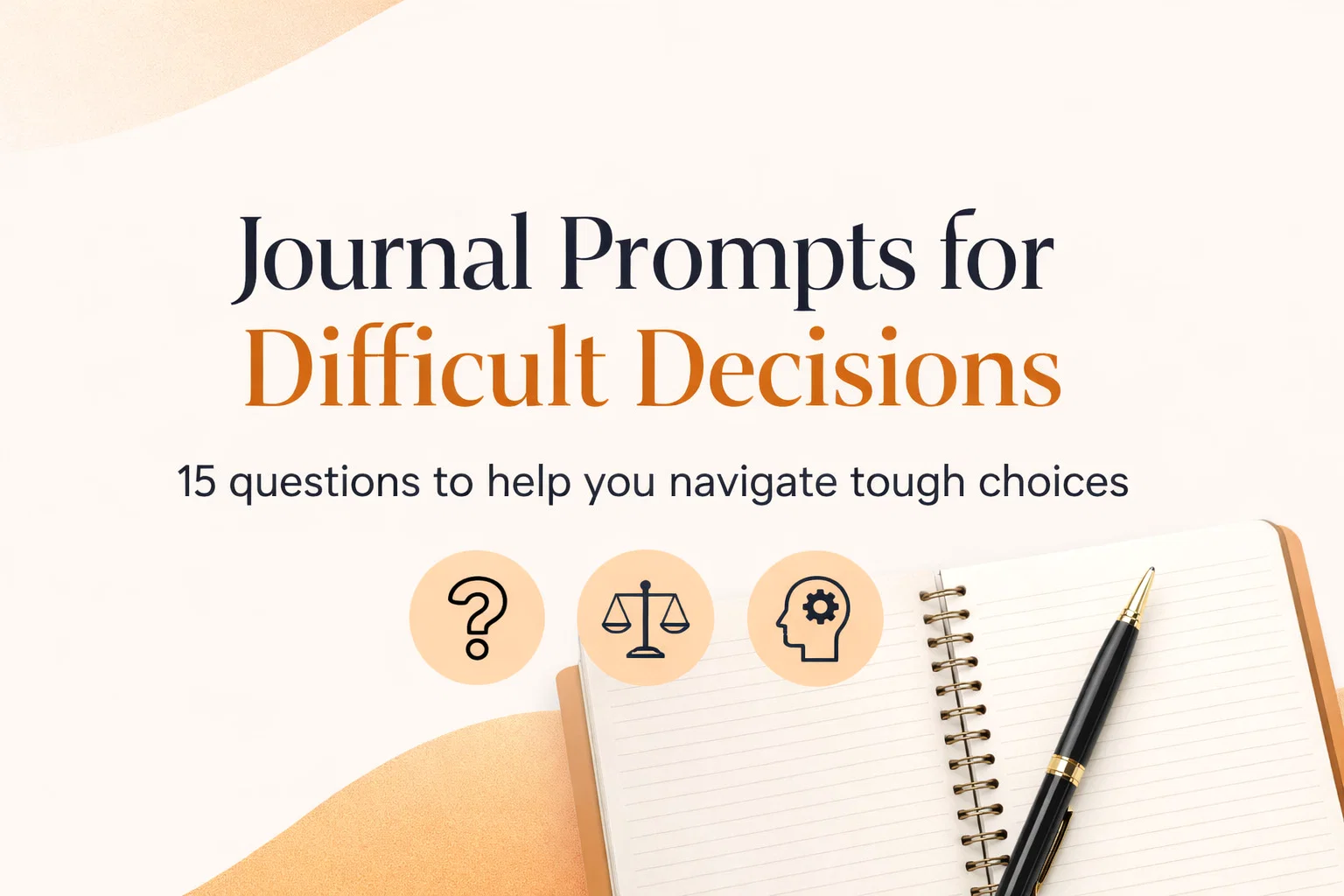
15 Journal Prompts for Difficult Decisions Clarity
We have all been in that uncomfortable space. You are standing at a major crossroads in your life, staring down a choice that feels impossibly heavy. Whether you are contemplating a drastic career change, deciding whether to relocate to a new city, navigating a complex relationship shift, or simply trying to figure out your next big life move, the weight of a difficult decision can be entirely overwhelming. Your mind races with endless “what ifs,” and analysis paralysis quickly sets in. You ask friends for advice, you make endless pros and cons lists, and yet, the right path remains frustratingly unclear.
When the noise of the outside world gets too loud, the most powerful thing you can do is turn inward. This is where the magic of mindful journaling comes into play. Journaling is not just about keeping a diary of your daily events; it is a profound tool for self-discovery, emotional regulation, and deep mental clarity. By putting pen to paper, you force your racing thoughts to slow down. You take the tangled web of anxieties, hopes, and logic spinning in your head and lay them out flat where you can actually examine them.
Today, we are going to dive deep into a curated list of powerful journal prompts specifically designed to help you navigate difficult decisions. These prompts will help you bypass your surface-level anxieties, separate cold hard facts from irrational fears, and ultimately tap into your deepest intuition. Grab your favorite notebook, find a quiet corner, and let us get to work on finding your clarity.
Why Journaling is the Ultimate Decision-Making Tool
Before we jump into the prompts, it is important to understand exactly why this process works so well. When we are faced with a tough choice, our brains naturally perceive the uncertainty as a threat. This triggers our fight or flight response, flooding our system with stress hormones. In this state, the logical, forward-thinking part of our brain, the prefrontal cortex, takes a backseat to the emotional center, the amygdala.
Writing by hand engages the logical part of your brain. It acts as a pressure valve for your anxiety. When you write down a fear, it loses some of its power over you. Furthermore, journaling provides a safe, judgment-free zone. You do not have to worry about managing anyone else’s expectations or cushioning your true feelings. It is just you and the page, allowing for a level of radical honesty that is rarely possible in conversation.
How to Set the Stage for Clarity
To get the most out of these prompts, you need to set yourself up for success. Do not try to rush through this exercise while standing in line at the grocery store or during a five-minute break between stressful meetings. Treat this process with the respect your future deserves.
- Create a physical sanctuary: Find a space where you will not be interrupted. Light a candle, make a cup of calming tea, or play some soft instrumental background music. Signal to your brain that it is time to focus.
- Go analog if possible: While typing on a laptop is perfectly fine if that is all you have, there is a proven cognitive connection between the physical act of writing by hand and emotional processing. A physical notebook is highly recommended.
- Commit to raw honesty: No one else is going to read this. If your true desire sounds selfish, write it down anyway. If your biggest fear sounds silly, put it on the page. Honesty is the only way to find your true north.
15 Transformative Journal Prompts for Difficult Decisions
Work your way through these questions slowly. You do not have to answer all fifteen in one sitting. Sometimes, a single prompt will crack the whole situation wide open. Let your intuition guide you toward the questions that feel the most resonant.
1. What decision am I trying to make right now?
This sounds incredibly basic, but it is the vital first step. Often, we are so tangled in the secondary consequences of a choice that we lose sight of the core issue. Write down the decision in one clear, concise sentence. Stripping away the excess context helps you focus your mental energy purely on the matter at hand.
2. What are the facts, and what are the fears?
This is perhaps the most crucial prompt on the list. When we are stressed, our brains blend reality with catastrophic imagination. Create two columns on your page. In the first column, list only the absolute, verifiable facts of the situation. In the second column, write down all the anxieties, “what ifs,” and worst-case scenarios your brain is generating. Seeing them separated physically helps you realize how much of your indecision is driven by unproven fears.
3. What would I choose if I weren’t afraid of failing or disappointing others?
Much of our hesitation comes from the pressure of external expectations. We worry about letting down our parents, looking foolish to our peers, or failing publicly. Imagine, just for a moment, that you have a magic shield that guarantees you will not fail and that everyone will applaud your choice. What does your heart immediately jump to? That instinct tells you volumes about your true desires.
4. What does my intuition say when I get quiet and still?
We often ignore our gut feelings because we cannot immediately justify them with logic. Take three deep breaths, close your eyes, and think about the two paths in front of you. What does your body tell you? Does one option make your chest feel tight, while the other makes your shoulders drop with relief? Your body often knows the answer long before your conscious mind catches up.
5. What is the worst-case scenario, and how likely is it?
Let us look that fear right in the eyes. What is the absolute disaster that could occur if you make the “wrong” choice? Write it out in excruciating detail. Now, put on your objective, analytical hat and assign a realistic percentage to the likelihood of that exact scenario happening. You will usually find that the disaster you are dreading is highly improbable. Then ask yourself: If it did happen, how would I recover? Knowing you have a bounce-back plan drastically reduces fear.
6. What outcome aligns most with the person I am becoming?
We often make decisions based on the person we used to be, sticking to old habits and outdated comfort zones. Instead, project yourself into the future. Think about the idealized version of yourself, the person you are striving to grow into. Which choice supports that growth? Which path feels expansive, and which path feels like shrinking back into an old shell?
7. If my best friend were in this situation, what would I tell them to do?
We are notoriously terrible at giving ourselves grace and good advice. We judge ourselves much more harshly than we judge those we love. Pretend your absolute favorite person in the world has come to you with this exact dilemma. Write out the compassionate, logical, and encouraging advice you would offer them. Now, read it back and apply it directly to yourself.
8. Which option feels heavier? Which one feels lighter?
This is a wonderful exercise in energetic alignment. Sometimes, a choice might look fantastic on paper, it makes financial sense, it looks great on a resume, but it feels incredibly heavy and draining to think about. Conversely, another option might involve risk and pay cuts, but thinking about it makes you feel bubbly and light. Pay close attention to that physical sensation of lightness. It is a massive indicator of alignment.
9. What values are most important to me in this moment?
Our core values shift depending on our season of life. In your twenties, your top value might be adventure and career acceleration. In your thirties or forties, it might shift to stability, community, or family time. List your top three values right now, in this exact phase of your life. Then, evaluate your options based purely on which choice honors those specific values the most.
10. Is this decision coming from a place of fear or self-trust?
Examine the motivation behind your leaning. Are you leaning toward Option A because it is the safe bet that guarantees you will not get hurt? Or are you leaning toward Option B because you deeply trust your ability to handle whatever challenges arise? Decisions made purely out of fear rarely lead to long-term fulfillment. Try to pivot your mindset toward trusting your own resilience.
11. What will each option teach me, even if it does not work out?
Reframing the concept of failure is incredibly liberating. Every choice, even the ones that lead to messy outcomes, provides valuable data and life experience. Look at your options not as “success vs. failure,” but as different curriculums in the school of life. What specific skills, resilience, or self-knowledge will you gain from path A, regardless of the final outcome? What about path B?
12. How will I feel about this choice in one year?
The immediate discomfort of a difficult conversation, a resignation, or a breakup can paralyze us. We get stuck in the short-term pain. Fast forward twelve months. Imagine you made the hard choice, survived the messy transition, and are now living in the new reality. How does future-you feel looking back? If the answer is “relieved and proud,” you have your answer, even if the short-term steps are terrifying.
13. What am I trying to avoid by not deciding?
Indecision is actually a decision in itself. By refusing to choose, you are choosing to stay exactly where you are. Often, we use confusion as a defense mechanism to avoid taking responsibility or stepping into the unknown. Be brutally honest with yourself here. Are you really confused, or are you just procrastinating because the right answer requires you to do something uncomfortable?
14. What does “success” look like in this situation for me?
Society has very loud opinions on what success is supposed to look like, usually involving money, status, or traditional milestones. Forget all of that. What does a successful resolution to this specific problem look like for your soul? Is success simply having peace of mind? Is it reclaiming your time? Is it establishing a boundary? Define your own metrics for victory.
15. What boundaries would I need to set to follow through on this choice?
Making the decision is only half the battle; honoring it is the real work. If you choose a certain path, who do you need to say “no” to? What habits do you need to break? What conversations do you need to have? Identifying the necessary boundaries right now prepares you for the actionable steps you must take once the journal is closed.
Taking Action After the Ink Dries
Once you have worked through these prompts, close your notebook and step away. Go for a walk, take a shower, or simply sleep on it. Do not force an immediate revelation. Often, the act of writing plants the seed, and your subconscious mind will continue to untangle the knot while you are doing other things. You might find that the answer suddenly drops into your mind while you are washing the dishes a day later.
Remember that there is rarely such a thing as a perfect, flawless decision. Every path will have its own unique set of challenges and joys. Your goal is not to find a risk-free route, but rather to choose the path that feels the most authentic to who you are and where you want to go. Trust that you have the resilience to handle whatever comes your way.
Have you ever used journaling to navigate a massive life shift? Which of these prompts resonated the most with your current situation? I would love to hear about your experiences and any lightbulb moments you had while doing this exercise. Leave a comment below, and let us support each other in making courageous, aligned choices!