15 Quiet Morning Night Habits for Better Health, Mindset, and Personal Growth 2026 Would you like me to write a keyword-rich Pinterest description to go with this title
Have you ever felt like your life is a series of loud, chaotic events that you are constantly trying to catch up with? We often think that to change our lives, we need to make massive, earth-shaking moves: quit the job, move across the world, or start a grueling three-hour workout regime. But the truth is much quieter than that. Real, lasting transformation rarely comes from a single explosion of effort. Instead, it happens in the tiny, almost invisible spaces of our daily routine. It happens in the quiet habits.
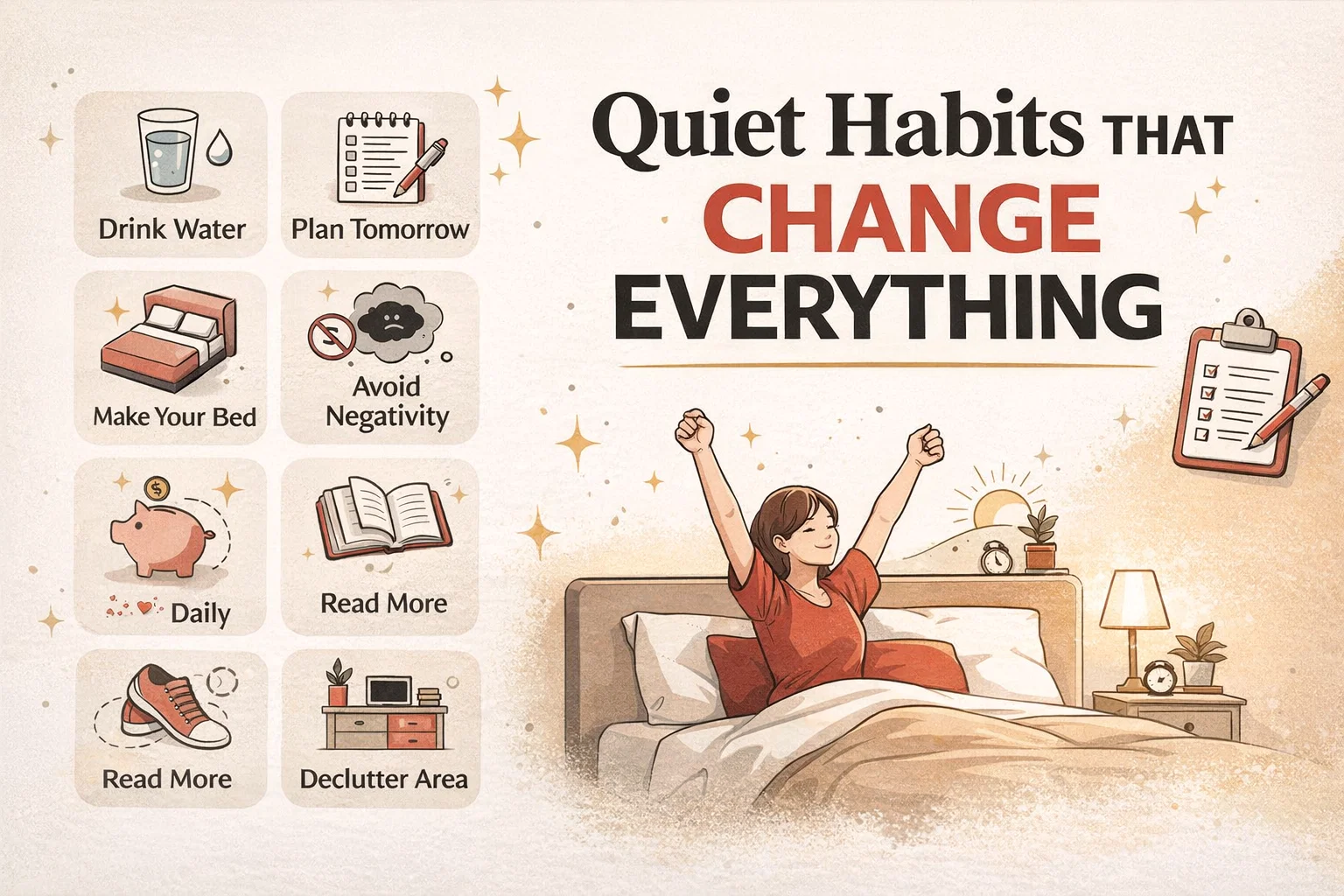
The image we are looking at today captures this philosophy perfectly. It suggests that the trajectory of your health, your mental clarity, and your financial peace is determined by the small things you do when no one is watching. These are the habits that do not require a spotlight but yield the highest return on investment. If you are ready to stop chasing “big” changes and start cultivating a “better” life, it is time to look at the quiet rituals that change everything.
The Power of a Morning Reset
How you start your day sets the chemical and psychological tone for every hour that follows. Most of us wake up and immediately reach for a phone or a carafe of coffee, but those actions can actually spike our stress hormones before we have even stepped out of bed. Integrating quiet morning habits allows your nervous system to wake up gently and efficiently.
Hydration Before Caffeine
Drinking water before your morning coffee is one of the simplest yet most profound health hacks available. After six to eight hours of sleep, your body is naturally dehydrated. Coffee is a diuretic, meaning it can further deplete your fluid levels if it is the first thing you consume. By drinking a full glass of water first, you reset your hydration levels, jumpstart your metabolism, and provide your brain with the fluid it needs to think clearly. It is a small act of kindness for your internal organs.
Seeking the Morning Light
Getting sunlight early in the day is about more than just a nice view. It is a biological necessity. When natural light hits your retinas, it signals to your brain to stop producing melatonin and start producing cortisol and serotonin. This helps regulate your circadian rhythm, which ensures that you feel alert during the day and sleepy at the appropriate time at night. Even ten minutes on a balcony or by a bright window can balance your hormones and improve your mood for the rest of the afternoon.
The Discipline of a Made Bed
It might seem trivial, but making your bed is your first “win” of the day. It is a signal of discipline and an external representation of an internal order. As Navy Seal Admiral William H. McRaven famously said, if you make your bed every morning, you will have accomplished the first task of the day. It gives you a small sense of pride and encourages you to do another task, and another. Plus, there is nothing quite like coming home to a tidy sanctuary after a long day of work.
Mindful Movement and Physical Presence
Our bodies were designed to move, yet modern life often traps us in a sedentary cycle. Quiet habits involving movement are not about burning calories as much as they are about maintaining the “machinery” of the human body and mind.
The Ten-Minute Daily Walk
You do not need an hour-long gym session to reap the benefits of movement. A simple ten-minute walk daily can drastically improve your digestion, clear your mental fog, and boost your heart health. Walking serves as a form of moving meditation. It allows your eyes to engage in “optic flow,” which has been shown to quiet the amygdala and reduce feelings of anxiety. It is the ultimate tool for perspective when you feel stuck on a problem.
Stretching Before Bed
While morning movement is about waking up, evening movement is about letting go. Stretching before bed helps release the physical tension accumulated throughout the workday. It lowers your heart rate and prepares your muscles for recovery. Think of it as a physical “off switch” that tells your brain the day is officially over. A few simple poses can lead to fewer aches in the morning and a much deeper, more restorative sleep.
Cognitive Habits for Personal Growth
Knowledge and wisdom are not gained in a day; they are compounded over time. By dedicating small pockets of time to your intellect and your awareness, you build a mental library that serves you for a lifetime.
The Five-Page Rule
Many people want to read more but feel they do not have the time to finish a book. The quiet habit of reading just five pages a day removes the barrier to entry. Five pages is manageable for almost anyone, regardless of how busy they are. Over a year, this small commitment adds up to about 1,825 pages, which is roughly six to eight full-length books. This is how you build massive knowledge without ever feeling overwhelmed by a reading list.
Noticing Negative Self-Talk
We are often our own harshest critics, and the worst part is that we usually do not even realize we are doing it. Noticing negative self-talk is the first step toward changing your internal narrative. When you catch yourself saying “I can’t do this” or “I always mess up,” simply pause and acknowledge it. You do not have to immediately force a positive thought; just noticing the negative one strips it of its power. This quiet awareness builds the foundation for real self-confidence.
Nurturing Relationships and Emotional Intelligence
Our quality of life is largely defined by the quality of our relationships. Quiet habits in this area focus on presence and restraint, ensuring that we show up as our best selves for the people we love.
Pausing Before Reacting
In a world of instant gratification and heated social media debates, the ability to pause is a superpower. When someone says something that triggers you, taking a three-second breath before responding can save a relationship. It allows you to move from a place of emotional reactivity to a place of logical response. This habit saves an incredible amount of mental energy that would otherwise be spent on regret or damage control.
Keeping Promises to Yourself
We often prioritize our promises to others while breaking the ones we make to ourselves. Every time you say you will work out and then don’t, or say you will eat healthy and then don’t, you lose a little bit of self-trust. Keeping small promises to yourself, like committing to a five-minute stretch, builds real, unshakable confidence. You begin to see yourself as a person who follows through, which is the cornerstone of a strong identity.
Environment and Financial Peace
Your surroundings and your financial habits provide the “container” for your life. If the container is chaotic, the life inside will feel chaotic too. These quiet habits focus on creating a sense of calm and security.
The Power of Daily Decluttering
You do not need a full weekend to organize your entire house. Instead, try decluttering one small area every day. It could be a single drawer, your desktop, or the console of your car. A calm environment leads to a calm mind. By handling small areas consistently, you prevent the “mountain of mess” from ever forming, keeping your stress levels low and your focus high.
Automating Your Savings
Financial peace is rarely about how much you make; it is about how much you keep. Saving a small amount automatically removes the “decision fatigue” of budgeting. When the money moves to a savings or investment account before you even see it, you learn to live on what remains without effort. Over time, these small, quiet transfers build a safety net that provides immense psychological freedom.
The Art of Being Present
Finally, the most transformative quiet habits are those that bring us back to the present moment. In a digital age, presence is becoming a rare and valuable commodity.
Putting the Phone Away While Eating
Eating has become a secondary activity for many of us, usually done while scrolling through news or watching videos. Putting your phone away while eating improves your digestion because your body is actually relaxed enough to process food. It also increases your “presence,” allowing you to actually taste your food and notice when you are full. This prevents overeating and turns a mundane task into a mindful ritual.
Expressing Gratitude Silently
Gratitude does not always need to be a public proclamation. Taking a moment to silently acknowledge three things you are grateful for each night rewires your brain for contentment. It shifts your focus from what is lacking to what is abundant. This simple practice can change your entire outlook on life, making you more resilient in the face of challenges.
Conclusion: Building Your Quiet Life
The beauty of these habits is that they do not require a life overhaul. You can start tomorrow morning by simply choosing one. Maybe you start with the glass of water, or maybe you commit to the ten-minute walk. The key is consistency over intensity. As these quiet habits begin to compound, you will find that the “everything” in your life starts to change for the better.
True transformation is not a loud event. It is the result of small, silent choices made day after day. By honoring these rituals, you are not just checking boxes; you are building a version of yourself that is healthier, calmer, and more capable of handling whatever the world throws your way. Start small, stay quiet, and watch everything change.
Which quiet habit are you going to start tomorrow? Choose one and stick to it for a week. Your future self will thank you for the small effort you put in today.