2-Minute Therapist Journal Prompts to Stop Overthinking
We have all been there. You are lying in bed, staring at the ceiling, while your brain runs a marathon of worst-case scenarios. Or maybe you are sitting at your desk, frozen by analysis paralysis, unable to make a simple decision. Overthinking is an exhausting habit that drains your energy, spikes your stress levels, and steals your joy. It can feel like being trapped in a maze with no exit.
But what if breaking free from this mental loop did not require hours of meditation or pages of deep, time-consuming reflection? What if you could hit the reset button on your brain in less time than it takes to brew a cup of coffee?
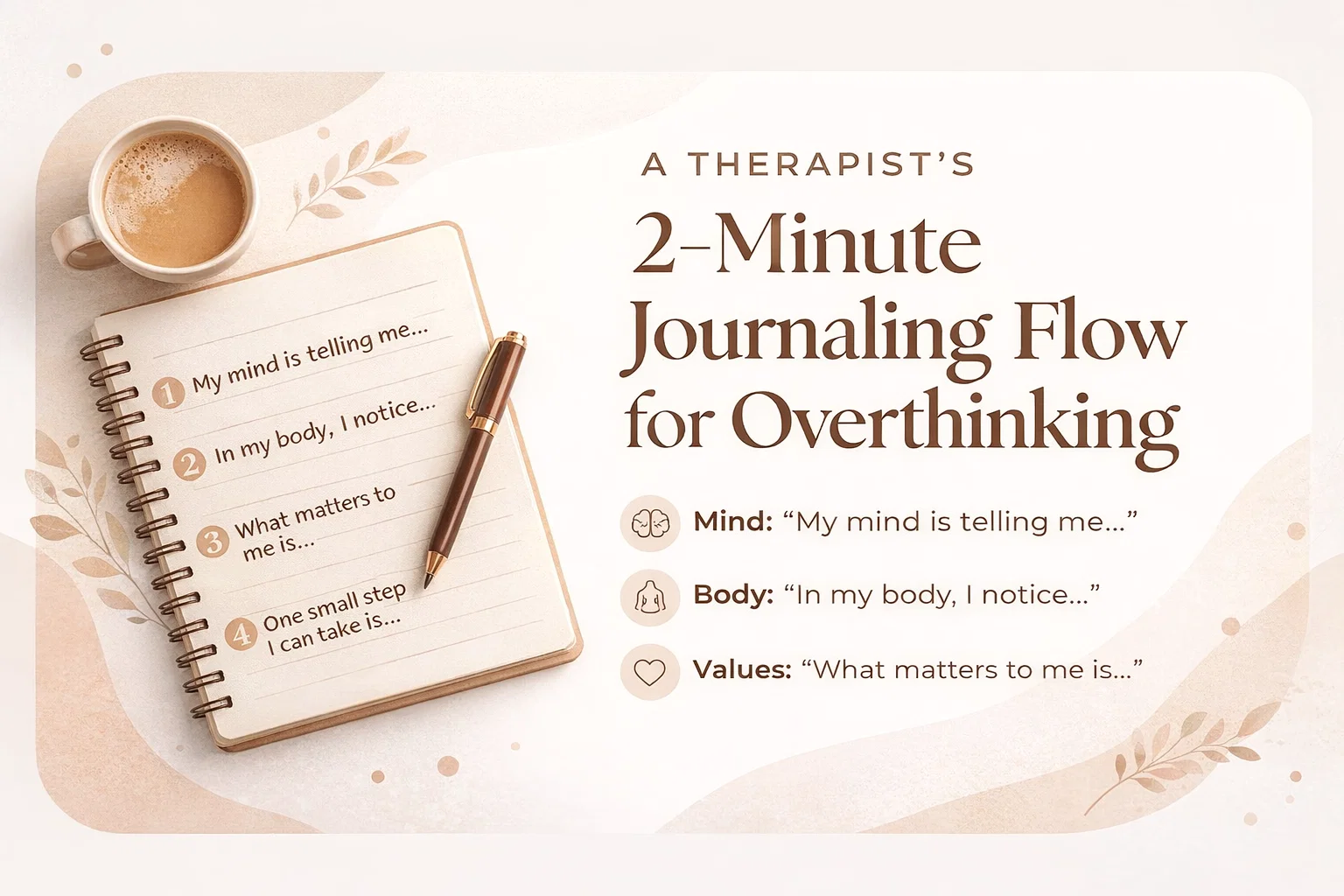
Today, we are diving into a brilliant, therapist-created 2-minute journaling flow designed specifically to help you stop overthinking, notice your mental patterns, and gently guide yourself back to the present moment. This incredibly simple yet profound four-step framework is about to become your favorite mental health tool.
The Heavy Toll of Overthinking
Before we explore the solution, it is important to understand what overthinking actually does to us. When we overthink, our brains enter a state of hyper-arousal. The amygdala, which is the alarm system of the brain, perceives our runaway thoughts as actual threats. This triggers the fight or flight response, flooding our bodies with cortisol and adrenaline.
This is why overthinking is not just a mental experience. It is a deeply physical one. Your chest tightens, your breathing becomes shallow, and your muscles tense up. Your mind believes you are in immediate danger, even if you are just stressing about an email you sent three hours ago or a social interaction from last week.
Traditional journaling is fantastic, but when you are already spiraling, the idea of staring at a blank page for thirty minutes can feel overwhelming. You need a quick, structured intervention. That is exactly where this 2-minute flow comes to the rescue.
Enter the 2-Minute Therapist-Backed Journaling Flow
This simple process breaks down the complex web of anxiety into four manageable pieces: your thoughts, your physical sensations, your core values, and a tiny, actionable step. Grab a pen and a scrap of paper, or open the notes app on your phone, and let us walk through this life-changing framework.
Step 1: Observe Your Mind Without Judgment
The Prompt: “Right now, my mind is telling me…”
The first step in breaking free from an anxiety spiral is to create distance between yourself and your thoughts. In psychology, this is known as cognitive defusion. When we overthink, we tend to believe our thoughts are absolute facts. If your brain says you are going to fail, you feel the shame of failure immediately.
By writing “Right now, my mind is telling me…”, you immediately change your relationship with the thought. You step into the role of the observer. You are not the anxious thought. You are simply the person listening to a very loud, very worried mind. This subtle shift in phrasing instantly lowers the emotional intensity of whatever you are stressing about.
- Instead of: “I am going to mess up this presentation.”
- Write: “Right now, my mind is telling me that I am going to mess up this presentation.”
Step 2: Check In With Your Physical Body
The Prompt: “In my body, I notice…”
As mentioned earlier, anxiety lives just as much in the body as it does in the mind. By ignoring our physical sensations, we allow the stress cycle to continue running in the background.
This second prompt forces you to ground yourself in the present moment. It shifts your focus from the hypothetical future back to the undeniable present. Take a quick scan from your head to your toes. What do you feel?
- “In my body, I notice my shoulders are creeping up toward my ears.”
- “In my body, I notice a fluttering sensation in my stomach.”
- “In my body, I notice my jaw is clenched tight.”
Simply naming the physical sensation helps to tame it. Once you notice your shoulders are tense, you will naturally take a breath and let them drop. This step bridges the gap between your runaway mind and your grounded physical self.
Step 3: Realign With Your Core Values
The Prompt: “What matters to me in this situation is…”
Overthinking almost always pulls us away from what actually matters. We get caught up in worrying about other people’s opinions, trying to control uncontrollable outcomes, or striving for impossible perfection.
This third prompt is your anchor. It asks you to cut through the noise of your anxiety and identify your true north. When you focus on your values, you reclaim your power. You cannot control what others think, but you can control how you show up.
- “What matters to me in this situation is being honest and doing my best.”
- “What matters to me in this situation is protecting my peace and setting a healthy boundary.”
- “What matters to me in this situation is showing up for my friend, even if I feel awkward.”
Step 4: Identify One Tiny Next Step
The Prompt: “A 1% kind step I can take is…”
Anxiety thrives on stagnation and massive, overwhelming goals. When you are overthinking, you often feel paralyzed because the “solution” seems too big or too far out of reach.
The magic of this final step lies in the phrase “1% kind step.” You are not asking yourself to solve the entire problem. You are not asking yourself to fix everything right now. You are simply looking for the tiniest, gentlest movement forward.
Action is the antidote to anxiety, but it must be compassionate action.
- “A 1% kind step I can take is drinking a glass of water.”
- “A 1% kind step I can take is closing my laptop for five minutes.”
- “A 1% kind step I can take is sending a quick text to clarify the meeting time.”
The Secret Ingredient: Compassionate Self-Talk
You have completed the four steps, but there is one final, crucial element to this journaling flow. It is a tip that transforms this from a simple exercise into a long-term habit of mental wellness.
End your brief journaling moment with one compassionate line directed at your own mind. Try writing: “Thank you, mind, for trying to protect me.”
This might sound a little unusual at first, but it is deeply rooted in evolutionary psychology. Your brain is not trying to torture you when it overthinks. It is actually trying to keep you safe. Your mind is simply scanning for threats to ensure your survival. By thanking your mind for doing its job, you stop fighting yourself. You replace frustration and self-judgment with radical self-compassion.
Over time, this practice rewires your brain. It replaces your inner critic with an inner caregiver. Instead of being angry at yourself for feeling anxious, you learn to comfort yourself through the anxiety.
How to Make This Habit Stick
The beauty of this 2-minute flow is its portability. You do not need a fancy leather-bound journal or a quiet retreat to make it work. Here is how you can integrate this practice into your daily life so it is always there when you need it.
- Keep it accessible: Write these four prompts on a sticky note and place it on your computer monitor or your bathroom mirror.
- Use your phone: Create a dedicated note in your smartphone. When you feel a spiral coming on while you are on the train or in a waiting room, simply copy and paste the prompts and fill in the blanks.
- Make it a transition ritual: Try doing this 2-minute flow during natural transitions in your day, like right after you finish work or right before you go to sleep, to clear out the mental clutter.
Conclusion: Reclaiming Your Peace of Mind
Overthinking does not have to be a life sentence. While it is completely normal to experience anxiety and racing thoughts, you do not have to let them sit in the driver’s seat. By taking just two minutes to observe your mind, check in with your body, remember your values, and take a 1% kind step, you can break the cycle.
The next time you feel the familiar wave of mental overwhelm crashing over you, do not fight it. Grab a pen, take a deep breath, and walk yourself through this gentle, therapist-created flow. Your mind is just trying to protect you, but you are the one in charge. Give yourself the gift of two minutes, and watch how quickly you can return to peace.
Would you like me to write a catchy meta description and a few social media captions to help you promote this blog post?