20 Daily Affirmations to Stop Overthinking Boost Mental Health
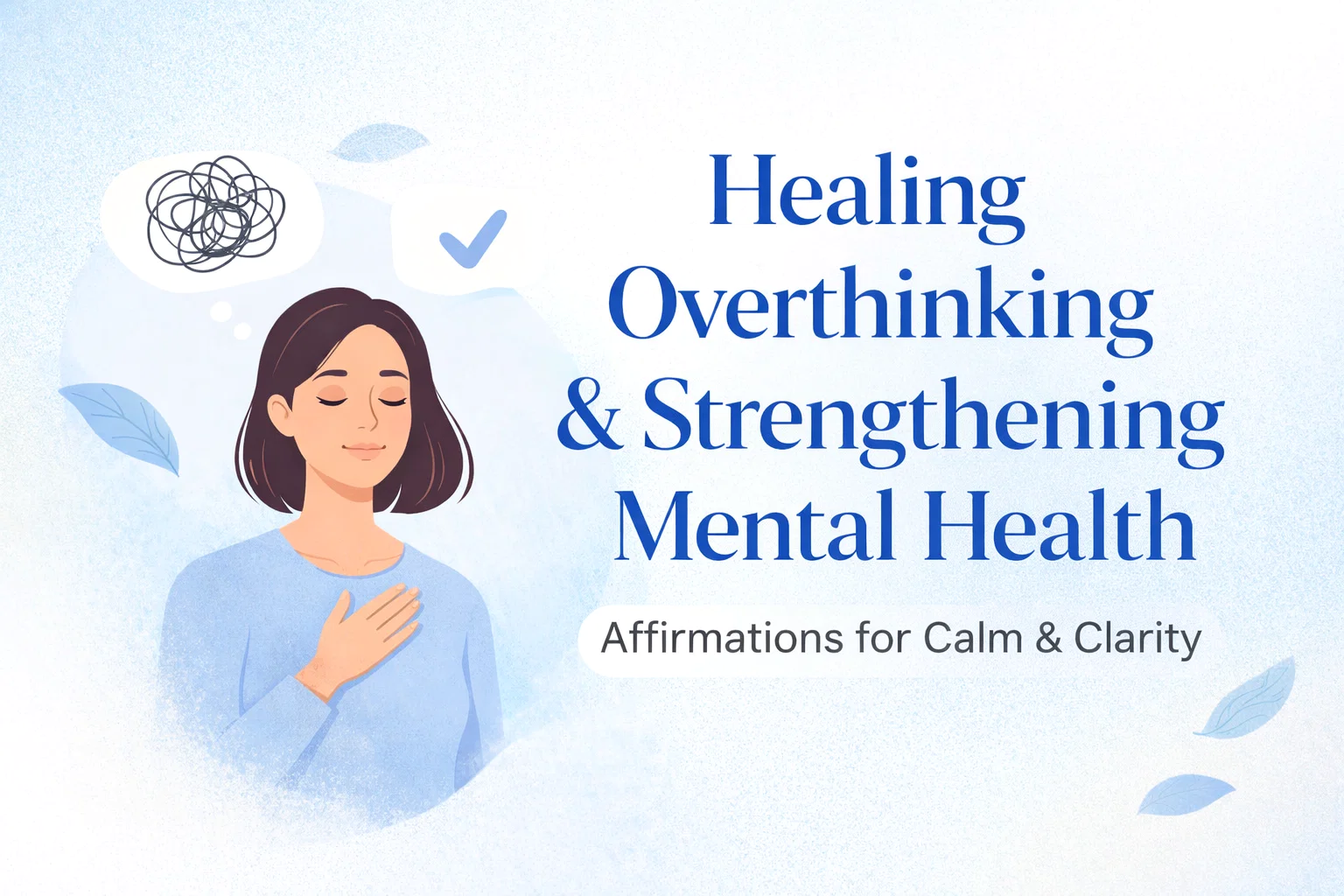
Overthinking is a silent thief. It steals your sleep, your focus, and your ability to enjoy the present moment. If you have ever found yourself lying awake at 3:00 AM replaying a conversation from three years ago or spiraling into a series of “what-if” scenarios about a meeting tomorrow, you are not alone. The human brain is wired to solve problems, but when it runs out of external problems to solve, it often turns inward, creating obstacles that do not actually exist. The image we are looking at today provides a powerful roadmap for exiting that mental loop. It is a collection of 20 profound affirmations designed to soften the mind and reclaim mental clarity.
Harnessing the power of affirmations is not about ignoring reality or pretending that life is perfect. Instead, it is about neuroplasticity. By consciously choosing to repeat phrases like “I allow my thoughts to soften” or “I trust myself in uncertainty,” you are literally training your brain to build new neural pathways. Over time, these positive declarations become your default setting, replacing the jagged, anxious edges of overthinking with a smoother, more resilient mental landscape.
The Science of Affirmations and Mental Health
To understand why these specific affirmations work, we have to look at how the brain handles stress. When we overthink, the amygdala (the brain’s alarm system) stays in a state of high alert. This triggers the release of cortisol, the stress hormone, which keeps us in a “fight or flight” mode. This is why overthinking feels so physically exhausting. It is a marathon that your mind is running while your body is sitting still.
Psychological studies have shown that self-affirmation theory allows individuals to maintain their sense of self-integrity. When we affirm our core values and our ability to handle challenges, we tell our nervous system that we are safe. This shifts the heavy lifting from the emotional amygdala back to the prefrontal cortex, the part of the brain responsible for logic, decision-making, and calm reflection. By repeating the phrase “I am safe in this moment,” you are providing your biology with the evidence it needs to power down the alarm.
Breaking Down the 20 Affirmations for Healing
Releasing the Need for Control
A huge portion of overthinking stems from the desire to control the uncontrollable. We think that if we analyze a situation enough, we can prevent a bad outcome. The affirmations “I release control over everything” and “I accept imperfect outcomes peacefully” are direct antidotes to this perfectionist trap. Perfectionism is often just anxiety in a fancy suit. When you give yourself permission to accept an outcome that is less than perfect, you remove the weight of the world from your shoulders.
Focusing on what you can control is another vital step. The affirmation “I focus on what I control” helps narrow your mental scope. You cannot control how others perceive you, the weather, or the global economy, but you can control your breath, your reactions, and your immediate environment. This shift in focus is incredibly empowering.
Cultivating Self-Trust and Safety
Overthinking is frequently a symptom of a lack of self-trust. We double-check our decisions because we are afraid of making a mistake. Phrases like “I trust myself in uncertainty” and “I trust my growth process” remind us that even if things go wrong, we have the internal resources to handle them. You have survived every “worst-day” you have ever had so far, which is a 100 percent success rate. Trusting your process means acknowledging that growth is not a straight line; it is a messy, beautiful series of lessons.
Establishing safety is the foundation of any mental health journey. “I am safe in this moment” is perhaps the most important phrase for someone in the middle of a panic spiral. Most of what we worry about exists in the past or the future. In the literal, physical present moment, you are usually safe. Bringing your attention back to the “now” halts the time-traveling nature of anxiety.
Practical Strategies to Integrate Affirmations Into Your Life
Knowing the affirmations is one thing, but living them is another. To truly heal overthinking, these phrases need to move from the screen into your daily routine. Here are a few ways to make that happen without adding more “work” to your plate.
- The Morning Mirror Method: Choose one affirmation from the list each morning. Look yourself in the eyes in the mirror and say it out loud three times. It might feel silly at first, but vocalizing these intentions reinforces them in your subconscious.
- Digital Reminders: Set a recurring alarm on your phone with an affirmation like “I deserve rest and clarity” as the label. When it goes off, take one deep breath and repeat the words.
- Journaling Prompts: Take an affirmation like “I forgive my past mistakes” and write for five minutes about what that looks like in practice. Who are you forgiving? What mistake are you finally letting go of?
- Sticky Note Visuals: Place a sticky note with “I choose calm over fear” on your computer monitor or fridge. Visual cues are excellent for interrupting a sudden spiral of overthinking.
The Connection Between Physical Sensation and Mental Peace
The image highlights “I breathe slowly and steadily.” This is not just a suggestion; it is a physiological hack. Your breath is the only part of your autonomic nervous system that you can consciously control. By slowing your breath, you send a physical signal to your brain that there is no immediate danger. This makes it significantly easier for the other affirmations, such as “I welcome peace into my mind,” to actually take root.
When you pair a physical action with a mental affirmation, you create a “somatic bridge.” For example, as you say “I allow my thoughts to soften,” try to physically relax your jaw, drop your shoulders, and uncurl your toes. Noticing where you hold tension in your body can give you a clue as to when overthinking is starting before it even becomes a full-blown narrative.
Handling Challenges with Calmness
Life will always throw curveballs. The goal of healing overthinking is not to reach a state where you never have a problem again. Rather, it is to reach a state where you can say “I handle challenges calmly” and believe it. This involves recognizing that your value is not tied to your productivity or your “perfect” handling of a situation. “I am enough as I am” serves as a protective barrier against the inner critic that tells you that you should be doing more, being more, or thinking more.
Why Gentleness is Your Greatest Weapon
The final affirmation in the list is “I continue growing gently.” This is a crucial distinction. Many people try to “fix” their mental health with the same intensity and aggression that caused the overthinking in the first place. They try to “force” themselves to be calm or “beat” their anxiety into submission. However, you cannot heal a stressed mind with more stress.
Growth is a gentle process. It is like tending to a garden. You cannot yell at a flower to grow faster; you can only provide the right environment, water it, and give it sun. By choosing to grow gently, you are accepting that some days will be harder than others. Some days you will overthink, and that is okay. The goal is to notice it, use an affirmation to pivot, and move forward without self-judgment.
Building a Stronger Mental Health Foundation
Beyond the affirmations themselves, strengthening mental health requires a holistic approach. Use these phrases as the “software” for your mind, but make sure the “hardware” is taken care of too. This means prioritizing sleep, movement, and social connection. When you are well-rested, the affirmation “I deserve rest and clarity” feels like an obvious truth rather than a distant goal.
Consistency is more important than intensity. You do not need to spend hours meditating on these phrases. A few seconds of genuine connection with the words “I let anxious thoughts pass” can be more effective than an hour of distracted thinking about peace. Think of these affirmations as “mental snacks” that you consume throughout the day to keep your psychological energy levels stable.
Conclusion: Your Journey Toward Clarity
Healing from overthinking is a journey of a thousand small pivots. Every time you catch yourself in a loop and choose to say “I choose clarity over chaos,” you have won a major victory. The 20 affirmations we have discussed are not just words on a page; they are tools for liberation. They remind you that you are the observer of your thoughts, not the thoughts themselves. You have the power to let them soften, to let them pass, and to choose a different narrative.
As you move forward, keep this list close. Refer to it when the world feels too loud or when your internal monologue becomes too critical. Remember that you are learning every day, and you have every right to move forward with confidence. You are enough, you are safe, and you are capable of handling whatever comes next with a calm and steady heart. It is time to stop overthinking your life and start living it with the peace you deserve.