24 Questions to Sharpen Your Critical Thinking Skills for Better Decision Making
Have you ever reached the end of a long day and realized you made several decisions purely on autopilot? In our fast-paced world, it is incredibly easy to fall into the trap of reactive thinking. We see a headline, we react. We face a problem at work, we grab the first solution that comes to mind. But what if there was a way to peel back the layers of your own thought process and see the world with startling clarity? Mastering critical thinking is not about being the smartest person in the room; it is about having the best questions in your pocket. By shifting from passive consumption to active inquiry, you transform how you navigate challenges, relationships, and your own personal growth.
The Foundations of a Sharp Mind
Critical thinking is often misunderstood as being critical or cynical. In reality, it is a disciplined process of actively and skillfully conceptualizing, applying, analyzing, and evaluating information. It is the mental toolkit that allows you to distinguish between a well-founded argument and a collection of logical fallacies. When we look at the core of human progress, it is almost always fueled by someone asking a question that others were too afraid or too tired to ask. To sharpen this skill, you must first commit to a posture of intellectual humility, admitting that your initial perspective might be incomplete.
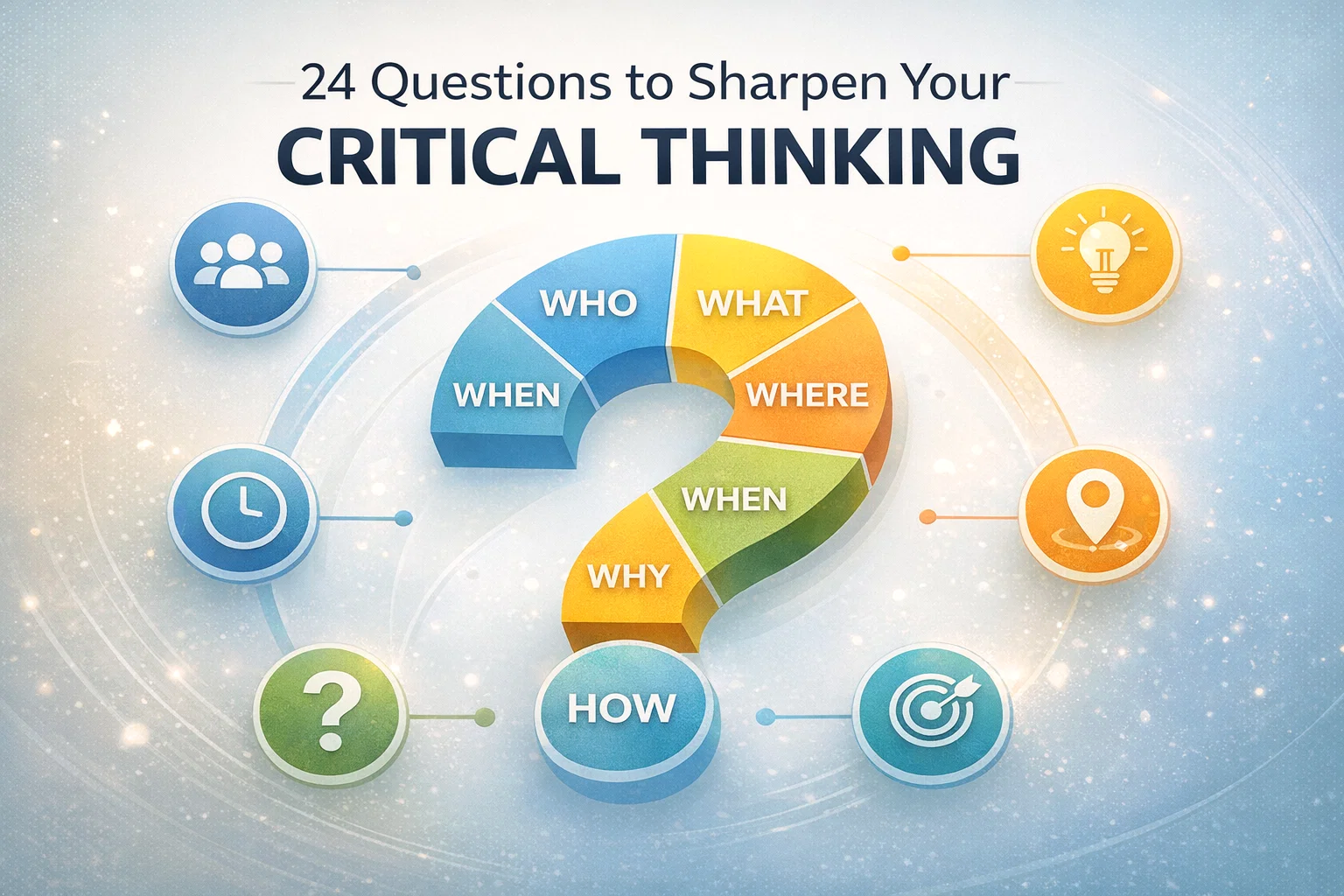
One of the biggest hurdles to clear thinking is our own cognitive bias. Our brains are wired for efficiency, not necessarily for accuracy. We look for patterns that confirm what we already believe, a phenomenon known as confirmation bias. To combat this, we need a structured framework. The image we are discussing provides a roadmap through the classic inquiry method: Who, What, Where, When, Why, and How. By applying these lenses to any situation, you force your brain to slow down and consider the variables that usually stay hidden in the shadows of your subconscious mind.
The Power of the Who Lens
Every decision or piece of information exists within a human context. When you start with Who, you are mapping out the stakeholders of a situation. This is vital because it reveals the motivations behind the information you are receiving. Consider these four pivotal questions:
- Who benefits from this? Understanding the incentive structure can explain why certain facts are emphasized while others are ignored.
- Who is affected if this goes wrong? This helps you calculate the true risk and empathy required for a decision.
- Who is missing from this conversation? Often, the most important perspective is the one that is not being heard.
- Who has solved a similar problem before? There is no need to reinvent the wheel when you can learn from the footprints of others.
Analyzing the What for Objective Truth
Once you understand the people involved, you must turn your attention to the data itself. The What category is about defining the boundaries of the problem and stripping away the emotional fluff. We live in an era of information overload, which makes the ability to filter facts from opinions more valuable than ever. If you cannot define what you are trying to solve, you will likely end up solving the wrong problem entirely.
Ask yourself what you are assuming without proof. We all carry “invisible scripts” or sets of beliefs that we take for granted. By bringing these assumptions into the light, you can test their validity. Furthermore, identifying what information is missing is just as important as analyzing what is present. A half-truth is often more dangerous than a total lie because it carries the veneer of credibility while leading you toward a flawed conclusion.
Finding Clarity Through Where and When
Context is everything. A solution that works in one environment might fail miserably in another. The Where questions focus on the origin and the destination of a thought. Where is this information coming from? Is the source reliable? Where will this decision lead in the long term? Critical thinkers do not just look at the immediate impact; they look at the second and third order consequences. This spatial awareness of logic prevents you from walking into traps that seem like shortcuts.
The When category introduces the element of timing. Problems often have a history, and understanding when a situation became an issue can provide clues to its resolution. Is there a pattern? Does this happen every Tuesday, or only when the budget is tight? Timing also dictates the urgency of action. Knowing when it would be the wrong time to act is a hallmark of emotional intelligence and strategic patience. Sometimes, the best move is to wait for more data to emerge.
The Deep Dive into Why and How
If the other categories provide the structure, Why provides the soul. Why does this matter? If a problem has no significant impact on your goals or values, it might not be worth your mental energy. We often spend hours agonizing over trivialities while ignoring the big questions. Asking why you believe something is true forces you to audit your internal logic. It is a moment of self-reflection that builds a more authentic and grounded personality.
Finally, we reach the How. This is the bridge between thinking and doing. A great idea is worthless without a viable path to implementation. How will you measure success? Without a metric, you are just guessing. How could this go wrong? Pre-mortems, or imagining a failure before it happens, allow you to build safeguards into your plan. How will you explain this choice to others? If you cannot articulate your reasoning clearly, you probably do not understand it well enough yourself.
Building a Daily Critical Thinking Habit
You do not become a master carpenter by reading a book; you do it by swinging a hammer. Similarly, critical thinking is a muscle that requires consistent exercise. You can start small. The next time you see a provocative post on social media, don’t just hit the like button. Run it through a few of the 24 questions. Who wrote this? What are they assuming? Why does it make me feel this way? This simple habit builds a protective barrier against manipulation and misinformation.
In professional settings, you can introduce these questions during meetings. Instead of asking “What should we do?”, try asking “Who is missing from this conversation?” or “How can we test this before committing?” These prompts shift the energy of a room from defensive to collaborative. It encourages a culture of curiosity where the goal is to find the right answer, not just to be right. Over time, this approach reduces friction and increases the quality of every project you touch.
The Long Term Benefits of Intellectual Rigor
The rewards of sharpening your critical thinking extend far beyond productivity. On a personal level, it leads to higher self-esteem. When you know how to think for yourself, you are less likely to be swayed by peer pressure or societal expectations that do not align with your true self. You become the architect of your own life rather than a passenger in someone else’s vehicle. It fosters a sense of agency that is incredibly empowering in an unpredictable world.
In terms of career longevity, critical thinking is the ultimate “future proof” skill. As automation and artificial intelligence take over routine tasks, the ability to synthesize complex information and make nuanced judgments remains uniquely human. Employers value people who can navigate ambiguity and provide strategic direction. By investing in your mental clarity today, you are ensuring your relevance in the economy of tomorrow. It is the highest ROI activity you can engage in.
Common Pitfalls to Avoid
As you embark on this journey, be wary of “over-analysis paralysis.” The goal of critical thinking is to reach a better decision, not to stop making decisions altogether. There is a point of diminishing returns where searching for more “missing information” becomes a form of procrastination. Learn to recognize when you have enough data to move forward with a calculated risk. The perfect choice is a myth; the informed choice is the goal.
Another pitfall is using these questions to tear others down. Critical thinking should be a tool for building bridges and uncovering truth, not a weapon for winning arguments. If you use your skills to make others feel small, you will quickly find yourself isolated. Instead, use your inquiries to help the team reach a higher level of understanding. True intelligence is often quiet, observant, and supportive.
Conclusion
Sharpening your critical thinking is a lifelong journey that pays dividends every single day. By utilizing a structured approach like the 24 questions we explored, you replace confusion with clarity and doubt with confidence. You begin to see the world not as a series of random events, but as a landscape of causes, effects, and opportunities. It is about more than just logic; it is about reclaiming your focus and making sure your mental energy is spent on things that truly matter. Start today by picking just one question from the list and applying it to a challenge you are currently facing. You might be surprised at how quickly the fog begins to lift. Stay curious, stay questioning, and watch as your world expands in ways you never thought possible.
Would you like me to help you create a specific implementation plan for these questions in your professional workflow?