3 Signs You Need Better Boundaries for Improved Mental and Emotional Health
Setting boundaries is one of the most transformative acts of self care you can undertake. It is the invisible line that defines where you end and where another person begins. When those lines become blurred, your mental and emotional health often pays the price. If you have been feeling perpetually drained, resentful, or anxious, it might not be your schedule that is the problem. It might be your boundaries. Learning to identify the signs that your personal limits are being crossed is the first step toward reclaiming your peace and building a life that feels authentic and sustainable.
Understanding the Importance of Personal Boundaries
Boundaries are not walls meant to keep people out. Instead, they are gates that allow you to let in what is healthy and keep out what is harmful. In the realm of emotional and mental health, boundaries act as a protective shield for your energy. Without them, you become a sponge for everyone else’s stress, expectations, and demands. This leads to a state of chronic depletion where you have nothing left for yourself.
Many of us grew up believing that being a good person means being infinitely available and endlessly agreeable. We were taught that saying no is rude or that making others happy is our primary job in life. However, true kindness requires a foundation of self respect. You cannot truly pour from an empty cup, and boundaries are the only way to ensure that your cup stays replenished. By establishing clear limits, you actually improve your relationships because you show up as your best self rather than a resentful version of yourself.
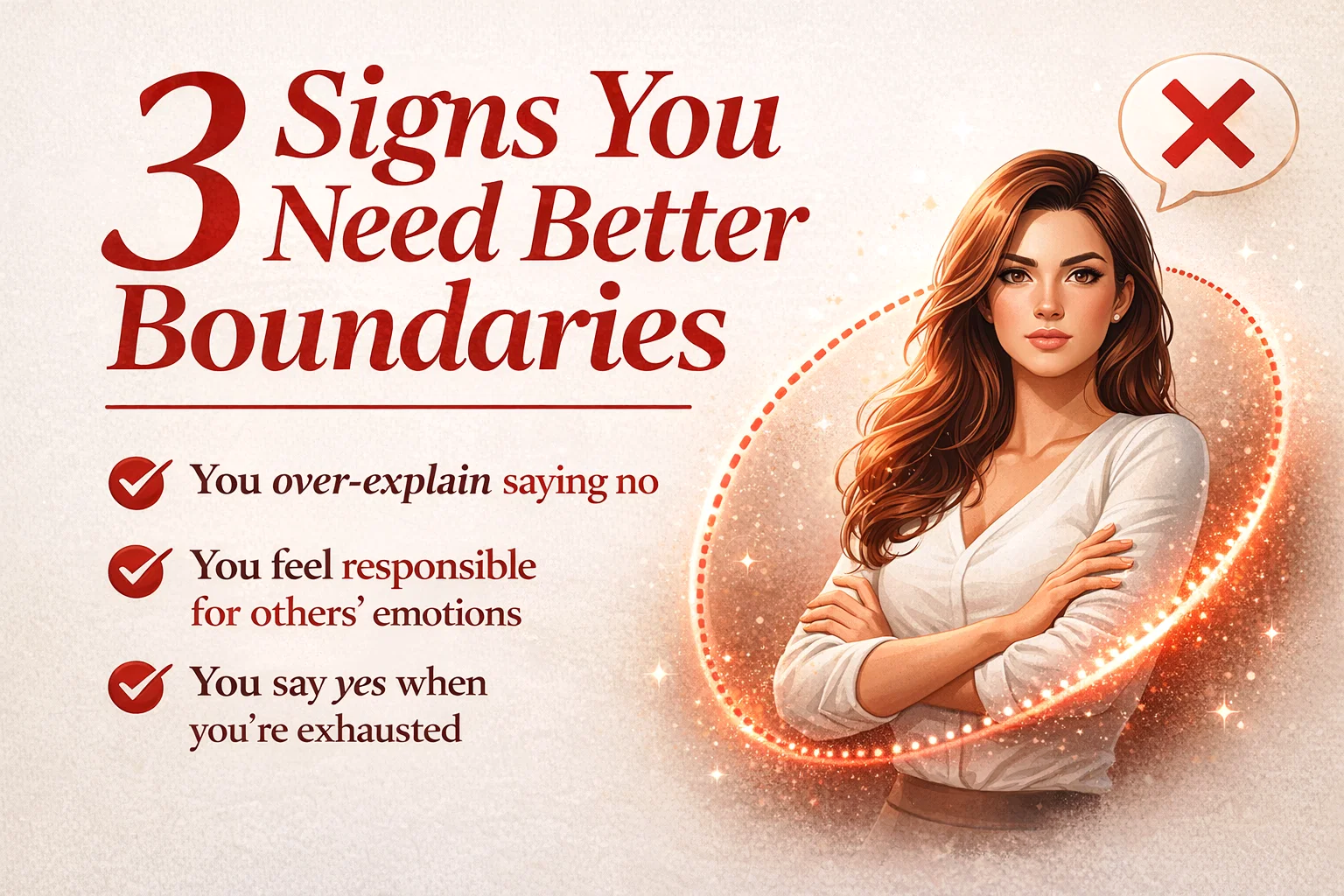
Sign Number 1: The Habit of Over-Explaining Your No
One of the most common signs that you need better boundaries is the felt need to provide a long list of justifications every time you decline a request. When someone asks you for a favor or invites you to an event you cannot attend, do you find yourself crafting a detailed story to prove why you are busy? This behavior usually stems from a lack of internal safety. You might feel that a simple no is not enough to protect you from judgment or conflict.
Why No is a Full Sentence
In a healthy boundary dynamic, no is a complete thought. You do not owe anyone an itemized itinerary of your life to justify why you are choosing to spend your time elsewhere. When you over-explain, you are subconsciously asking for permission to have a boundary. You are presenting your reasons to the other person and waiting for them to validate that your excuse is good enough. This gives the other person the power to negotiate your boundaries away.
How to Practice a Simple Decline
To break this habit, start small. Next time a coworker asks you to take on an extra task that you don’t have time for, try saying, I appreciate you asking, but I won’t be able to take that on right now. Resist the urge to add because my kids have practice and I have a headache and my car is in the shop. Stand in the silence that follows. You will find that most people respect a firm, polite decline much more than a shaky, explained one.
Sign Number 2: Feeling Responsible for Other People’s Emotions
Do you feel a pit in your stomach when someone around you is sad or angry? If you immediately jump into fix it mode to change their mood, you are likely struggling with emotional enmeshment. This is a sign that your boundaries are porous. While empathy is a beautiful trait, taking responsibility for the feelings of others is a heavy burden that was never meant for you to carry.
The Trap of Emotional Management
When you believe it is your job to keep everyone happy, you become a prisoner to their moods. If a friend is disappointed because you couldn’t make it to dinner, that is their emotion to process. It is not a sign that you did something wrong. By trying to manage their disappointment, you are actually robbing them of the opportunity to handle their own feelings and grow through them. It is important to remember that you can be compassionate without being responsible.
Distinguishing Between Empathy and Responsibility
To move toward better mental health, you must learn the difference between being there for someone and carrying someone. You can offer a listening ear or a kind word, but the ultimate responsibility for their emotional state lies with them. Remind yourself daily: How they feel is not my responsibility. This mantra can be incredibly freeing when you find yourself spiraling into guilt over someone else’s reaction to your healthy choices.
Sign Number 3: Making Yourself Available Even When You Are Tired
The third major sign that your boundaries need work is a chronic tendency to say yes when your body is screaming no. If you find yourself agreeing to late night phone calls, extra projects, or social outings when you are physically and mentally exhausted, you are ignoring your own biological and emotional needs. This is the fastest route to burnout and resentment.
Listening to the Wisdom of Your Body
Your body is often much more honest than your mind. While your mind might be saying, I should go to this party so they don’t get mad, your body might be signaling exhaustion through a tight chest, a headache, or a general sense of dread. Checking in with your physical self before giving an answer is a vital boundary practice. If the thought of saying yes makes your stomach churn with anxiety, that is a clear signal that you are overstepping your own limits.
The Cost of Constant Availability
Being always available might make you feel indispensable in the short term, but it ruins your long term well being. When you never switch off, your nervous system stays in a state of high alert. This constant drain makes it impossible to show up authentically in your life. You become a shell of yourself, performing tasks out of obligation rather than genuine interest or joy. Better boundaries allow you to rest so that when you do say yes, you can do so with your full heart and energy.
Common Barriers to Setting Boundaries
If setting boundaries is so beneficial, why is it so hard? For many people, the primary barrier is fear. We fear rejection, we fear being labeled as selfish, and we fear the discomfort of conflict. It is helpful to recognize these fears so you can move through them. Setting a boundary for the first time will feel uncomfortable. It might even feel like you are doing something wrong. However, that discomfort is just the feeling of old patterns breaking.
- The Fear of Being Disliked: Many of us are people pleasers at heart. We worry that if we say no, people will stop liking us. The reality is that people who only like you when you say yes are not truly your friends; they are fans of your compliance.
- Guilt: This is the most common emotional hurdle. You might feel like a bad daughter, friend, or employee for putting yourself first. Remember that guilt is a feeling, not a fact. You are not doing anything wrong by protecting your health.
- Lack of Examples: If you grew up in a household where boundaries were not respected, you might not even know what a healthy boundary looks like. You are essentially learning a new language. Give yourself grace as you practice.
Practical Steps to Reclaim Your Power
Improving your mental and emotional health through boundaries is a gradual process. You don’t have to overhaul your entire life in a single day. Start by identifying one area where you feel the most drained. Is it at work? Is it with a specific family member? Is it on social media?
Start with Small Stakes
Practice setting boundaries in low stakes situations. For example, if a waiter brings you the wrong order, politely ask for it to be corrected. If a telemarketer calls, practice saying no and hanging up without an explanation. These small wins build the emotional muscle you need for the bigger, more difficult conversations.
Communicate Clearly and Bravely
When you are ready to set a boundary with someone close to you, use I statements. Instead of saying, You always demand too much of me, try saying, I have realized that I need more downtime in the evenings to stay healthy, so I won’t be answering my phone after 8 PM. This keeps the focus on your needs rather than the other person’s behavior, which reduces defensiveness.
The Benefits of Healthy Boundaries
The rewards of setting boundaries are immense. As you get better at saying no to things that drain you, you will find that you have more energy for the things that actually matter. Your mental health will stabilize because you are no longer constantly reacting to everyone else’s needs. Your relationships will deepen because they will be based on honesty rather than resentment.
Perhaps the greatest benefit is the sense of self mastery you will develop. When you respect your own limits, you send a message to yourself that you are worthy of protection. This boosts your self esteem and gives you the confidence to pursue your own goals and dreams without constantly looking over your shoulder for approval.
Conclusion: Your Journey Toward Better Health
Recognizing the signs that you need better boundaries is a brave first step. Whether it is stopping the cycle of over-explaining, releasing the weight of other people’s emotions, or finally listening to your body’s need for rest, every boundary you set is an investment in your future self. It is not selfish to have limits. It is necessary. As you begin to implement these changes, remember to be patient with yourself. Some days will be easier than others, and there will be moments of pushback from those who were used to your old ways. Stay firm in your resolve. Your mental and emotional health are worth the effort, and you deserve to live a life that feels balanced, peaceful, and entirely your own.
Would you like me to generate a list of daily affirmations to help you stay firm with your new boundaries?