5 AI Prompt Secrets to Learn Faster Master Any Skill in 20 Hours
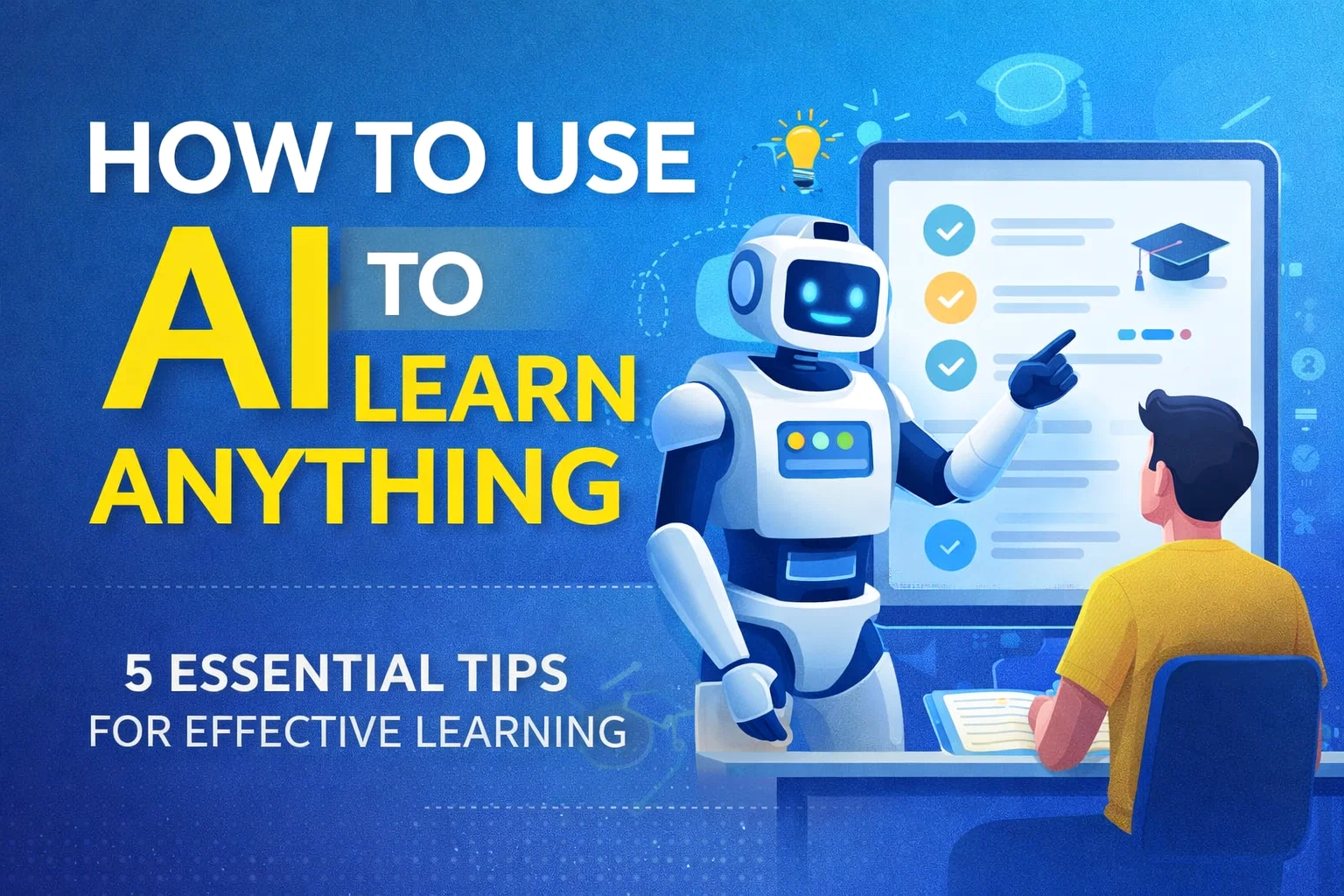
In an era where information is abundant but time is our most precious commodity, the ability to learn quickly is no longer just a luxury. It is a competitive advantage. Traditional education often feels slow and cumbersome, leading many to give up before they even scratch the surface of a new skill. However, the rise of Artificial Intelligence has completely flipped the script. We are living in a golden age of self directed learning where anyone with an internet connection and the right prompts can master complex subjects in a fraction of the time it used to take. The image we are looking at today provides a roadmap for this exact transformation, offering five powerful shortcuts to turn AI into your ultimate personal tutor.
The beauty of using AI for learning lies in its ability to synthesize vast amounts of data into actionable steps tailored specifically to your needs. Instead of scrolling through endless YouTube tutorials or reading thick textbooks with unnecessary fluff, you can now command a machine to filter out the noise. This article will dive deep into the five strategies outlined in our visual guide: the 80/20 Shortcut, the One-Pager, the Teach Me Like I am New method, the Skill Ladder, and the essential guide to avoiding beginner mistakes. By the end of this post, you will have a masterclass in AI prompted learning that you can apply to coding, cooking, marketing, or even a new language.
Strategy 1: The 80/20 Shortcut for Rapid Mastery
The Pareto Principle, or the 80/20 rule, suggests that 80 percent of your results come from 20 percent of your efforts. When applied to learning, this means that most of what you need to know to be functional in a skill is hidden within a very small core of essential concepts. The first prompt in our guide is designed to identify that core immediately. By asking AI to build a plan for a 20 hour window, you are forcing it to prioritize high impact knowledge over academic trivia.
How to Structure Your 20 Hour Learning Sprint
To make this work, you need to break your time into manageable blocks. The prompt suggests ten two-hour sessions. This is psychological brilliance because two hours is long enough to achieve a flow state but short enough to prevent burnout. In each block, you should focus on one specific sub skill. For example, if you are learning photography, one block might be dedicated entirely to the exposure triangle. By the end of that block, you perform a 15 minute check. This active recall ensures that the information moves from your short term memory into your long term understanding.
Finding the Right Resources
One of the biggest hurdles in self learning is “resource paralysis.” There are too many books, videos, and courses available. When you use the 80/20 AI prompt, you can ask the AI to suggest exactly one high quality resource for each block. This eliminates the time spent searching and allows you to spend 100 percent of your energy on actual consumption and practice.
Strategy 2: The One-Pager for Mental Clarity
Complexity is the enemy of execution. When a topic feels too big, our brains tend to shut down. The “One-Pager” strategy is a compression technique. It asks the AI to take a massive subject and distill it into a single page that can be reviewed in five minutes. This is not just a summary. It is a cognitive map. By asking for core concepts, connections, and real world examples, you are building a framework that allows you to see the “big picture” at a glance.
The Power of Visual Connections
When you prompt an AI to explain how concepts connect, you are engaging in associative learning. This is how experts think. They don’t just know isolated facts. They understand how Fact A influences Fact B. Having this mapped out on a single page that you can pin to your wall or keep as a desktop background acts as a constant environmental cue, reinforcing the material every time you look at it.
Learning from Common Mistakes
A unique part of the One-Pager prompt is the inclusion of common mistakes. Most tutorials tell you what to do, but few tell you what NOT to do. By seeing the pitfalls alongside the concepts, you develop a more rounded understanding of the topic. You begin to understand the boundaries of the skill, which is a hallmark of true proficiency.
Strategy 3: The Teach Me Like I am New Method
There is a famous concept called the Feynman Technique which suggests that if you cannot explain something simply, you do not understand it well enough. The third strategy in our guide uses AI to perform this simplification for you. By asking the AI to explain a topic as if you were 12 years old, you strip away the jargon and pretension that often gatekeep difficult subjects.
Why Simplicity Trumps Technicality
Jargon often masks a lack of fundamental understanding. When an AI uses stories and daily life comparisons, it anchors new information to things you already know. If you are learning about blockchain, an AI might compare it to a shared digital ledger in a community garden. Suddenly, a complex cryptographic concept becomes relatable and easy to visualize. This removes the “fear factor” associated with high level technical subjects.
The Interactive Feedback Loop
The prompt concludes with a request for three questions. This is the most critical part of the process. It turns a passive reading experience into an active testing environment. If you cannot answer the questions, the AI re-explains. This creates a personalized feedback loop that mimics a one on one session with a world class tutor, ensuring you never move forward with gaps in your foundational knowledge.
Strategy 4: The Skill Ladder for Long Term Growth
Learning is a journey, but without a map, it is easy to get lost. The Skill Ladder strategy asks the AI to create a five level progression for your chosen topic. This transforms a vague goal like “I want to learn web design” into a series of concrete, achievable milestones. It moves you from “I know nothing” to “I could teach this” in a structured, logical sequence.
Defining Level Competency
For each level, the AI defines what you will be able to do. This is “competency based learning.” Instead of measuring progress by hours spent, you measure it by capabilities gained. At Level 1, you might be able to read code. At Level 3, you might be able to build a basic landing page. This sense of progression provides the dopamine hits necessary to stay motivated over the long haul.
Knowing When to Level Up
The Skill Ladder prompt also includes a “readiness check.” This prevents the common mistake of moving too fast and building on a shaky foundation. By having clear criteria for when you are ready for the next step, you ensure that your progress is solid. This structured approach is what separates those who dabble in a hobby from those who actually master a profession.
Strategy 5: Skipping Beginner Mistakes to Save Time
Time is the one thing we can never get back. The final strategy focuses on efficiency by identifying the “traps” that cause beginners to go in circles. Every field has them. In fitness, it might be focusing on supplements instead of sleep and diet. In business, it might be over-designing a logo before you have a single customer. AI can act as a seasoned mentor who warns you about these dead ends before you even reach them.
Breaking the Cycle of Frustration
Beginners often waste weeks on tasks that feel like work but don’t actually move the needle. By asking the AI why these traps happen and what to do instead, you gain a perspective that usually takes years of trial and error to acquire. This is essentially “experience on demand.” It allows you to skip the frustration and head straight for the activities that produce real results.
The Value of Proactive Problem Solving
By identifying these five biggest traps at the very start of your journey, you develop a mental “early warning system.” When you find yourself getting bogged down in minor details, you will recognize it as one of the traps the AI warned you about. This self awareness allows you to pivot quickly and keep your momentum high.
Conclusion: Your New Path to Mastery
The five strategies we have explored today provide a comprehensive toolkit for anyone looking to hack their learning process. By combining the 80/20 Shortcut, the One-Pager, the Teach Me Like I am New method, the Skill Ladder, and the Beginner Mistake Guide, you are creating a personalized, high efficiency education system. AI is no longer just a tool for generating text or images. It is a bridge between who you are now and the person you want to become.
The key to success with these prompts is consistency and action. Don’t just generate the plan. Execute the blocks. Print out the one-pager. Answer the questions. If you commit to these structured AI prompts, you will find that “impossible” subjects become manageable and “long” journeys become short. The world is changing fast, and the ability to learn anything in 20 hours is the best way to keep up. Take these prompts, pick a topic you have always wanted to master, and start your first two hour block today. Your future self will thank you for the time you saved and the skills you gained.