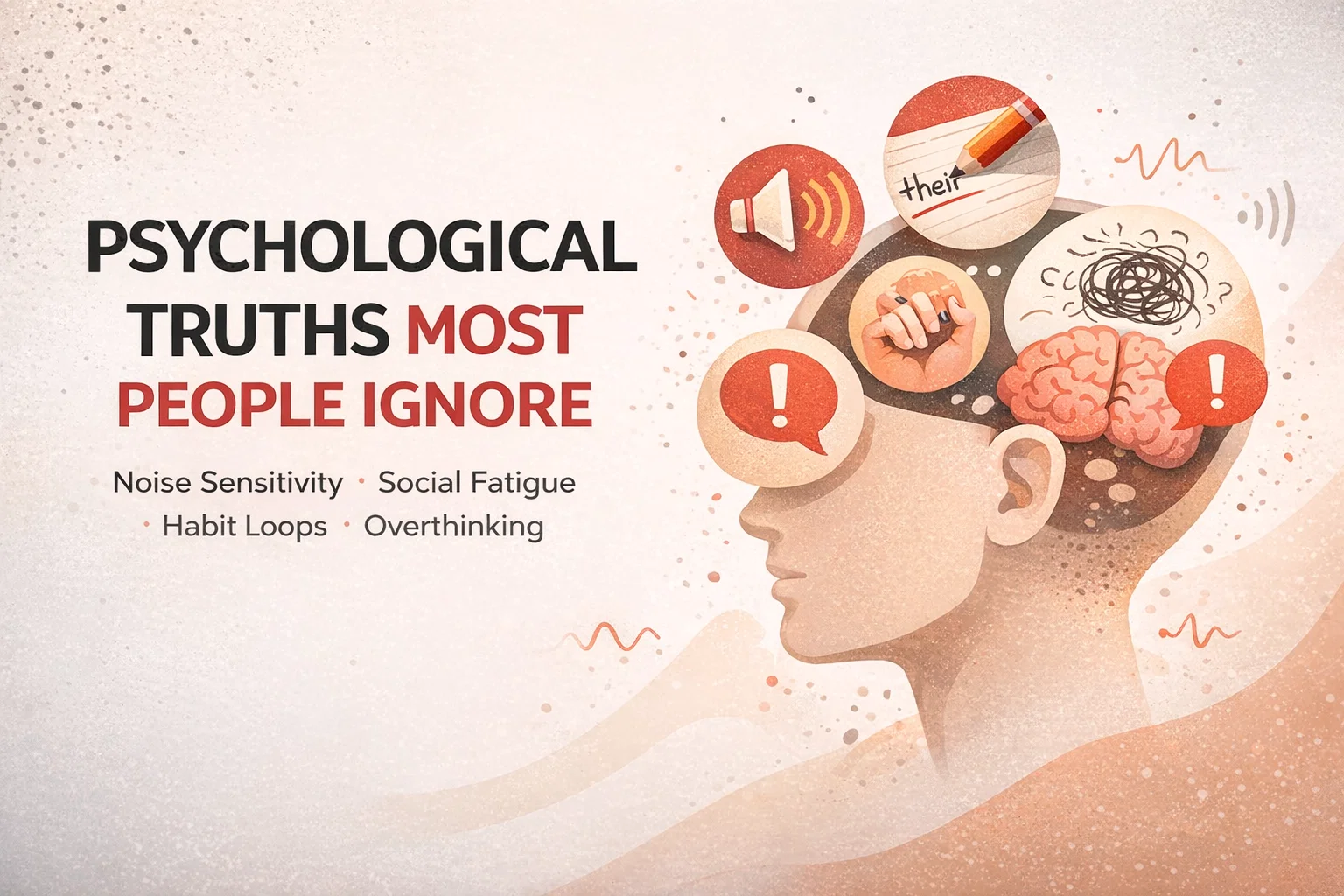
5 Psychological Truths Most People Ignore Psychology Facts
Have you ever caught yourself biting your nails during a stressful meeting, or perhaps you have felt completely exhausted after a fun night out with friends? Most of us brush these moments off as simple personality quirks or bad habits. We might even judge ourselves harshly for them, wishing we could just be “normal.” However, human behavior is rarely that simple. Beneath the surface of our everyday actions lies a fascinating world of psychological truths that most people completely ignore.
Our brains are constantly working behind the scenes. They process incredible amounts of stimuli, manage our underlying anxiety, and constantly try to keep us safe from perceived threats. By understanding the root causes of our behaviors, we can stop being so hard on ourselves. We can start living with a much higher level of self-awareness and compassion. When you understand the psychology behind your actions, you unlock the ability to work with your mind instead of fighting against it.
Today, we are going to dive deep into five common psychological phenomena that you have probably experienced but never fully understood. From how you process environmental noise to why you find yourself overthinking every little detail of your day, these scientific insights will completely change the way you view yourself and the people around you. Let us explore the hidden depths of the human mind together.
Unpacking the Psychological Truths We Overlook
Noise Sensitivity: A Highly Tuned Nervous System
We all know someone who gets easily irritated by a ticking clock, loud chewing, or sudden jarring noises. Perhaps that person is you. Society often labels this trait as being overly picky, dramatic, or easily annoyed. The psychological truth, however, is far more complex and interesting. If loud sounds easily irritate you, your nervous system is likely much more tuned-in and sensitive than the average person.
This heightened state of awareness is often associated with Sensory Processing Sensitivity. People with this trait have central nervous systems that process physical, social, and emotional stimuli much more deeply than others. When you flinch at a loud siren or feel intensely overwhelmed in a bustling, crowded cafe, your brain is not overreacting. It is simply processing a massive amount of sensory data all at once, leading to cognitive overload. This sensitivity can actually be an incredible superpower. It means you are likely more observant, deeply appreciative of subtle details in music and art, and highly attuned to the shifting moods in your environment. The key to thriving with this trait is learning to manage your sensory input effectively so you do not become overwhelmed.
The Grammar Fixer: A Quest for Order
It is incredibly common to encounter someone who simply cannot resist the urge to correct another person’s grammar. While it is easy to write this behavior off as intellectual snobbery, pedantry, or mere annoyance, psychology offers a completely different perspective. People who constantly correct the grammar of others often have a deep, subconscious need for order and control in their environment.
The world is a chaotic, unpredictable place filled with variables we cannot control. For some individuals, applying the strict, unwavering rules of language is a way to create a tiny pocket of predictability and structure in their daily lives. When they see a misplaced comma or hear a misused word, it feels like a literal disruption to their internal sense of order. Correcting the mistake is not necessarily about making the other person feel inferior or asserting dominance. Instead, it is an automatic psychological response designed to restore balance, logic, and harmony to their immediate world. Understanding this underlying need for control can help you practice much more patience the next time someone points out a typo in your text message.
Social Fatigue: The Burden of High Empathy
Do you ever return home from a social gathering feeling completely drained, even if you had a genuinely wonderful time? This phenomenon, often referred to as social fatigue or an introvert hangover, is frequently misunderstood. People often assume it simply means you do not like being around others or that you lack social skills. In reality, feeling drained after socializing is often a major indicator of exceptionally high empathy.
When highly empathetic individuals engage in conversation, they are not just passively listening to words. They are actively absorbing the energy, emotions, and subtle body language of everyone in the room. If a friend is subtly stressed, the empath feels it in their own body. If the room is buzzing with chaotic excitement, the empath absorbs that high frequency. This emotional sponging requires an immense amount of cognitive and emotional energy. By the time the event is over, their internal battery is completely depleted. Recognizing social fatigue as a byproduct of deep empathy allows you to stop feeling guilty for needing alone time to recharge your emotional reserves. You are not anti-social; you are simply processing the emotional weight of the world around you.
The Habit Loop: Perfectionism and Suppressed Anxiety
We all have little physical tics we fall back on during our daily routines. Biting your nails, chewing your lips, or picking at your cuticles are universally labeled as bad habits that simply need to be broken through sheer willpower. However, clinical psychology tells us that these actions are rarely just mindless routines. These specific physical behaviors are frequently linked to perfectionism or suppressed internal anxiety.
These actions fall under a psychological category known as body-focused repetitive behaviors. When you are grappling with internal stress, an intense fear of failure, or the heavy weight of perfectionism, your body urgently needs a physical outlet for that nervous energy. Biting your nails provides a brief, subconscious moment of distraction and self-soothing. It is a physical manifestation of an internal emotional struggle. Treating these behaviors simply as bad habits to be punished often makes them significantly worse, because the added shame only increases the underlying anxiety you are trying to escape. Healing requires addressing the root cause of the stress rather than just trying to force the physical habit to stop.
Overthinking: A Misguided Survival Mechanism
Perhaps the most universal psychological struggle in the modern world is overthinking. Lying awake at night playing out worst-case scenarios or analyzing a brief conversation from three days ago can make you feel like your brain is fundamentally broken. The truth is quite the opposite. Your brain is working exactly as it was designed to work. Overthinking is an evolutionary survival mechanism designed to predict and prevent pain before it happens.
Thousands of years ago, anticipating danger and planning for the worst kept our ancestors alive in a hostile environment. Today, our brains apply that exact same life-or-death processing power to modern stressors like unanswered emails, complex relationships, and financial worries. Your mind spins out dozens of different scenarios in a desperate attempt to protect you from emotional or physical harm. It wants to solve the problem before the problem even arrives at your doorstep. While this mechanism is exhausting and largely unhelpful in the modern world, realizing that your brain is simply trying to keep you safe can completely change your relationship with anxiety. You can learn to thank your brain for its intense concern while consciously choosing to step away from the spiral of overthought.
Applying These Truths to Improve Your Mental Wellness
Understanding these psychological truths is only the first step on the journey. The real magic happens when you actively apply this knowledge to your daily life. Transforming insight into action is how you build resilience. Here are a few ways to use these psychological insights to foster a healthier, more balanced relationship with yourself and others.
- Practice Radical Self-Compassion: The next time you catch yourself overthinking a work project or feeling entirely drained after a holiday party, pause and offer yourself some grace. Recognize that your brain is either trying to fiercely protect you or is simply overwhelmed by its own empathetic capacity. Do not punish yourself for how your nervous system operates.
- Set Clear and Firm Boundaries: If you know you have high noise sensitivity or experience rapid social fatigue, you must structure your life accordingly. Invest in a high-quality pair of noise-canceling headphones for your commute. Give yourself permission to leave events early without over-explaining your departure. Your peace of mind and mental bandwidth are worth far more than perceived social obligations.
- Look for the Root Emotional Cause: When a physical “bad habit” flares up, use it as an emotional barometer rather than a reason for self-loathing. Instead of getting angry at yourself for chewing your lip until it bleeds, pause and ask yourself what exactly is making you feel anxious, pressured, or uncertain in that exact moment. Address the feeling, and the habit will naturally lessen.
- Reframe Your Perspective on Others: When a colleague sharply corrects your grammar or a friend seems unusually irritable in a loud, crowded restaurant, remember these psychological principles. It helps you depersonalize their behavior. You can respond with genuine understanding and patience rather than knee-jerk defensiveness.
Final Thoughts on the Human Mind
The human brain is an incredibly complex, beautiful, and sometimes deeply frustrating organ. We spend so much of our lives trying to “fix” ourselves, operating under the false belief that our sensitivities, our repetitive habits, and our racing thoughts are signs of weakness or flaws in our character. By embracing these hidden psychological truths, we can finally see these traits for what they really are: complex coping mechanisms, profound empathy, and ancient evolutionary survival tactics operating in a modern world.
You are not broken. Your mind is simply navigating an overwhelmingly complex world the absolute best way it knows how. By leaning into self-awareness and seeking to understand the deep “why” behind your actions, you can cultivate a life filled with far less judgment and much more inner peace. The journey to mental wellness begins with understanding, and you are already well on your way.
Which of these psychological truths resonated with you the most today? Do you relate more to the heavy social fatigue of an empath, or do you recognize the protective, swirling spirals of an overthinker in your own daily life? Take a quiet moment today to reflect on your own behaviors, and start giving yourself the grace and understanding you truly deserve.
Would you like me to generate a list of SEO meta descriptions to accompany this blog post?