5 Signs You Are Emotionally Unavailable To Yourself Emotional Intelligence Self-Care Tips
Have you ever felt like you are running a race with no finish line, only to realize you are actually running away from yourself? It is a subtle, quiet kind of distancing that happens when we stop being present for our own internal experiences. We often talk about emotional unavailability in the context of romantic partners or distant parents, but the most significant relationship that can suffer from this lack of presence is the one you have with your own soul. When you are emotionally unavailable to yourself, you are essentially ghosting your own needs, silencing your intuition, and keeping your own heart at arm’s length.
Understanding this concept is the first step toward a deeper, more authentic life. It is about moving from a state of constant “doing” into a state of intentional “being.” In a world that prizes productivity and external validation, staying connected to your inner landscape is a radical act of self-care. This post explores the hidden signs that you might be avoiding your own emotions and offers a roadmap for coming back home to who you really are.
What Does It Mean to Be Emotionally Unavailable to Yourself?
At its core, being emotionally unavailable to yourself means you have developed a habit of bypassing your internal emotional state. Instead of experiencing your feelings as they arise, you treat them as inconveniences or obstacles to be overcome. You might find that you are great at showing up for others, offering a shoulder to cry on or sound advice, yet when it comes to your own pain, you are remarkably distant.
This dynamic often develops as a survival mechanism. Perhaps at some point in your life, it was not safe or productive to express your feelings, so you learned to tuck them away. While this helped you get through a difficult period, it can eventually lead to a sense of hollowness or burnout. You are essentially living on the surface of your life, never quite diving deep enough to touch the parts of you that need the most attention.
The Disconnection from the Body
Emotional unavailability is not just a mental state; it is a physical one. Our emotions live in our bodies. When we avoid our feelings, we often become disconnected from our physical sensations. You might experience chronic tension, digestive issues, or a general sense of numbness without knowing why. By ignoring the “knots” in your stomach or the tightness in your chest, you are ignoring the data your body is trying to send you about your well-being.
The Subtle Signs You Are Avoiding Your Inner World
Recognizing the patterns of self-avoidance is essential for growth. Many of these behaviors are so normalized in our fast-paced society that we do not even realize they are symptoms of a deeper disconnection. Here are some of the most common indicators that you are keeping yourself at a distance.
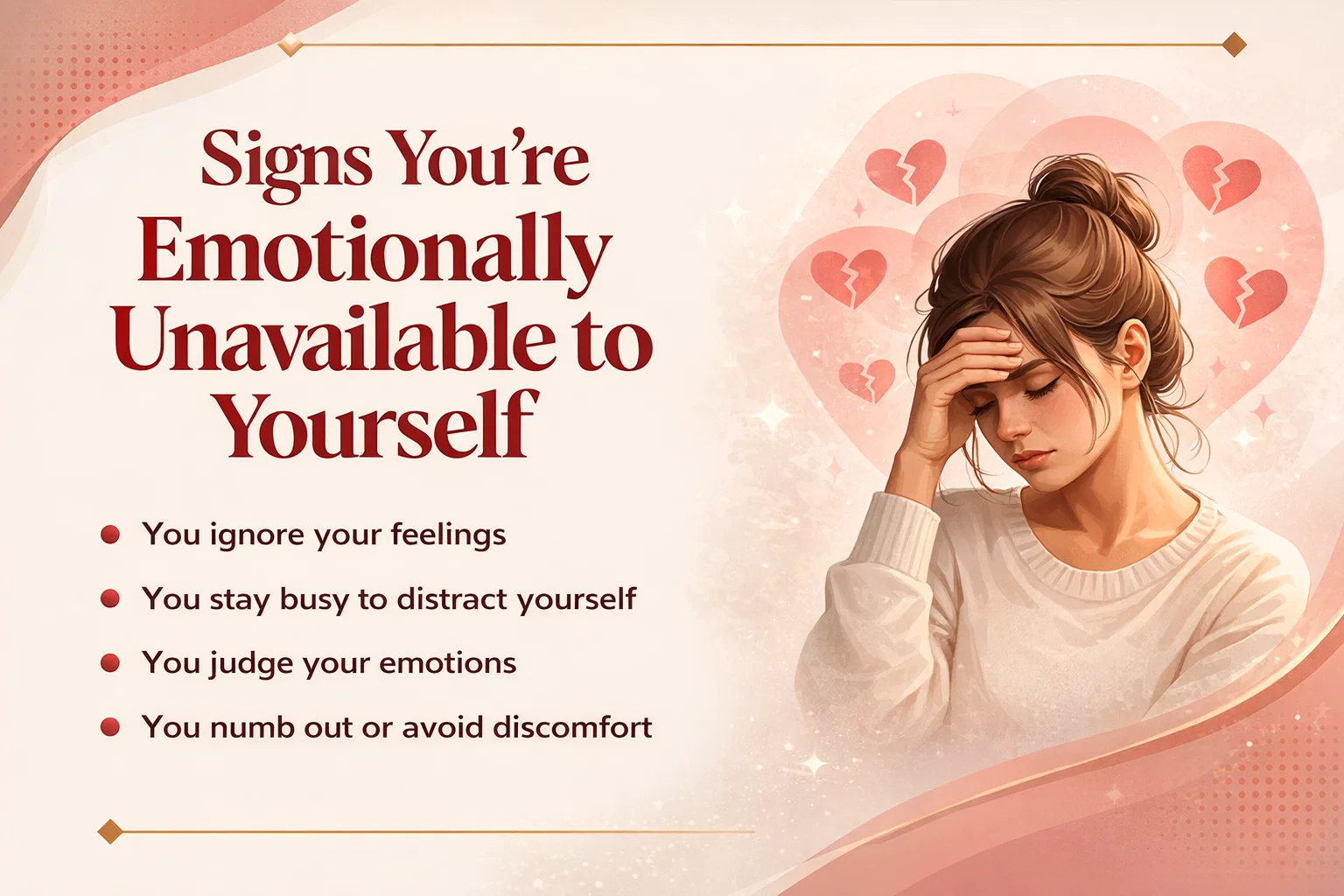
1. You Downplay Your Feelings or Tell Yourself to Get Over It
Do you often find yourself saying things like “It is not that big of a deal” or “Others have it much worse”? This is a classic form of self-invalidation. By comparing your pain to others or minimizing its importance, you are effectively telling your inner self that your experiences do not matter. This creates a rift where your emotions feel “wrong” or “unnecessary,” leading you to suppress them further.
2. You Stay Busy to Avoid Sitting with Discomfort
If your calendar is packed from dawn until dusk and the idea of sitting in a quiet room for twenty minutes feels terrifying, you might be using busyness as a shield. Productivity is a socially acceptable way to escape. When we are constantly moving, we do not have to hear the quiet whispers of our anxiety, sadness, or dissatisfaction. The moment things slow down, those feelings bubble up, which is why many people feel the urge to pick up their phone or turn on the TV the second they have a free moment.
3. You Judge Your Emotions Instead of Listening to Them
When a difficult emotion like anger or jealousy arises, do you immediately label it as “bad”? Judging your emotions puts you in a position of authority over your heart rather than in a partnership with it. Emotions are simply information. Anger might be telling you a boundary has been crossed, while sadness might be highlighting something you truly value. When you judge the feeling, you miss the message.
4. You Only Allow Yourself to Feel When Things Fall Apart
For many, the only time emotions are “allowed” to surface is during a crisis. If you find that you are generally “fine” until you have a massive breakdown or a physical health scare, it is a sign that you have been bottling things up. You are waiting for your system to reach a breaking point before you grant yourself permission to be human.
The Impact of Self-Avoidance on Mental Health
Living in a state of self-unavailability has long-term consequences. While it might feel easier to ignore a problem in the short term, the internal pressure continues to build. This can manifest in several ways that affect your overall quality of life.
- Increased Anxiety: Unprocessed emotions do not disappear; they transform into a low-level hum of anxiety that follows you everywhere.
- Lack of Clarity: When you are disconnected from your feelings, it becomes very difficult to make decisions that align with your true desires.
- Strained Relationships: It is hard to be truly intimate with someone else if you are not being intimate with yourself. Your external relationships often mirror your internal one.
- Emotional Volatility: Because you are not processing small feelings, they accumulate until they explode over something minor.
How to Reconnect and Become Emotionally Available to Yourself
The good news is that the relationship with yourself can always be repaired. It requires patience, curiosity, and a willingness to be uncomfortable. Here is how you can begin the journey back to self-connection.
Cultivating the Role of the Observer
Start by simply noticing your reactions without trying to change them. When you feel a surge of irritation or a wave of loneliness, say to yourself, “I am noticing that I feel lonely right now.” This creates a small space between you and the emotion. You are not the emotion; you are the one experiencing it. This “witnessing” is the foundation of emotional availability.
Creating Safe Spaces for Silence
You do not need to start with an hour of meditation. Start with five minutes of silence a day. Put your phone in another room, sit comfortably, and just check in. Ask yourself, “How am I doing, really?” Listen for the answer without judgment. At first, you might feel nothing but boredom or restlessness, but over time, deeper layers will begin to reveal themselves.
Reframing Discomfort as Growth
We are conditioned to run from pain, but discomfort is often the doorway to transformation. Instead of seeing a difficult emotion as something to be fixed, see it as a guest that has something to teach you. When you stay with the discomfort instead of reaching for a distraction, you build emotional resilience. You prove to yourself that you are strong enough to handle your own heart.
Practical Tools for Daily Self-Connection
Integrating these concepts into your daily life makes them more than just ideas; they become habits. Here are a few practical tools to help you stay present with yourself.
The “Body Scan” Check-in
Throughout the day, take thirty seconds to scan your body from head to toe. Are your shoulders hunched? Is your jaw clenched? Breathe into those areas of tension. This simple act brings your awareness back into the present moment and helps bridge the gap between mind and body.
Journaling for Self-Discovery
Writing is a powerful way to externalize what is happening internally. Try “stream of consciousness” writing, where you write for ten minutes without stopping or editing. This bypasses your internal critic and allows suppressed thoughts and feelings to come to the surface. It is like having a deep conversation with your subconscious mind.
Setting Emotional Boundaries
Sometimes, we are unavailable to ourselves because we are too available to everyone else. Practice saying no to things that drain you. Protect your energy so that you have enough left over to tend to your own internal needs. Remember, self-care is not selfish; it is a prerequisite for being able to care for others effectively.
The Rewards of Being Emotionally Present
As you become more emotionally available to yourself, your life begins to change in beautiful ways. You start to feel more grounded and less reactive to external circumstances. Your intuition becomes sharper because you are finally listening to it. Most importantly, you develop a sense of self-trust that no one can take away from you.
You will find that you no longer need to look to others for constant validation because you are providing it for yourself. Your “inner child” feels seen and safe, which allows your adult self to move through the world with more confidence and grace. This is the essence of “growing through it.”
Conclusion: Coming Home to Yourself
Becoming emotionally available to yourself is a lifelong journey, not a destination. There will be days when you fall back into old patterns of busyness and self-judgment, and that is okay. The goal is not perfection; it is presence. Each time you choose to acknowledge a feeling instead of suppressing it, or choose a moment of stillness over a moment of distraction, you are strengthening the bond with your soul.
By choosing to be available to yourself, you are opening the door to a more vibrant and meaningful existence. You are no longer just surviving your life; you are truly living it. Start small, be gentle with yourself, and remember that your emotions are the compass that will lead you back to your most authentic self. You deserve the same compassion and attention that you so freely give to the rest of the world.
Would you like to explore specific journaling prompts to help you reconnect with your emotions today? Let me know how I can support your journey further!