6 Laws of Detachment for Spiritual Peace Mindful Living Buddhist Wisdom for Inner Calm
In a world that constantly demands our attention, our energy, and our control, the ancient wisdom of detachment offers a refreshing and necessary sanctuary. Many people mistake detachment for being cold or uncaring, but in reality, it is one of the most profound acts of self love and spiritual maturity one can practice. By looking at the core principles of the laws of detachment, we can begin to see how releasing our grip on specific outcomes actually allows the universe to provide exactly what we need. When we stop trying to force the river to flow, we finally learn how to swim with the current.
Understanding the True Essence of Detachment
Detachment is not about abandoning your goals or becoming indifferent to the people in your life. Instead, it is about letting go of the rigid expectations and the desperate need for things to happen in a specific way or at a specific time. When we are overly attached to an outcome, we create a state of tension and anxiety that actually pushes our desires further away. By practicing these laws, we create an internal environment of peace where growth can happen naturally.
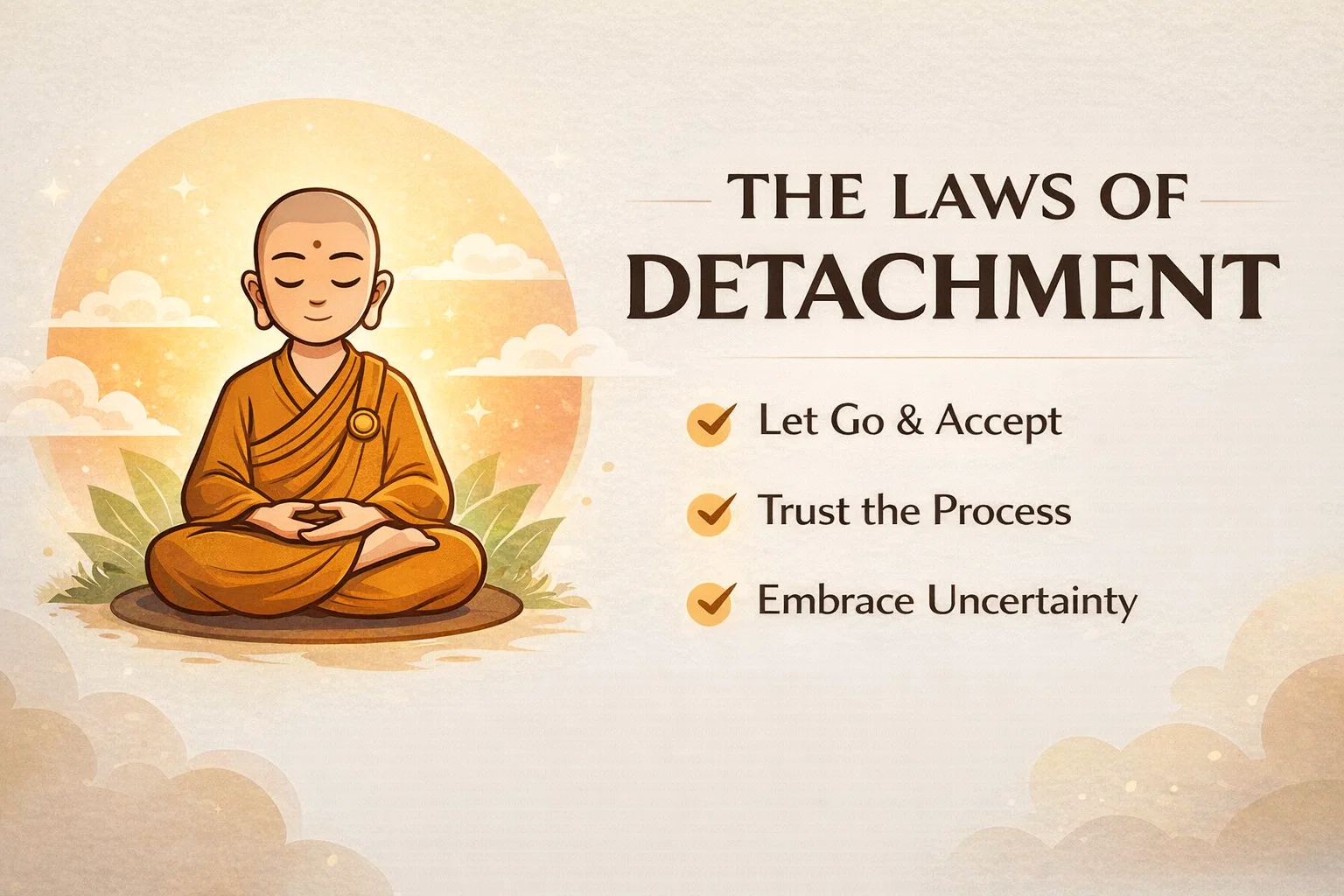
The image of the meditating monk reminds us that true power comes from stillness. When we are still, we are no longer reactive to the chaos around us. We become observers of our lives rather than victims of our circumstances. This shift in perspective is the foundation of a mindful life.
Law 1: Allow Others to Be Who They Are
One of the greatest sources of human suffering is the desire to change or control the people around us. We often have a blueprint in our minds of how our partners, friends, or family members should behave. When they deviate from that blueprint, we feel frustrated, angry, or betrayed.
The first law of detachment teaches us to release that blueprint. By allowing others to be exactly who they are, we grant them the freedom to grow at their own pace. More importantly, we grant ourselves the freedom from the exhausting job of being the world’s manager. When you stop trying to fix others, you suddenly have an abundance of energy to focus on your own journey.
The Beauty of Acceptance
Acceptance does not mean you agree with everything someone else does. It simply means you acknowledge the reality of their personality and choices without internalizing them. This creates healthier boundaries and deeper, more authentic connections. You start to love people for who they actually are, rather than the idealized version you want them to be.
Law 2: Allow Yourself to Be Who You Are
While we are often busy judging others, we are usually our own harshest critics. We wear masks to fit in, suppress our true desires to please others, and constantly compare our behind the scenes footage to everyone else’s highlight reel. Detachment involves detaching from the ego’s need for external validation.
Allowing yourself to be who you are means embracing your flaws, your quirks, and your unique path. It means acknowledging that you are a work in progress and that your worth is not tied to your productivity or your social status. When you detach from the need to be perfect, you open the door to genuine self expression.
Living Authentically
Authenticity is the natural byproduct of self detachment. When you no longer care about maintaining a false image, you become magnetic. People are drawn to those who are comfortable in their own skin. This law encourages you to listen to your intuition and follow the beat of your own drum, regardless of societal expectations.
Law 3: Don’t Force Situations
We live in a culture that glorifies the hustle and the grind. We are told that if we just push harder and scream louder, we can make anything happen. While effort is important, there is a fine line between persistence and force. Forcing a situation is like trying to make a flower bloom by pulling on its petals; you only end up destroying the very thing you want to nurture.
The third law reminds us that there is a natural timing to all things. If a door remains closed despite your best efforts, it might be because what is behind that door is not meant for you, or perhaps the timing isn’t right. Detaching from the timeline allows you to recognize when it is time to pivot and when it is time to wait.
The Power of Non-Striving
In Zen philosophy, this is often referred to as Wu Wei or effortless action. It is the state of being so aligned with the present moment that things seem to fall into place on their own. By not forcing, you remain open to better opportunities that you might have missed if you were too laser focused on one specific path.
Law 4: Solutions Will Emerge
When we face a problem, our instinct is to panic and obsessively search for a solution. This mental noise actually blocks the creative insights we need. The law of detachment suggests that when we step back and create space, the solution has room to appear.
Think of a time when you forgot a name or a word. The harder you tried to remember it, the more it escaped you. It was only when you moved on to another task and relaxed your mind that the answer suddenly popped into your head. Life works the same way. Solutions emerge from a state of calm, not a state of frenzy.
Cultivating a Solutions-Oriented Mindset
By trusting that the answer will come, you reduce your stress levels and improve your cognitive function. You can still take practical steps toward solving a problem, but you do so without the heavy weight of desperation. This clarity of mind is where true innovation and “aha” moments are born.
Law 5: Uncertainty is Reality
Human beings crave certainty. We want to know exactly what the future holds so we can feel safe. However, the only thing that is truly certain in life is change. When we cling to the illusion of certainty, we become rigid and fearful. We view every change as a threat rather than an opportunity.
The law of detachment invites us to embrace uncertainty as the ultimate reality. In the field of all possibilities, uncertainty is the ground where anything can happen. If everything was fixed and certain, there would be no room for miracles or happy accidents. By accepting that we don’t know what tomorrow brings, we become more flexible and resilient.
Finding Security in the Unknown
True security doesn’t come from a bank account or a stable job; it comes from the internal knowledge that you can handle whatever life throws at you. When you are detached from the need for certainty, you find a deep sense of peace that is independent of external circumstances. You stop fearing the future and start living in the now.
Law 6: Embrace It
The final law is the culmination of all the others: total embrace. This means saying yes to life exactly as it shows up. Whether you are experiencing a moment of joy or a period of challenge, embracing the present moment prevents the suffering that comes from resistance. Resistance is the refusal to accept what is happening, and it is the primary cause of emotional pain.
When you embrace your reality, you stop fighting with the universe. This doesn’t mean you become passive; it means you act from a place of clarity and peace rather than conflict. You acknowledge the current situation, learn the lesson it has to offer, and move forward with grace.
The Freedom of Total Surrender
Surrender is not defeat; it is a conscious decision to stop fighting against the inevitable. When you embrace the present, you find that even the difficult moments have a certain beauty and purpose. You begin to see life as a grand tapestry where every thread, dark or light, is necessary for the final design.
How to Practice Detachment Daily
Incorporating these laws into your life is a journey, not a destination. You can start by catching yourself when you feel tense or frustrated. Ask yourself: “What am I clinging to right now?” Is it a specific comment someone made? A deadline? A fear of what people think? Once you identify the attachment, visualize yourself opening your hands and letting it go.
- Meditate regularly: Meditation helps you cultivate the “observer” mind, making it easier to see your attachments without being controlled by them.
- Practice mindfulness: Stay present in your daily tasks. When you wash the dishes, just wash the dishes. Don’t worry about the email you have to send later.
- Journaling: Write down the things you are trying to control. Seeing them on paper often makes you realize how much energy you are wasting on things outside your influence.
- Use Affirmations: Remind yourself daily: “I trust the process of life” or “I release the need to know the outcome.”
The Lasting Benefits of a Detached Life
As you get better at practicing detachment, you will notice a significant shift in your quality of life. Your relationships will improve because they are no longer burdened by your expectations. Your creativity will flourish because you are no longer afraid of failure. Most importantly, you will experience a level of inner peace that cannot be shaken by the ups and downs of the world.
Detachment allows you to live fully, love deeply, and experience everything life has to offer without being destroyed by the eventual loss of those things. It is the path to true emotional and spiritual sovereignty.
Final Thoughts on the Laws of Detachment
The journey toward detachment is one of the most rewarding paths a person can take. It requires courage to face the unknown and humility to admit that we don’t have all the answers. By following these six laws, allow others to be themselves, allow yourself to be you, stop forcing situations, wait for solutions, accept uncertainty, and embrace your reality, you transform your life into a masterpiece of peace and purpose. Remember that the goal is not to feel less, but to live more freely. Start small today, let go of just one thing that is weighing you down, and feel the lightness that follows.