6 Signs Youre Healing From People-Pleasing Setting Boundaries
Recovering from the habit of putting everyone else first is a quiet, often messy process. It is not a sudden transformation where you wake up one morning perfectly assertive and completely immune to the opinions of others. Instead, healing from people-pleasing happens in the small, uncomfortable gaps between your old reactions and your new boundaries. If you have been looking at your life and wondering if you are actually making progress because you still feel a twinge of guilt when you say no, this guide is for you. We are going to dive deep into the subtle markers of growth that prove you are reclaiming your time, your energy, and your identity.
The Paradox of Progress: Why Healing Feels Like Failing
One of the most confusing aspects of emotional growth is that it often feels worse before it feels better. When you are a chronic people-pleaser, your internal system is calibrated to keep the peace at all costs. Breaking that pattern feels like breaking a law. You might expect that setting a boundary would feel empowering and light, but for many, it initially feels like a heavy weight of anxiety. This is because you are dismantling a survival mechanism that has protected you for years.
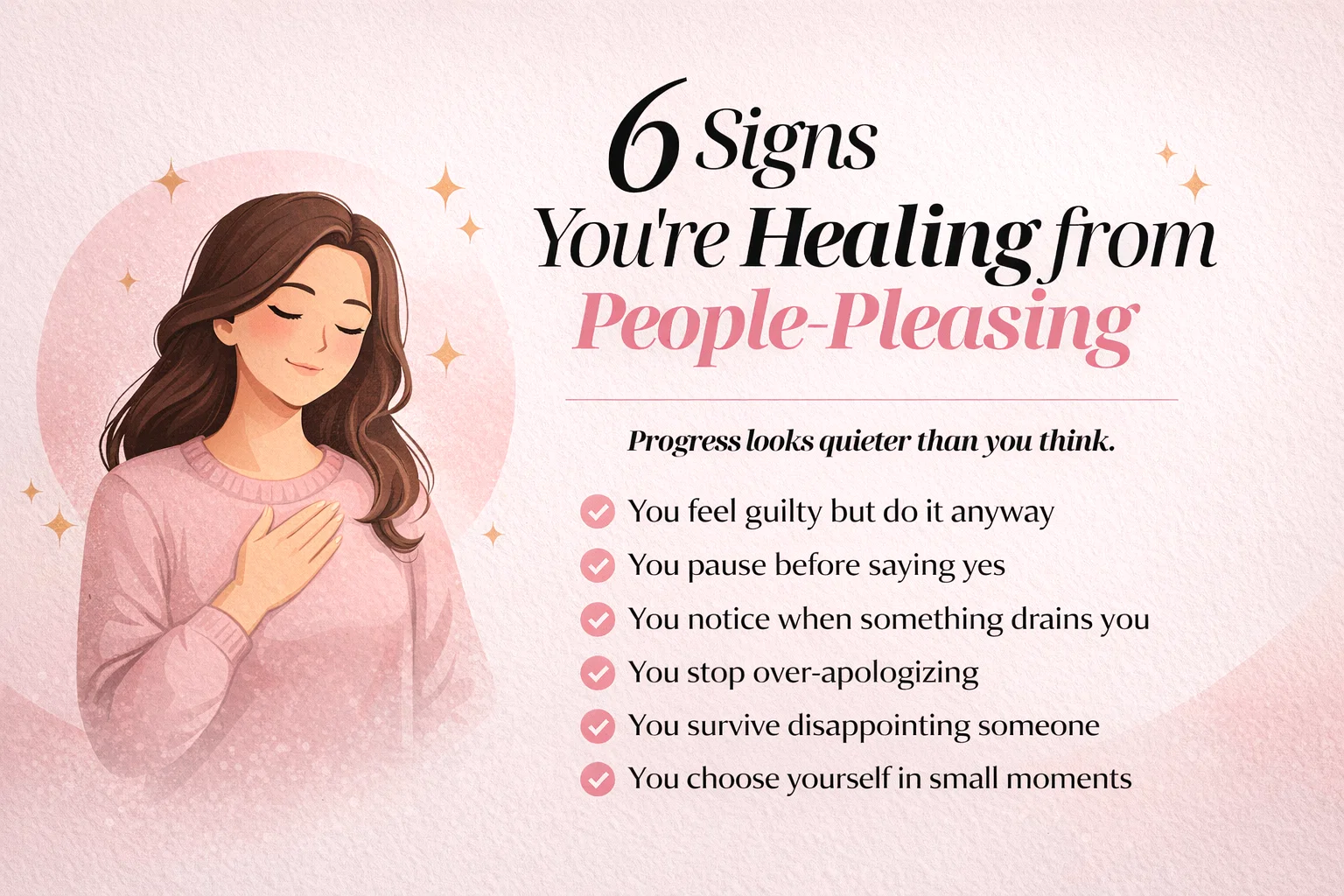
Progress in this area is rarely a loud celebration. It is much quieter. It is the moment you catch yourself before over-committing, or the second you decide to let someone be slightly annoyed with you so that you can rest. If you are waiting for the guilt to disappear entirely before you consider yourself healed, you might be waiting a long time. The real sign of healing is not the absence of guilt, but the ability to act in your own best interest despite it.
1. You Feel Guilty, But You Do It Anyway
For a long time, guilt was your stop sign. If you felt guilty, you assumed you were doing something wrong, and you immediately pivoted to fix it. Healing means you have started to view guilt as a side effect of growth rather than a moral compass. You realize that you feel guilty not because you are being mean, but because you are breaking an old habit of self-sacrifice.
When you say no to an extra project or decline a social invitation and the guilt hits, you no longer let it drive the car. You acknowledge the feeling, sit with the discomfort, and keep your “no” firm. This is a massive victory. It shows that your commitment to your own well-being has finally become stronger than your need for external validation.
2. The Power of the Pause
People-pleasing is often an impulsive, “fast” behavior. Someone asks for a favor, and before your brain can even process your schedule, your mouth has already said yes. This is a reflex designed to reduce immediate social tension. One of the clearest signs of healing is the introduction of a intentional pause.
You might still feel the urge to jump in and help, but now there is a gap. In that gap, you are asking yourself: Do I have the capacity for this? Do I actually want to do this? Am I saying yes because I care, or because I’m afraid of their reaction? Even if the pause is only five seconds long, it represents a shift from being a reactive pleaser to being a conscious decision-maker.
3. Recognizing the Energy Drain
In the past, you might have been so disconnected from your own needs that you didn’t even realize you were exhausted until you hit a complete burnout. You were a master at ignoring the “low battery” warning signs of your own soul. Now, you are becoming more attuned to your internal landscape.
You are starting to notice the physical and emotional sensations that occur when a situation or a person is draining you. Maybe your chest tightens, or you feel a sudden wave of fatigue. Instead of pushing through and ignoring it to keep others happy, you are acknowledging it. This self-awareness is the foundation of every boundary you will ever set. You can’t protect your energy if you don’t know where it is going.
The Difference Between Selfishness and Self-Maintenance
As you notice these drains, you might worry that you are becoming selfish. It is important to distinguish between the two. Selfishness is a lack of consideration for others. Self-maintenance is ensuring you have enough fuel in your own tank to function. By noticing what drains you, you are actually becoming a more authentic friend and partner because when you do show up, you are doing so fully, rather than out of obligation.
4. Letting the Sentence Stand
Have you ever noticed how people-pleasers tend to over-explain? “I can’t make it because my car is acting up and I have this thing for work and I’m so sorry, please don’t be mad.” This is an attempt to negotiate for forgiveness. You are looking for the other person to say, “It’s okay, I understand,” so that you can stop feeling bad.
A major milestone in your healing journey is when you stop apologizing mid-sentence. You state your boundary or your “no” clearly and concisely, and then you stop talking. You let the silence sit. You aren’t being cold; you are being clear. You are realizing that “No” is a complete sentence and that you do not need to provide a legal defense for your personal boundaries.
5. Surviving the Disappointment of Others
This is perhaps the hardest stage of the journey. To a people-pleaser, someone else’s disappointment feels like a personal failure or a threat to safety. You might have spent years bending yourself into a pretzel to ensure no one was ever unhappy with you. Healing looks like realizing that you are not responsible for managing other people’s emotions.
When you disappoint someone, and they show it, you realize that you survived it. The world didn’t end. They didn’t leave (or if they did, you realized the relationship was conditional on your compliance). You are learning that you can be a good person and still be the “villain” in someone else’s story because you chose your own mental health over their convenience.
6. Choosing Yourself in the Small Moments
Grand gestures of assertiveness are great, but the real work happens in the moments that nobody else sees. It is choosing the restaurant you actually like when it’s just you and a close friend. It is taking a nap instead of folding the laundry because you are tired. It is wearing the outfit you love even if it’s not “trendy.”
These small acts of self-loyalty build a library of evidence that you are worth looking after. Every time you choose yourself in a small way, you are re-parenting that part of you that felt it had to perform to be loved. Over time, these small moments add up to a life that actually feels like yours, rather than a life built to satisfy a committee of other people.
Why Small Wins Matter Most
Don’t undervalue the small victories. If you managed to stay off your phone for an hour to read a book instead of answering non-urgent work emails, that is a win. If you told a salesperson “No thank you” without a three-minute explanation of why you can’t buy the product, that is a win. These are the bricks that build the fortress of your new life.
Navigating Relationships During Your Evolution
As you change, the people around you will react. Some will celebrate your new confidence, but others who benefited from your lack of boundaries may push back. This “extinction burst” is a common psychological phenomenon where people try even harder to get you to return to your old ways. Understanding this helps you stay firm.
It is helpful to remember that you are teaching people how to treat you. If you have always been the person who says yes to everything, people have built their expectations around that. When you change the rules, there will be a period of adjustment. This doesn’t mean you are doing it wrong; it means the system is recalibrating.
The Long-Term Rewards of Healing
What lies on the other side of people-pleasing? It isn’t a life of isolation or conflict. On the contrary, it is a life of genuine connection. When you stop pleasing, the people who stay are the ones who actually love you for who you are, not for what you do for them. You find that you have more energy, less resentment, and a profound sense of peace.
You start to trust yourself. You stop looking left and right for approval and start looking inward for direction. The anxiety that used to buzz in the background of your social interactions begins to quiet down because you know that no matter what happens, you have your own back.
Final Thoughts: Embracing Your Progress
If you recognized yourself in any of these signs, take a moment to acknowledge how far you have come. Healing is not a linear path, and there will be days when you slip back into old patterns. That is okay. The goal is not perfection; it is persistence. You are learning a new language, the language of self-respect, and it takes time to become fluent.
Keep noticing the pauses. Keep surviving the discomfort. Keep letting the sentences stand. You are doing the brave work of reclaiming your life, and even if it doesn’t feel like it every day, you are making incredible progress. Your time and energy are precious resources, and you are finally learning how to be their rightful owner.
Would you like me to help you draft some specific scripts for setting boundaries in the workplace or with family members?