7 Proven Ways to Stop Overthinking and Find Calm Today
Does your mind feel like a browser with too many tabs open? You are certainly not alone. Many of us find ourselves caught in a relentless cycle of rumination, replaying past conversations or catastrophizing about future events that haven’t even happened yet. This state of mental overload is known as overthinking, and it is a major thief of joy, productivity, and peace. The good news is that your brain is not destined to remain in this loop forever. By learning how to interrupt these patterns and implementing actionable strategies, you can reclaim your mental space and focus on what truly matters.
Overthinking is often a defense mechanism gone wrong. We believe that by dwelling on a problem, we are somehow preparing for it or fixing it. In reality, it usually just leads to paralysis. Today, we are going to dive deep into practical, effective ways to stop overthinking and start living more intentionally.
Why We Get Stuck in Mental Loops
To stop overthinking, it helps to understand why it happens in the first place. Often, it stems from a desire for control. When we feel anxious about uncertainty, our brains try to map out every possible outcome to avoid negative surprises. However, this is an impossible task because the future is inherently unpredictable.
Another common driver is perfectionism. When we are afraid of making mistakes, we overanalyze every detail before taking action. This leads to procrastination, as the task becomes so daunting in our minds that we become unable to start. Recognizing that these habits are attempts to protect ourselves—even if they are misguided—is the first step toward changing them.
Effective Strategies to Quiet the Noise
1. Master the Art of Staying Present
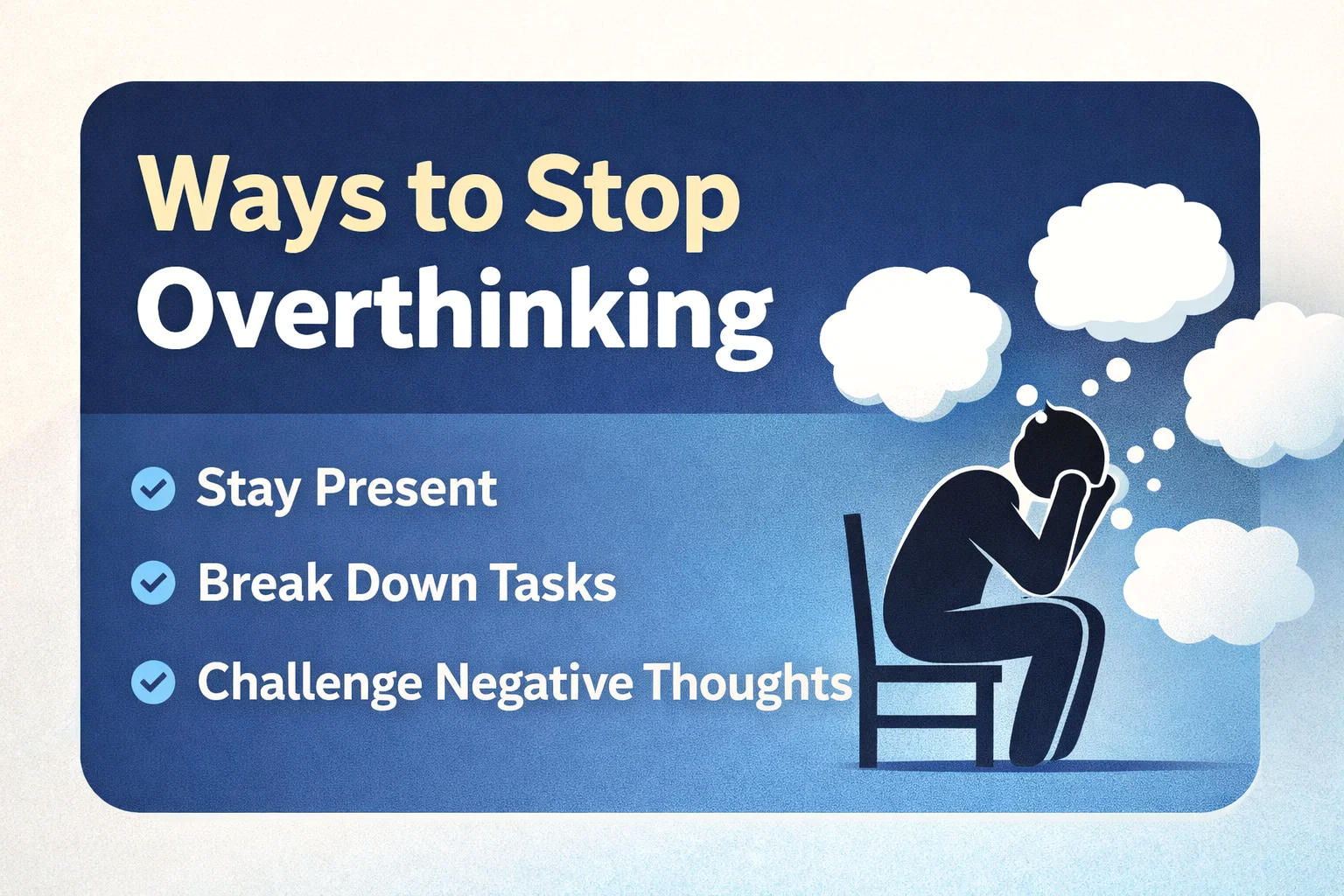
The past is a memory, and the future is an imagination. The only place where you can actually make changes or experience life is in the present moment. When you feel yourself drifting into “what if” scenarios, try to ground yourself in your immediate environment. Notice the sensation of your feet on the floor, the temperature of the air, or the sounds around you. This simple shift helps break the connection to anxious thoughts and brings you back to the here and now.
2. Use Breathing to Calm the Nervous System
When you are overthinking, your body often enters a low-level “fight or flight” mode. You might notice shallow breathing, a tight chest, or racing thoughts. Deep breathing is a physiological hack to tell your brain that you are safe. Techniques like box breathing, where you inhale for four seconds, hold for four, exhale for four, and hold for four, can physically slow your heart rate and signal your nervous system to relax.
3. Set Intentional Deadlines
Parkinson’s Law states that work expands to fill the time available for its completion. This applies to our thoughts too. If you give yourself all day to “worry” about a project, you will spend all day worrying. By setting strict time limits for decision-making or brainstorming, you create artificial urgency that prevents endless mental chatter. When the time is up, you must make a choice or move on to the next task.
4. Break Down Overwhelming Tasks
Often, we overthink because we are looking at a goal as one massive, insurmountable obstacle. The sheer scale of it triggers anxiety. The remedy is to break the big task into tiny, manageable chunks. Instead of thinking about “finishing the project,” think about “writing the first two sentences of the introduction.” By focusing only on the next small step, you reduce the mental burden and make it easier to get started.
Focusing on What You Can Control
A huge portion of overthinking is spent on things entirely outside of our influence. We worry about what other people think, how they will react, or what the weather will be like on our wedding day. None of these things are within our direct control. The Stoic philosophy of the “dichotomy of control” is vital here.
Ask yourself these questions when you are spiraling:
- Is this within my control?
- If yes, what is one small action I can take right now?
- If no, how can I accept this and let it go?
By focusing your energy solely on your own attitude, actions, and attention, you stop wasting energy on the unchangeable and start making real progress.
The Power of Acceptance
Acceptance is not about being passive or giving up. It is about acknowledging reality as it is, without fighting it. When you accept that uncertainty is a natural part of life, you stop demanding guarantees that don’t exist. This releases the pressure to have all the answers and allows you to be more flexible when things don’t go exactly as planned.
Challenging Your Internal Narratives
Our thoughts are not always facts. Often, they are just interpretations influenced by our current mood. When you catch yourself thinking “I am not good enough,” challenge it. Replace it with a more balanced thought like “I have plenty to offer and I am capable of learning.” Changing your internal dialogue requires practice, but over time, it rewires your brain to be more supportive rather than critical.
Conclusion: Start Small and Be Patient
Stopping overthinking is not a one-time event; it is a continuous practice. You will have days where you slip back into old habits, and that is perfectly okay. The goal is not to never have a negative thought again, but to notice when you are doing it and have the tools to pivot back to a calmer state of mind.
Start with just one of the strategies mentioned above. Perhaps you try deep breathing this week or focus on breaking down your to-do list into smaller, more manageable steps. As these actions become habits, you will notice that the noise in your head begins to quiet, leaving more room for the things that truly make you happy and fulfilled. Be patient with yourself, trust the process, and remember that you have the power to decide where you place your attention.