The Wheel of Life Sticker Self Care, Productivity Wellness Goal Tracker Decal
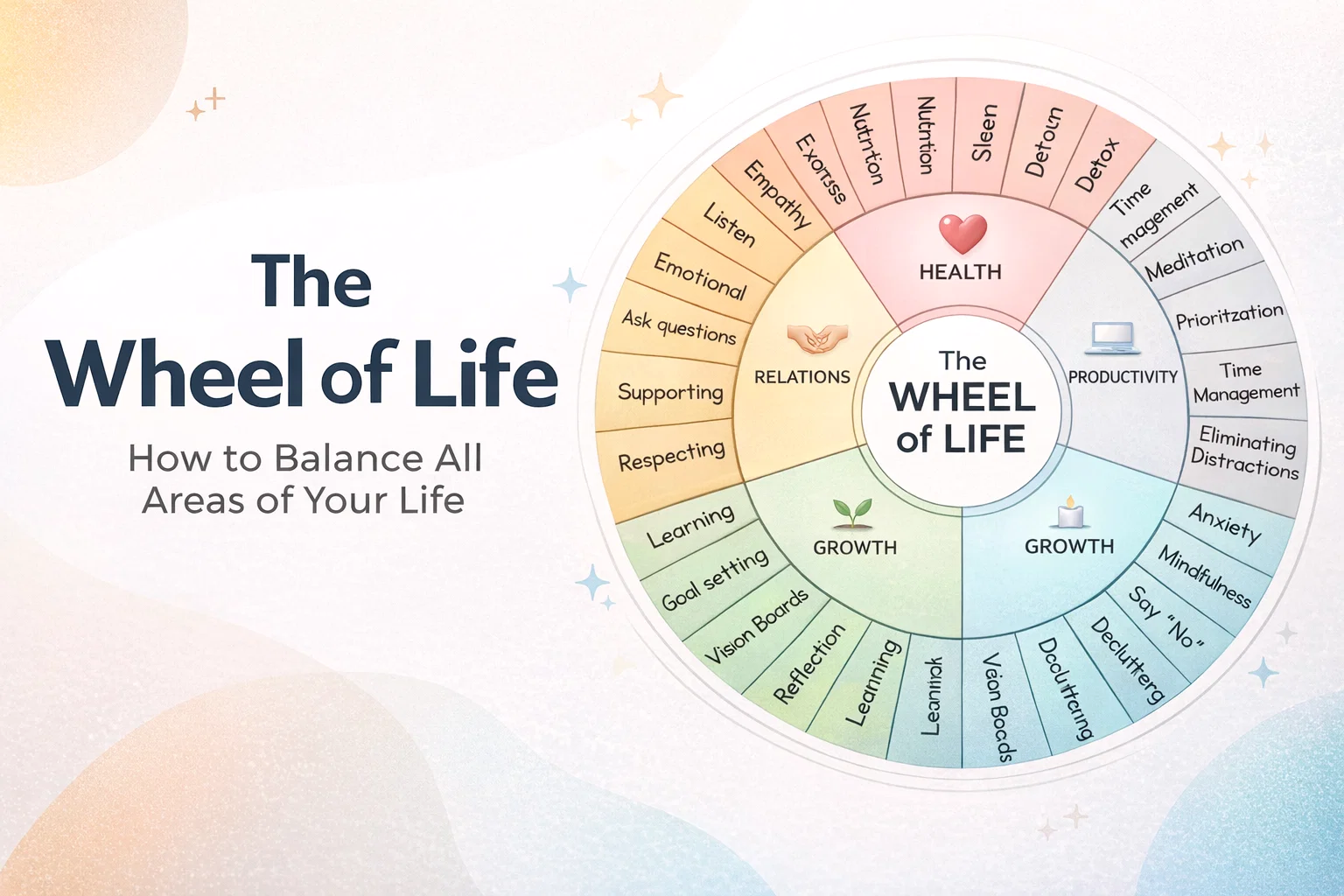
Transforming your life is rarely about making one massive, earth-shaking change. Instead, it is about the quiet, consistent calibration of the small gears that keep your daily engine running. The image of the Wheel of Life serves as a vivid, colorful blueprint for this exact process. It is a holistic map that breaks down the overwhelming concept of self-improvement into digestible, actionable segments. By looking at life through these six lenses—Health, Productivity, Anxiety, Growth, Relations, and Emotional Control—we can finally stop guessing where our energy is leaking and start plugging the holes with intention.
Understanding the Architecture of the Wheel of Life
The Wheel of Life is more than just a decorative sticker or a colorful graphic. It is a diagnostic tool used by life coaches and psychologists to help individuals visualize their current state of being. When one area of the wheel is over-inflated and another is flat, the ride through life becomes bumpy and unsustainable. The beauty of this specific visual guide is that it categorizes the abstract “stuff” of daily life into concrete pillars. It forces us to ask: Is my productivity thriving at the expense of my health? Am I growing intellectually but failing to manage my internal anxiety?
To use this wheel effectively, you must treat it as a living document. It represents a snapshot of your current habits. By analyzing each segment, you can identify which “spokes” need strengthening to ensure your life rolls forward smoothly. Let us dive deep into these six pillars to understand how they interconnect and how you can optimize each one for a more balanced existence.
The Health Pillar: Fueling the Machine
At the top of the wheel sits Health, the foundational requirement for everything else. Without physical and mental vitality, the other segments of the wheel eventually collapse. The visual highlights several high-impact habits that go beyond the standard advice of just eating your greens.
- Nutrition and Sleep: These are the non-negotiables. Sleep is the period when your brain flushes out toxins and consolidates memory, while nutrition provides the chemical building blocks for your mood and energy.
- Exercise: This is not just about aesthetics. Movement is a biological necessity that regulates insulin sensitivity and releases endorphins.
- Cold Showers and Detox: These represent the “edge” of health. Cold exposure is a proven way to boost dopamine levels and improve immune response, while periodic detoxing allows your digestive system to reset.
- Meditation and Relaxation: Health is as much about the nervous system as it is about the muscles. Incorporating stillness allows the body to move from a “fight or flight” state into “rest and digest” mode.
Productivity: Mastering Time and Focus
In the modern world, being busy is often confused with being productive. The Productivity segment of the wheel clarifies this by focusing on systems rather than raw effort. It suggests that high performance is a result of structure, not just willpower.
The Power of Habit Stacking
One of the most effective concepts mentioned in the wheel is habit stacking. This involves taking a habit you already have, like brushing your teeth, and “stacking” a new habit on top of it, like practicing one minute of mindfulness. This utilizes the neural pathways already established in your brain to make new behaviors stick with less resistance.
Deep Work and Flow States
The wheel points toward “Flow State” and “Eliminating Distractions.” In an age of constant notifications, the ability to achieve deep work is a superpower. By setting up morning routines and prioritizing tasks, you create the environment necessary for your brain to enter a state of total immersion. This is where your best work happens and where time seems to disappear.
Managing Anxiety: Creating Internal Peace
Anxiety is often the “friction” that slows down the Wheel of Life. This section of the graphic focuses on environmental and behavioral interventions to lower cortisol and regain a sense of control.
Interestingly, the wheel suggests “Unplugging” and “Saying No” as primary tools against anxiety. We often feel anxious because we are over-committed or over-stimulated by digital noise. By practicing the art of the boundary, you protect your mental space. Additionally, tactile activities like journaling or listening to music provide a healthy outlet for processing emotions rather than suppressing them. Even simple biological cues, like getting enough sunlight, can fundamentally shift your circadian rhythm and reduce feelings of dread.
The Growth Pillar: The Pursuit of Evolution
If you are not growing, you are stagnating. The Growth pillar is about the long-term expansion of your capabilities and your mindset. This is where we move from surviving to thriving.
Shutterstock
- Embracing Failure: This is perhaps the most critical component of growth. Seeing failure as data rather than a personal indictment allows for faster experimentation and learning.
- Reflection and Goal Setting: Growth requires a compass. Without regular reflection, you might be climbing the ladder of success only to realize it is leaning against the wrong wall.
- Reading and Learning: Constant input of new ideas keeps the mind plastic and adaptable. Whether it is through books or vision boards, keeping your goals and new knowledge at the forefront of your mind ensures you stay on an upward trajectory.
Relations and Social Skills: The Human Connection
Humans are inherently social creatures. The Relations segment reminds us that our success is hollow if we have no one to share it with. This area focuses on the “soft skills” that make life meaningful and professional interactions smoother.
The wheel emphasizes “Listening” and “Asking Questions” over talking. True connection is built on empathy and the ability to make others feel heard. By mastering emotional control and showing respect, you build a social capital that acts as a safety net during hard times. Supporting others is not just a selfless act; it creates a feedback loop of positive reinforcement that stabilizes your own mental health.
Emotional Control: The Center of the Storm
The final pieces of the wheel, often overlapping with Relations and Growth, involve the internal regulation of our feelings. Emotional control does not mean being a robot. It means having the space between a stimulus and your response. When someone cuts you off in traffic or a project fails, emotional control is the tool that allows you to choose a constructive path rather than a reactive one.
This is achieved through several practices mentioned across the wheel, such as meditation, reflection, and journaling. By observing your thoughts without immediately acting on them, you become the master of your internal world rather than its prisoner.
How to Implement the Wheel in Your Daily Life
Looking at this comprehensive list can feel overwhelming. You might feel the urge to start all thirty habits tomorrow morning. However, that is the quickest way to break the wheel. The secret to using this visual effectively is incremental progress.
Step 1: The Audit
Rate yourself on a scale of 1 to 10 for each of the six main categories. Be brutally honest. You might find that your Productivity is a 9, but your Relations are a 3. This visual gap tells you exactly where your next “project” should be.
Step 2: Pick One Small Win
Choose one sub-habit from your weakest category. If your Health is low, don’t start a marathon training plan. Just commit to “Nutrition” by adding one vegetable to your dinner or “Sleep” by going to bed 15 minutes earlier. Small wins build the confidence needed for larger changes.
Step 3: Visual Reminders
There is a reason this design looks like a sticker. Keeping this image in a place where you see it daily—whether on your fridge, your workspace, or as a phone wallpaper—acts as a psychological nudge. It reminds you that life is a balancing act and that every small choice contributes to the overall rotation of the wheel.
The Synergy of the Wheel
What makes the Wheel of Life so fascinating is how the segments bleed into one another. When you improve your Sleep (Health), you naturally have more Flow State (Productivity). When you learn to Say No (Anxiety), you have more time for Reflection (Growth). This is the “flywheel effect.” Once you get one part of the wheel moving, it provides momentum for the rest.
Conversely, neglecting one area creates a drag on the others. High stress and poor Emotional Control will eventually ruin your Social Skills and your Relations. By viewing your life as an interconnected system rather than a series of isolated problems, you can solve issues at their root rather than just treating the symptoms.
Conclusion: Finding Your Balance
The Wheel of Life is a journey, not a destination. You will never reach a point where every single spoke is perfectly tuned forever. Life happens. You will have seasons where your career demands 110% of your Productivity, and your Health might temporarily take a backseat. You will have seasons of deep personal Growth that require you to pull back from Social Skills for a while.
The goal is not perfection, but awareness. By using this wheel as a guide, you gain the clarity to see when the wheel is wobbling and the tools to fix it. Start today by picking just one habit from the image. Whether it is a cold shower, a five-minute journal session, or simply drinking more water, that small movement is what keeps the wheel turning toward a better version of you.
Would you like me to create a personalized 30-day action plan based on one of the specific sections of this wheel, such as Productivity or Anxiety management?