Boost Your Logic 24 Essential Questions to Sharpen Your Critical Thinking Skills Fast
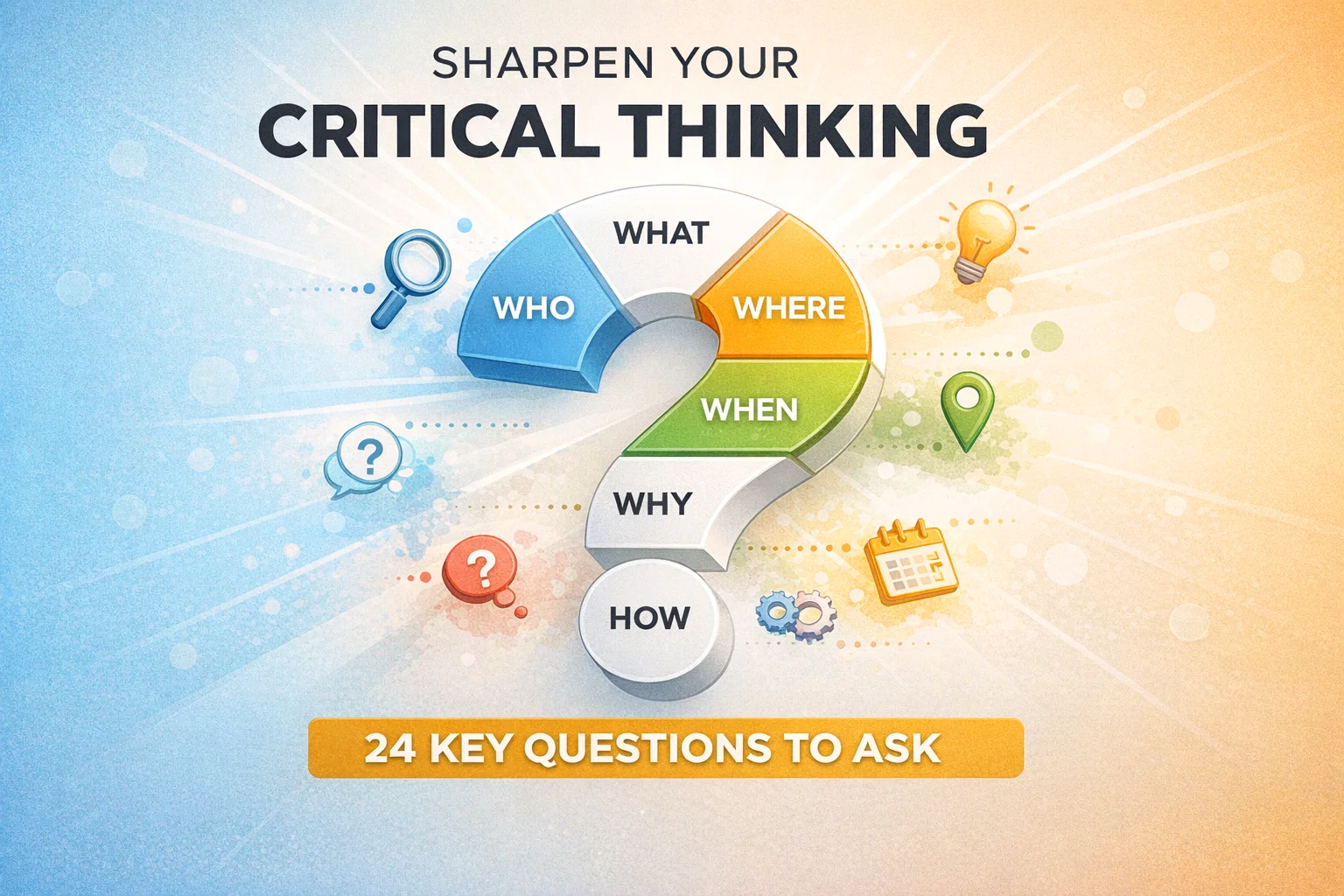
In an era where information travels faster than a heartbeat, the ability to sift through noise and find the truth is more than just a skill. It is a superpower. Every day, we are bombarded with headlines, social media posts, and professional challenges that demand our immediate attention and judgment. But how often do we stop to actually evaluate the quality of our thoughts? Critical thinking is the engine of effective decision making, yet many of us operate on mental autopilot. By intentionally sharpening your critical thinking skills, you unlock the door to better problem solving, clearer communication, and a more profound understanding of the world around you. The visual framework we are exploring today provides twenty four surgical questions designed to dismantle complex issues and rebuild them with logic and clarity.
The Foundation of Inquiry: Why Critical Thinking Matters Today
We live in what many call the attention economy, where being loud is often confused with being right. Without a structured approach to thinking, it is incredibly easy to fall prey to cognitive biases, logical fallacies, and emotional manipulation. Critical thinking is not about being cynical or finding fault in everything. Instead, it is a disciplined process of actively and skillfully conceptualizing, applying, analyzing, and evaluating information. It is the difference between reacting to a situation and responding to it with purpose.
When you master these twenty four questions, you essentially create a mental toolkit. You stop taking things at face value and start looking for the underlying architecture of arguments. This leads to higher emotional intelligence, as you begin to understand not just what people are saying, but why they are saying it and who stands to benefit from the narrative being pushed. Whether you are a student, a CEO, or a curious learner, these frameworks are your roadmap to intellectual independence.
Analyzing the Players: The Who Questions
Every problem and every piece of information has a human element. The first step in sharpening your critical thinking is identifying the stakeholders involved. Who are the visible players, and more importantly, who are the invisible ones? By asking Who benefits from this? you immediately uncover potential biases or motives that might be hidden beneath a polished surface. Profit, power, and reputation are strong drivers that often color the way facts are presented.
Equally vital is asking Who is affected if this goes wrong? This question shifts your perspective toward risk management and empathy. It forces you to consider the ethical implications of a decision. Furthermore, identifying Who is missing from this conversation? ensures that you are not operating in an echo chamber. Diversity of thought is a requirement for truth. Finally, looking for Who has solved a similar problem before? allows you to leverage existing wisdom, preventing you from wasting energy on reinventing the wheel.
The Power of Perspective in Social Dynamics
When we analyze the “Who,” we are essentially auditing the source of information. In the digital age, the source is often just as important as the message. If a study on the benefits of sugar is funded by a soda company, the “Who benefits” question reveals a conflict of interest that changes how you interpret the data. Developing this habit ensures you are never the passive recipient of an agenda.
Defining the Core: The What Questions
Before you can solve a problem, you must define it with absolute precision. Many failures in business and personal life stem from solving the wrong problem perfectly. Asking What am I really trying to solve? forces you to strip away the symptoms and find the root cause. It is the difference between putting a bucket under a leak and actually fixing the roof. This clarity is the first step toward efficiency.
Distinguishing between evidence and intuition is the next hurdle. What are the facts, and what are opinions? is a question that requires brutal honesty. Facts are verifiable and objective; opinions are interpretations. In a heated debate, these two often get blurred. By separating them, you ground your logic in reality. You must also confront your own mind by asking What am I assuming without proof? We all have “blind spots” created by our upbringing, education, and past experiences. Identifying these assumptions is like cleaning a foggy lens.
Identifying Information Gaps
One of the most dangerous things in the world is a confident person with incomplete data. Asking What information is missing? protects you from making premature conclusions. It encourages a “detective mindset” where you seek out the holes in a story before you commit to a course of action. This keeps you curious and humble, two traits that are essential for any great thinker.
Context and Origin: The Where Questions
Information does not exist in a vacuum. It is born in a specific context and carries the weight of its origin. Asking Where is this coming from? helps you trace the lineage of an idea. Is it based on a peer reviewed study, a hearsay comment, or a deep seated cultural belief? Understanding the “Where” gives you a sense of the information’s reliability and its intended environment.
Forward thinking is another branch of the “Where” category. Where will this decision lead? and Where could this create problems? are essentially mental simulations of the future. You are playing out the chess moves of your life before you actually touch a piece. This prevents “second order effects” where a solution for one problem creates two new, bigger problems. If you find yourself stuck, asking Where can I find more clarity? directs your energy toward better resources, whether that is a book, a mentor, or a different set of data.
Timing and Frequency: The When Questions
Timing can be the difference between a brilliant move and a total disaster. In critical thinking, we must look at the timeline of events. When did this become a problem? helps you understand if you are dealing with a sudden crisis or a systemic issue that has been brewing for years. Understanding the history of a problem often provides the keys to its resolution.
Urgency is another factor. When does this need to be decided? protects you from the “urgency trap,” where people pressure you to make a quick choice so you don’t have time to think critically. If there is no real deadline, take the time to reflect. On the flip side, asking When have I seen this happen before? allows for pattern recognition. History doesn’t always repeat, but it often rhymes. Recognizing a familiar pattern can save you hours of deliberation. Lastly, When would be the wrong time to act? helps you identify periods of high emotion or low information where your judgment might be compromised.
The Roots of Motivation: The Why Questions
The “Why” is the heart of the matter. It is the deepest layer of the critical thinking onion. Why does this matter? is a filter for your time and energy. If the answer is “it doesn’t,” then you can move on to more important tasks. This keeps your mental resources focused on high impact thinking. In personal growth, Why do I believe this is true? is perhaps the most challenging question you can ask. It requires you to audit your own belief system and acknowledge that you might be wrong.
To be a truly balanced thinker, you must look outside yourself. Why might others see this differently? is the ultimate tool for empathy and negotiation. If you can understand the logic of your opponent, you can find common ground or build a stronger counterargument. Finally, Why haven’t we solved this already? uncovers the obstacles, whether they are technical, political, or psychological. It identifies the “friction” that is keeping progress from happening.
Execution and Verification: The How Questions
Once the analysis is done, you must move into the realm of action and measurement. Critical thinking doesn’t stop once a decision is made; it continues through the implementation phase. How will I measure success? ensures that you have objective metrics to track your progress. Without a yardstick, you are just guessing. This question turns a vague goal into a concrete plan.
Risk assessment comes back into play with How could this go wrong? This is sometimes called a “pre mortem.” By imagining a failure before it happens, you can build safeguards to prevent it. You should also ask How can I test this before committing? Small scale experiments or “pilot programs” are the best way to gather real world data without risking everything. Finally, How will I explain this choice to others? forces you to synthesize your logic. If you cannot explain your decision simply, you probably don’t understand it well enough yet.
The Feedback Loop of Logic
The “How” section creates a feedback loop. As you measure success and see how things go wrong, you gain new “facts” and “experiences” that feed back into the “Who, What, Where, When, and Why” of your next challenge. This is how you grow from a beginner to an expert. You aren’t just thinking; you are learning how to think better with every single iteration.
Putting It All Together: A Daily Practice
You do not need to ask all twenty four questions for every minor decision, like what to have for lunch. However, for significant life choices, professional projects, or evaluating major news stories, this framework is invaluable. Start by picking one category each week to focus on. For example, spend a week really diving into the “Who” behind the stories you read. The next week, focus on identifying “What” assumptions you are making in your meetings.
Over time, these questions will become second nature. You will find yourself automatically looking for missing information or questioning the timing of a request. Your brain will become “sharper” because you have given it a better operating system. You will find that you are less stressed because you have a process to handle uncertainty. Confidence comes from knowing that your conclusions are built on a solid foundation of inquiry rather than a shaky ground of gut feelings and external pressure.
The Path Forward to Intellectual Mastery
Sharpening your critical thinking is a lifelong journey, not a destination. The world is constantly changing, and new challenges will always require new ways of looking at things. By embracing these twenty four questions, you are committing to a life of curiosity, integrity, and clarity. You are choosing to be the architect of your own thoughts rather than a passenger in someone else’s narrative.
As you move forward, remember that the goal of critical thinking is to reach the best possible conclusion based on the available evidence. It requires the courage to change your mind when new facts emerge and the humility to admit when you don’t have all the answers. Use these questions as your compass. They will guide you through the fog of misinformation and help you find the truth that lies beneath. The more you practice, the more intuitive this process becomes, transforming your approach to every problem you encounter. Start today by picking one question from the list and applying it to a challenge you are currently facing. You might be surprised at how much clarity a single, well placed question can provide. Stay curious, stay questioning, and keep sharpening that mind.