Off Grid Amish Tools Survival Solutions for a World Without Power
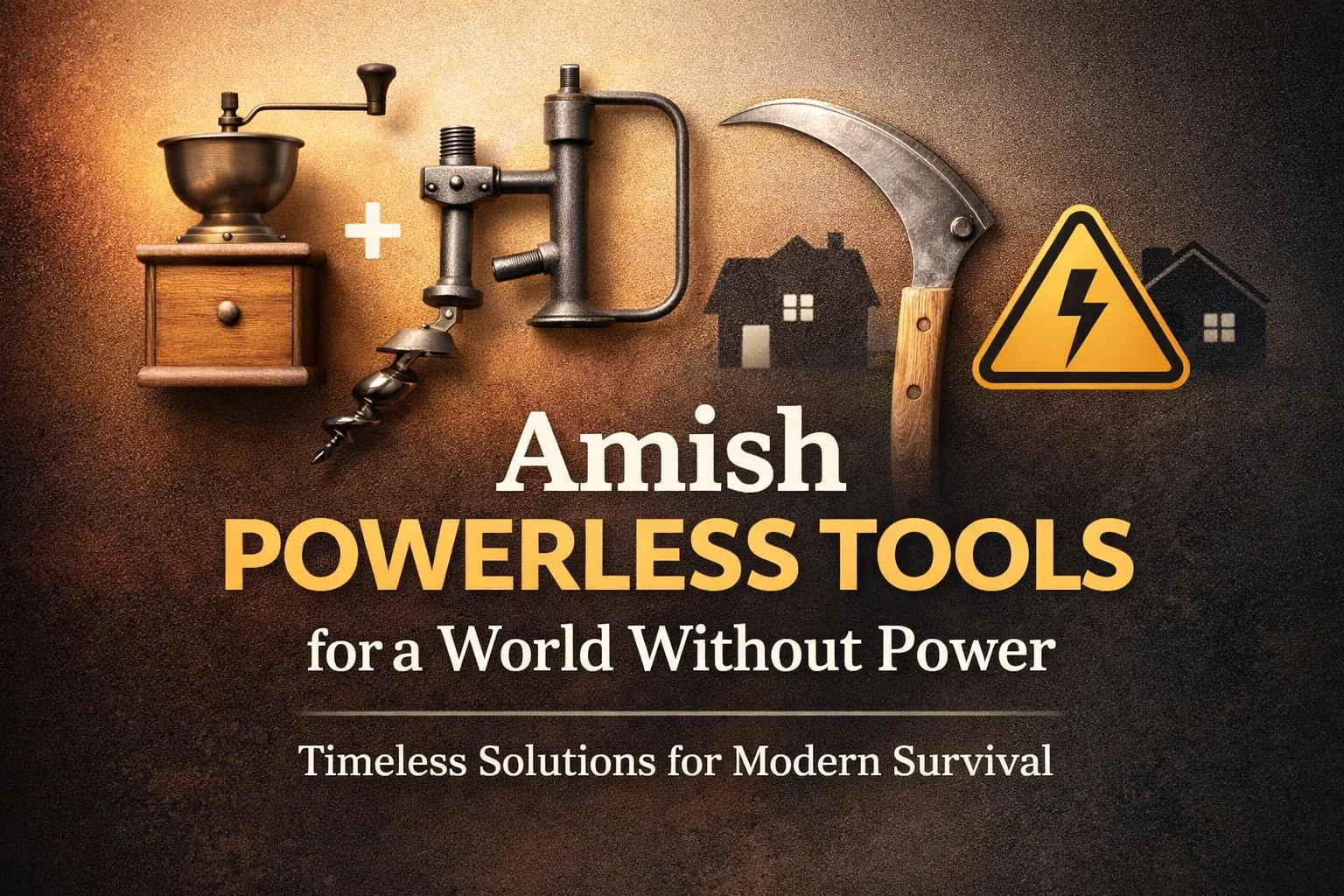
Imagine a world where the power grid goes silent. For many, this is a terrifying concept, but for the Amish community, it is just another Tuesday. The image before us is more than a collection of vintage-looking contraptions; it is a profound blueprint for resilience. It is a visual representation of self-reliance, sustainability, and time-tested solutions that are becoming increasingly relevant in our modern, tech-dependent lives. We are looking at “Amish Powerless Tools for a World Without Power: Timeless Solutions for Modern Survival.” And we are here to explore how these remarkable, non-electric tools can revolutionize your approach to emergency preparedness, off grid living, and homesteading.
When you deeply analyze the contents of this image, you see a masterclass in utility. Each item, resting on a rustic wooden backdrop, tells a story of human ingenuity. We have a complex hand-crank coffee or grain grinder, a powerful manual drilling device or press, a rustic wooden mallet and bowl, a simple and effective scythe for harvesting, and a substantial handle-operated press or perhaps a corn sheller. These are the tools that build a life when electricity is non-existent or unreliable. Let’s delve into why these implements are not just relics of the past but essential gear for the future.
The Critical Shift to Non-Electric Tools for Resilience
In our modern era, we are spoiled by immediate power. A flip of a switch brings light, heat, communication, and complex food processing. However, this convenience creates a profound vulnerability. A single natural disaster, a localized grid failure, or a more systemic crisis can plunge us into chaos within hours. This is why the principles of Amish tools are gaining traction far beyond the fields of Pennsylvania.
The core philosophy here is not about regressing, but about diversifying your dependencies. Having a motorized wood splitter is efficient, until the gas runs dry or the engine breaks. But owning a heavy-duty splitting maul means you will always be able to process firewood. The shift to powerless tools is about regaining control. It is about building a toolkit that is as resilient as the people who use it.
Deconstructing the Toolkit: What We See in the Image
Let’s break down the actual tools shown. They represent specific, crucial functions required for an off-grid or power-loss scenario, focusing on fundamental needs like food processing, agriculture, and construction.
The Complex Grinder: Beyond Morning Coffee
The item on the far left, labeled “MOWELES CIOIEIFF-A” (a perhaps fictionalized label that captures the essence of vintage manufacturing), is a high-capacity, hand-crank grinder. In a power-loss world, this tool is the gatekeeper to staple foods. Yes, it can grind coffee beans for a comfort ritual, but its true survival purpose is for grains. Grinding dry corn, wheat, oats, and barley into flour is the backbone of long-term nutrition. Without this, you cannot make bread, porridge, or any grain-based dish from your stored whole grains. It teaches us that the ability to process raw ingredients manually is an indispensable survival skill.
The Manual Drilling and Pressing Station
The central apparatus is a beautiful piece of metal and wood engineering. This appears to be a dual-purpose or convertible tool, acting either as a massive manual drill press or a high-leverage press. In an off-grid construction setting, creating consistent, precisely placed holes in wood or metal is vital for building structures, repairs, and crafting other tools. If it operates as a press, its uses are equally critical: think pressing fruits for juice (a key preservation method), pressing oil from nuts or seeds, or even pressing home-manufactured materials for building.
The Scythe: Reclaiming Agriculture and Foraging
The tool on the far right, with its long, curved blade and warm wooden handle, is a scythe. Before the age of diesel tractors and robotic lawnmowers, this was how humanity processed all small-scale grain crops and large quantities of fodder for livestock. A scythe is silent, highly efficient, and uses no fuel. It can harvest an acre of hay or wheat in a day by a skilled operator. More than that, it is an ideal tool for large-scale weed management and clearing brush without needing a gas-powered string trimmer. It is agriculture in its most sustainable, powered-by-people form.
The Mallet and the Round Block
The collection of wooden pieces is crucial. The round wooden piece with a central hole might be a component of another machine or a simple pounding surface. The wooden-handled tool is likely a robust mallet or ram. These represent the fundamental forces: impact. Impact is needed to drive stakes, to hammer joinery together, to process fibers (like pounding flax for linen), and for general demolition or shaping. They are the simple, effective partners in any manual labor task, showing that sometimes a well-balanced piece of wood is the most effective tool.
The Power of High-Leverage Pressing
At the very bottom, we see the lower half of another machine, featuring a large circular casting and another heavy-duty handle mechanism. This is another press. It illustrates how much of Amish-style tool design revolves around mechanical advantage. When electricity cannot provide the power, levers, pulleys, and flywheels are used to multiply human force, allowing a single person to generate hundreds of pounds of pressure for tasks like shelling corn, crushing ore, or compressing materials.
Why Amish-Inspired Tools Are Perfect for Preppers and Homesteaders
These tools are not just functional; they represent a philosophy that is incredibly valuable to the prepping and homesteading communities. Their design offers several key advantages over modern electric alternatives, particularly when preparing for long-term power outages.
- Unmatched Durability: These tools are designed for daily use on a farm. They use thick-gauge metal (often cast iron) and solid hardwoods. They are built with simple, replaceable parts, and many are designed to be repaired on-site with only basic metalworking skills. This is the opposite of the “planned obsolescence” we see in modern electronics.
- Zero Dependency: They don’t need electricity, gasoline, solar panels, or even specialized fuels. They only require human effort. In a true grid-down situation, this complete independence is the ultimate security.
- Mechanical Simplicity: There are no circuit boards to fry from a solar flare, no sensors to fail, and no complicated wiring. If it’s not working, the problem is usually obvious and fixable. This simplicity fosters self-reliance.
- Efficiency Through Design: People often underestimate the efficiency of manual tools. A well-designed, heavy flywheel on a grain mill or a sharp, properly-set scythe can process a surprising amount of material with less effort than you might imagine.
- Quiet Operation: This is a massive tactical advantage for preppers. Modern machinery is loud and attracts attention. Amish-style tools work silently, which is crucial for maintaining security and low-profile operations in a crisis.
Integrating Timeless Solutions into Your Modern Survival Plan
You don’t need to completely ditch all your electronic devices to benefit from this wisdom. A smart, modern survival plan involves layering your capabilities. The goal is to build resilience, not to become a historical reenactor.
Layer 1: The Modern Ideal
You may use solar power to run an electric refrigerator, water pump, and perhaps a small grain mill. This is fantastic and keeps life efficient.
Layer 2: The Redundant Powered Solution
Have a gasoline or propane generator that can keep those critical systems running if the solar panels are covered in ash or a controller fails. This provides another layer of security.
Layer 3: The Timeless Solution
This is where the tools from our image come in. If the solar system fails AND the fuel is gone, your Layer 3 is your hand-pump for water, your manual grain grinder (like the one in the image), and your wood cookstove. Layer 3 is what ensures your survival when all modern solutions have run their course. The tools in this image are Layer 3.
Beyond the Grid: Building a Life of Sustainability
It’s important to remember that these tools are not just for disasters. They are for building a more sustainable and connected life right now. Using a manual coffee grinder or grain mill creates a deeper connection to your food. Harvesting a small patch of grass with a scythe for chicken fodder connects you to your land in a way a powered trimmer cannot. Embracing these hand-powered alternatives is a form of self-discipline and appreciation for craftsmanship. It shifts you from being a consumer to a producer.
Where to Find and How to Care for Your Powerless Tools
Acquiring these tools requires a different kind of shopping. You will rarely find a massive, heavy-duty grain mill or a scythe at a standard big-box home improvement store. You need to look for specialists. Companies that cater to homesteaders, preppers, and the Amish community itself are your best source.
When searching, focus on companies selling tools that are still manufactured for functional use, not just for decoration. Online marketplaces are excellent for finding both new high-quality tools and vintage ones that are ready to be restored. Caring for these tools is equally crucial. Since they are often made of metal and wood, rust prevention and proper wood sealing are paramount. A regular regimen of sharpening (for the scythe, drill bits, etc.) and lubrication will keep these robust machines functioning for generations. This maintenance itself is a skill, forcing you to understand how the tools work and how to keep them in peak condition.
Conclusion: Empowering Yourself Through the Lessons of the Past
The image we analyzed is more than a list of tools; it is an invitation. It invites you to step outside the narrow confines of your electric-dependent life and reclaim a measure of independence. It shows us that a “world without power” does not have to be a world of powerlessness. With the right tools and the right skills, we can be incredibly productive, resilient, and safe.
These Amish powerless tools are not about retreating to a primitive existence. They are about advanced preparedness. They are about having the ultimate fallback plan. By integrating these timeless solutions into your modern survival strategy, you are not just preparing for a potential crisis, you are actively choosing to become a more capable, self-reliant, and sustainable human being. Start your collection today, learn a new manual skill, and empower yourself for whatever future unfolds.