Neuroscience Tips Why Your Inner Voice Isnt You Mindfulness Mental Health Advice
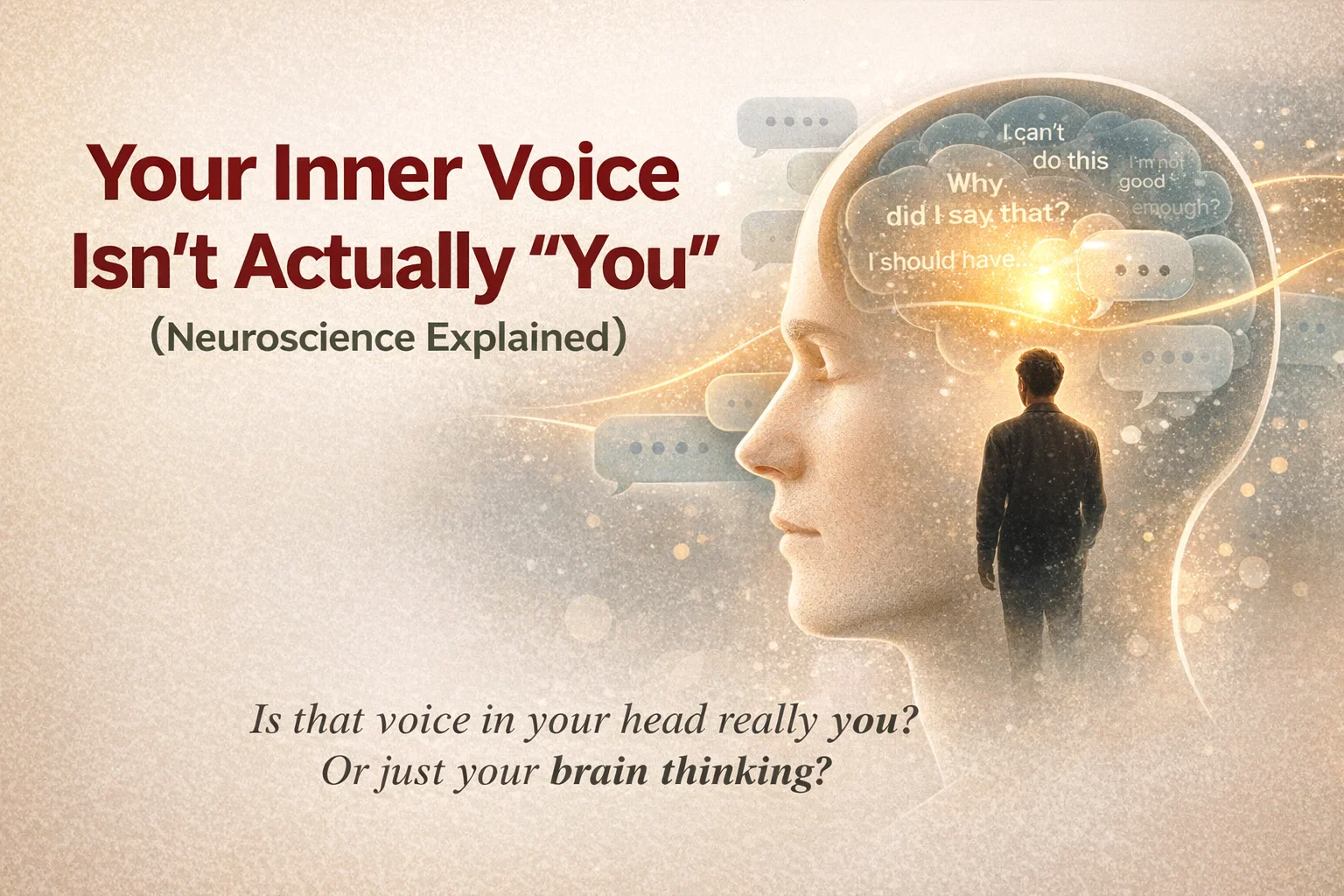
Have you ever had one of those days where your internal monologue just won’t quit? Maybe it is a nagging reminder of a mistake you made three years ago, or perhaps it is a sudden wave of anxiety about a meeting that hasn’t even happened yet. For most of us, that voice in our head feels like the core of who we are. We call it our soul, our identity, or our true self. However, modern neuroscience is beginning to pull back the curtain on a startling truth: that inner voice isn’t actually you. It is a biological process, a sophisticated piece of software running on the hardware of your brain, designed to help you navigate the world, not to define your existence.
Understanding this distinction is one of the most liberating shifts you can make in your mental health journey. When you realize that you are the observer of the thoughts rather than the thoughts themselves, the power that negative self talk holds over you begins to evaporate. In this deep dive, we are going to explore the mechanics of the mind, the evolutionary reasons why our brains won’t stop talking, and how you can step back into the role of the silent observer to find lasting peace.
The Biological Machinery of Inner Speech
To understand why the voice in your head isn’t your soul, we have to look at the physical structures responsible for generating it. Inner speech is primarily a function of the brain’s language centers, specifically Broca’s area and Wernicke’s area. These are the same regions used when you speak out loud or listen to someone else talk. When you think in words, your brain is essentially performing a “silent” version of external communication.
The Default Mode Network
One of the most significant discoveries in recent neuroscience is the Default Mode Network or DMN. This is a large scale network of interacting brain regions that becomes active when you aren’t focused on the outside world. When you are daydreaming, reflecting on the past, or worrying about the future, your DMN is firing on all cylinders. This network is heavily involved in self referential thought. It is the engine that generates the “I” and “me” stories we tell ourselves. By identifying this network, scientists have proven that the sense of a continuous “narrator” is simply a specific mode of brain operation rather than an ethereal spirit.
Language as a Tool for Control
Why did we evolve to have this constant chatter? The brain narrates to create control. By turning abstract feelings and sensory data into concrete language, the brain can better predict and organize experience. If you can name a threat, you can plan for it. If you can narrate a sequence of events, you can learn from them. The voice is a survival mechanism designed to keep you safe by analyzing every possible variable of your life. The problem arises when we forget that this narrator is just a specialized tool and start believing it is the boss.
Why Your Thoughts Appear Automatically
One of the biggest misconceptions about the mind is that we are the conscious authors of our thoughts. If you sit quietly for five minutes and try not to think, you will quickly realize that thoughts appear unbidden. They bubble up from the subconscious like bubbles in a carbonated drink. You don’t consciously manufacture most of them; they are the result of your brain processing data in the background.
The Myth of Conscious Creation
Research suggests that many of our decisions and thoughts are formulated in the brain seconds before we even become aware of them. This means the “voice” is often just reporting on work that has already been done by the subconscious. When the voice says “I think I’ll have coffee,” it is often just announcing a physiological state that was already present. Realizing that thoughts are automatic takes the pressure off. You wouldn’t blame yourself for a sneeze, so why blame yourself for a random intrusive thought?
The Role of Conditioning and Past Experience
The tone and content of your inner voice are not random. They are shaped by years of conditioning. Your past experiences, the way your parents spoke to you, the societal pressures you face, and your deepest fears all act as filters for your internal monologue. If you grew up in a hyper critical environment, your inner narrator will likely be hyper critical. This isn’t because you are fundamentally flawed; it is because your brain’s “prediction software” has been programmed to look for flaws as a way to avoid pain. The voice reflects your history, not your current potential.
The Observer vs. The Commentary
If the voice isn’t you, then who are you? The answer lies in the concept of awareness. In many psychological and meditative traditions, this is referred to as the “Observer” or “The Silent Witness.” Awareness is the space in which thoughts appear. It is the screen upon which the movie of your life is projected. If you can observe a thought, you cannot be that thought. The very act of noticing a feeling proves that there is a “you” that exists independently of that feeling.
The Freedom of Detachment
When you shift your identity from the commentary to the observer, your relationship with your mind changes fundamentally. Instead of being swept away by a wave of anger, you can say “I notice there is a feeling of anger arising.” This small linguistic shift creates a massive psychological distance. You are no longer the victim of the neural narration; you are the one watching the show. This detachment allows you to choose which thoughts to engage with and which ones to let float away.
Neural Narration vs. Truth
Just because your brain says something doesn’t make it true. The brain is often a “clumsy” narrator. It uses cognitive biases, exaggerations, and emotional reasoning to get your attention. It might tell you that “everyone hates you” because one person didn’t smile at you. Recognizing this as “neural narration” allows you to fact check your own mind. You can ask: Is this the truth, or is this just my brain trying to protect me from social rejection using a very loud alarm?
Practical Techniques to Silence the Critic
Knowing the neuroscience is great, but how do we actually apply this in the heat of the moment? There are several practical tools you can use to remind yourself that you are the observer.
- Labeling Your Thoughts: When you catch a negative thought, label it. Say “That is a ‘not good enough’ thought” or “That is a ‘worrying about money’ thought.” Labeling activates the logical part of your brain and cools down the emotional center.
- The Third Person Perspective: Try talking to yourself in the third person. Instead of saying “I am stressed,” say “John is feeling stressed right now.” This simple shift reinforces the observer role.
- The “Five Senses” Grounding: When the inner voice gets too loud, drop into your body. Identify five things you can see, four you can touch, three you can hear, two you can smell, and one you can taste. This pulls resources away from the Default Mode Network and back into the present moment.
Transforming Your Mindset Through Science
The goal of understanding your inner voice isn’t to stop it entirely. You couldn’t do that even if you wanted to! The goal is to change your relationship with it. When you stop taking the voice so seriously, it loses its ability to dictate your mood and your actions. You begin to see your thoughts as “mental events” rather than “personal truths.”
Building New Neural Pathways
The brain is plastic, meaning it can change over time. Every time you consciously choose to observe a thought rather than reacting to it, you are strengthening the neural pathways associated with mindfulness and weakening the grip of the Default Mode Network. Over time, the narrator becomes less of a dictator and more of a background advisor. You might still hear the criticism, but it will sound like a radio playing in another room rather than a megaphone in your ear.
The Power of Self Compassion
Once you realize the voice is a product of conditioning, it becomes much easier to practice self compassion. You can look at your inner critic with a sense of curiosity and even kindness. You can say “Ah, there’s my brain trying to protect me by worrying again. Thanks for the input, but I’ve got this.” This approach turns internal conflict into internal cooperation.
Conclusion: Living as the Observer
Your inner voice is a fascinating, complex, and sometimes frustrating byproduct of being a human with a highly evolved brain. It is a storyteller, a predictor, and a commentator. But it is not your soul, and it is certainly not the final authority on who you are or what you are worth. The “you” that matters is the one who is reading these words right now, the one who can step back and watch the thoughts pass by like clouds in a vast sky.
The next time your inner voice starts to spiral into criticism or fear, take a deep breath and remember the neuroscience. Remind yourself that what you are hearing is just neural narration, a biological process doing its best to keep you safe in a complicated world. Stand in your power as the observer. You are the space, the awareness, and the peace that remains when the commentary finally fades into the background. Embrace the silence, trust your awareness, and let your brain do the talking while you do the living.