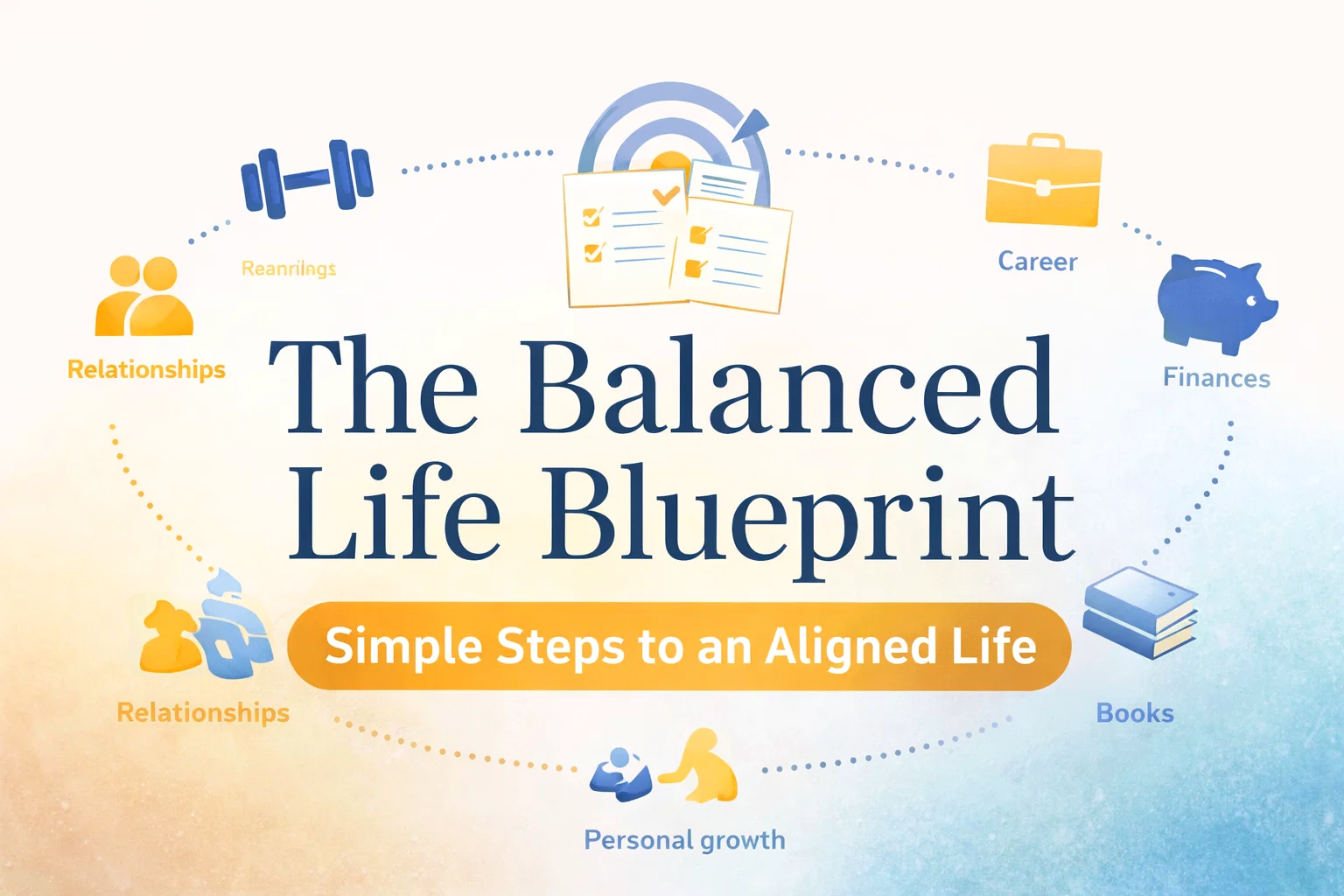
How to Design a Balanced Life Simple Blueprint for Clarity, Habits Better Boundaries
We all have those moments where life feels like a giant, tangled knot. You are working hard, checking off your to-do list, and showing up for everyone else, yet you still feel a persistent sense of misalignment. It is that heavy feeling of being overwhelmed without necessarily being productive. The truth is that a balanced life does not happen by accident; it is designed. Moving from a state of chaos to a state of clarity requires a roadmap that prioritizes your peace over your pace. By implementing a structured blueprint for balance, you can stop reacting to the world and start responding to your own needs with intention.
The Power of the Life Audit
Before you can change where you are going, you have to be brutally honest about where you are standing. Most of us go through our days on autopilot, ignoring the subtle signs of burnout until they become impossible to overlook. A life audit is a diagnostic tool that brings your current reality into sharp focus. It is not about judgment; it is about data collection.
Rating Your Core Pillars
To begin your audit, take a look at the different segments of your existence. Rate each of the following areas on a scale of one to ten. Be honest with yourself. If your physical health is a four but your career is a nine, that gap is exactly where your stress is hiding. Consider these categories:
- Physical Health: Your energy levels, sleep quality, and how you fuel your body.
- Mental Health: Your internal monologue and your ability to manage stress.
- Finances: Your relationship with money and your level of security.
- Relationships: The depth and quality of your connections with others.
- Environment: The physical space you live and work in every day.
- Personal Growth: Your commitment to learning and evolving.
Once you have these numbers in front of you, the path forward becomes much clearer. You cannot fix what you do not measure, and these ratings serve as the baseline for your transformation.
Identifying and Plugging Your Energy Leaks
Balance is rarely about doing more things; it is almost always about fixing what is misaligned. Think of your energy like a bucket of water. You can keep pouring more water in, but if the bucket is full of holes, you will always end up empty. These holes are your energy leaks.
Recognizing the Signs of Overgiving
Where are you overextending yourself? Many high achievers fall into the trap of overgiving because they equate their worth with their utility to others. If you feel resentful after saying yes to a request, that is a massive energy leak. Ask yourself what you are currently avoiding. Often, the things we avoid are the very things that drain our mental energy the most because they sit in the back of our minds, taking up valuable bandwidth.
Clearing the Chaos
Chaos is a choice that we often make unconsciously. It shows up in a cluttered desk, a packed calendar with no breathing room, or a lack of clear boundaries. By identifying what feels chaotic in your weekly routine, you can begin to implement systems that provide structure. This might mean automating a task, delegating a responsibility, or simply deciding that certain things are no longer your problem to solve.
Choosing Your Three Core Priorities
The fastest way to fail at personal growth is to try to change everything at once. This leads to “improvement fatigue,” where you start ten different habits and quit all of them by week three. Depth is always better than overwhelm. For the next thirty days, you must give yourself permission to ignore almost everything else and focus on just three core areas.
Why Three is the Magic Number
Limiting your focus to three priorities allows you to actually move the needle. If you choose health, finances, and personal growth, every decision you make for the next month should be filtered through those three lenses. This creates a sense of momentum. When you see real progress in a few specific areas, it builds the confidence you need to tackle the rest of your list later.
Shifting from Goals to Daily Standards
Goals are about the future, but standards are about right now. A goal is an outcome you hope to achieve, whereas a standard is a behavior you refuse to compromise on. If your goal is to feel better, that is too vague to be actionable. If your standard is that you sleep before 11 PM and move your body four times a week, you have a clear blueprint for success.
Creating Non-Negotiable Behaviors
Your life is a reflection of your standards, not your dreams. When you raise your standards, your life naturally follows. This means deciding what kind of person you are on a daily basis. Are you the person who honors their workout schedule? Are you the person who checks their bank account every Friday? Transitioning your mindset from “I want to” to “I do” is the key to permanent change.
Building Ritual Anchors for Consistency
Motivation is a feeling, and feelings are unreliable. Rituals, on the other hand, are functional. A ritual anchor is a small, consistent action that you attach to your priorities. These anchors act as the glue that holds your balanced life together when things get busy.
Examples of Effective Anchors
- The Sunday Meal Prep: Anchoring your health priority by preparing nutritious food for the week ahead.
- The Friday Money Check-In: Anchoring your financial priority by reviewing your spending and savings once a week.
- The Morning Reading Ritual: Anchoring your growth priority by spending ten minutes with a book before checking your phone.
These rituals do not have to be hour-long ordeals. In fact, the smaller they are, the more likely you are to stick with them. The goal is to make these actions so automatic that they require zero willpower to execute.
The Art of Protecting Your Energy
You cannot have a balanced life without firm boundaries. People who seem to have it all together are usually just people who are very good at saying no. Protecting your energy is a radical act of self-care that allows you to show up fully for the things that actually matter.
Learning to Say No Faster
The longer you take to say no, the more energy you waste agonizing over it. Practice saying no without offering a long-winded explanation. “I can’t commit to that right now” is a complete sentence. By saying no to the things that don’t align with your three core priorities, you are saying a giant yes to your own well-being.
Reducing Digital Noise
Our phones are the biggest source of energy leaks in the modern world. Constant notifications, social media scrolling, and the pressure to be “always on” create a baseline of low-level anxiety. Set boundaries with your technology. This could look like a “no phones at the dinner table” rule or turning off all non-essential notifications. Creating digital space allows your mind to rest and recharge properly.
Monthly Reviews and Adjustments
The Balanced Life Blueprint is not a set-it-and-forget-it system. It is a living document that requires regular maintenance. Life changes, and your priorities will need to shift along with it. A monthly review is your chance to look back at the last four weeks and see what worked and what slipped.
Reflective Questions for Success
At the end of every month, sit down and ask yourself three questions. What improved? What slipped? What needs my attention right now? This practice prevents small slips from turning into total collapses. If you noticed that your health ritual started to fade, you can adjust your strategy for the coming month without feeling like a failure. It is all about course correction.
Embracing the Journey Toward Alignment
True balance is not about perfection. You will have weeks where everything feels seamless and weeks where you feel like you are barely holding it together. The goal is to have a framework to return to when things get off track. By auditing your life, plugging your energy leaks, and setting high daily standards, you are building a foundation that can weather any storm.
Remember that you are the architect of your own experience. You have the power to decide what gets your time, what gets your attention, and what gets your energy. Start small, stay consistent, and watch as your life begins to feel more aligned, more purposeful, and infinitely more joyful. You deserve a life that feels as good on the inside as it looks on the outside. It is time to stop settling for overwhelm and start living your blueprint.