Antique Palmistry Book 1897 Fortune Telling Palm Reading Guide Digital Instant Download
Have you ever looked at your hands and wondered if the shape of your fingers or the lines on your palm held a deeper meaning? The art of palmistry, or chiromancy, has fascinated humanity for centuries. It is a practice that bridges the gap between the physical and the metaphysical, suggesting that our character and destiny are etched into our very skin. Today, we are diving deep into a remarkable piece of history: a 1897 guide to palmistry that breaks down the subtle nuances of finger shapes and joints. This antique wisdom offers a unique perspective on personality that feels just as relevant in our modern world as it did in the Victorian era.
The Evolution of Palmistry: From Ancient Roots to the 19th Century
While palmistry is often associated with traveling carnivals or mystical parlors, its origins are deeply academic and ancient. Roots of the practice can be traced back to Hindu astrology in India and later to the great philosophers of Greece. By the time we reached the late 1800s, palmistry had undergone a massive revival in Europe and America. It was no longer seen merely as “fortune telling” but as a form of character analysis. The 1897 text we are exploring reflects this shift toward a more structured, almost scientific approach to reading the hand.
During this period, palmists began to focus heavily on the topography of the hand. They believed that the mounts, lines, and even the curvature of the fingertips could reveal a person’s temperament, career potential, and emotional health. This specific era of literature is prized by collectors today because it combines beautiful, hand drawn illustrations with dense, philosophical explanations that challenge the reader to look beyond the surface.
Decoding Finger Shapes: Square vs. Pointed Tips
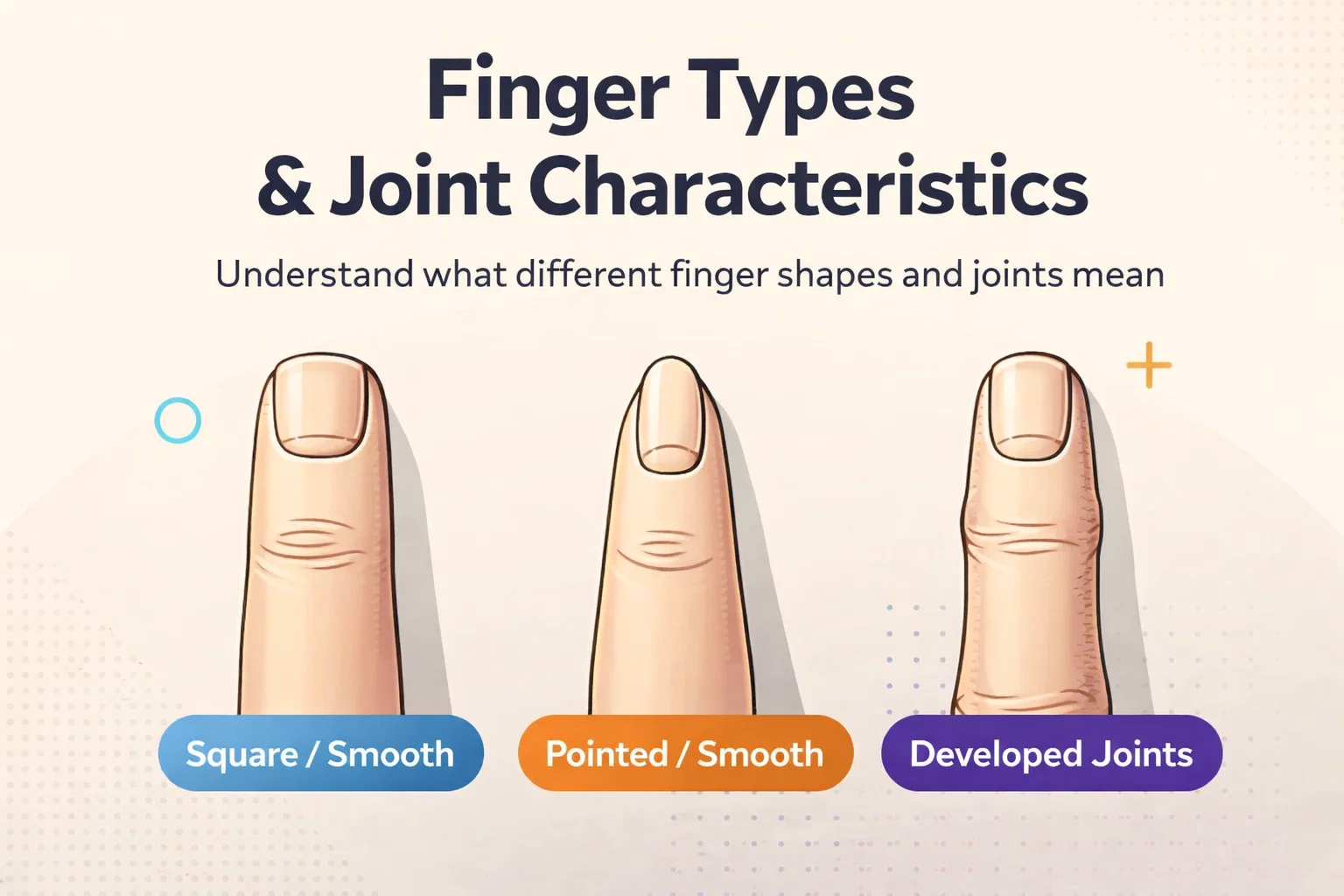
One of the most fascinating sections of this 1897 guide focuses on the “termination” of the fingers. According to the diagrams, the shape of your fingertip acts as a filter for how you process energy and ideas. If you look at the first two illustrations in the plate, you see a clear distinction between the square tip and the pointed tip.
The Practicality of the Square Finger
The square finger, labeled as “Square with Smooth Joints,” represents the ultimate realist. In the world of palmistry, square tips are synonymous with order, regularity, and conventionality. These individuals are the backbone of society. They value logic over intuition and prefer to have a clear plan before taking action. If your fingers end in a blunt, square shape, you likely have a natural talent for organization and a deep respect for authority and tradition. You are the person friends turn to when they need a grounded perspective.
The Intuition of the Pointed Finger
Contrast this with the “Pointed with Smooth Joints” illustration. These fingers taper elegantly toward the nail, signifying a highly sensitive and artistic nature. This shape is often referred to as the “Psychic” or “Idealistic” finger. Those with pointed tips are guided by their emotions and sudden flashes of insight rather than cold hard facts. They are often drawn to the arts, spirituality, and anything that touches the soul. While they may struggle with the mundane details of daily life, their ability to envision a more beautiful world is their greatest gift.
The Mystery of the Joints: Smooth vs. Developed
The image also highlights a crucial detail that many modern palm readers overlook: the knots or joints of the fingers. The text distinguishes between “Smooth Joints” and “Developed Joints,” and the difference in meaning is profound.
Smooth joints, as seen in the first two examples, suggest a mind where ideas flow quickly and unimpeded. These people are impulsive and quick-witted. They don’t spend hours agonizing over a decision; they feel the right path and take it. They are “spontaneous” thinkers who rely on their first impressions.
On the other hand, the third illustration shows “Developed Joints.” These are the bony, prominent knots that give the finger a more rugged appearance. In 1897 palmistry, these were called “Philosophical Joints.” They act as “speed bumps” for thought. A person with developed joints doesn’t take anything at face value. They analyze, they deconstruct, and they doubt until they have found the absolute truth. This is the hand of the scientist, the researcher, and the deep thinker who values reason above all else.
How to Read Finger Combinations in Your Own Hand
It is rare to find a hand where every finger is identical. Most of us are a “mixed” type, which makes the reading even more interesting. To begin your own analysis using this 1897 method, follow these simple steps:
- Check the Index Finger: This finger relates to ambition and ego. A square tip here suggests a practical approach to leadership, while a pointed tip might indicate a more visionary or spiritual type of influence.
- Look at the Middle Finger: Known as the finger of Saturn, this represents your sense of duty. Developed joints here are very common in people who take their responsibilities very seriously.
- Examine the Ring Finger: This is the finger of Apollo, linked to creativity. A pointed tip on this finger is a classic sign of someone with a natural flair for the aesthetic.
- The Pinky Finger: This relates to communication. If your pinky is square and smooth, you are likely a direct, honest communicator who gets straight to the point.
The Value of Victorian Digital Books for Modern Enthusiasts
You might wonder why a book from 1897 is still so valuable today. The answer lies in the depth of the material. Modern palmistry books are often “watered down” for a quick read, but these antique texts go into exhaustive detail about the psychological implications of every tiny line. By accessing a digital version of these original works, you are getting the source material that helped shape the modern New Age movement.
Furthermore, the aesthetic value cannot be overstated. The hand-drawn plates, like Plate iX shown above, are works of art in their own right. They make wonderful additions to digital scrapbooks, junk journals, or even framed art for a home office. They carry an energy of mystery and history that modern computer-generated graphics simply cannot replicate.
Why Palmistry Still Matters
In our high-tech, digital world, why do we still care about the shape of our fingers? Perhaps it is because palmistry offers a moment of self-reflection. It encourages us to put down our phones and look at our own hands, connecting us to our physical selves and our ancestral history. Whether you believe that the lines are a map of your soul or simply a result of how you use your hands, the process of reading them is a form of meditation.
Learning from an 1897 guide allows you to participate in a tradition that has survived for millennia. It reminds us that humans have always sought to understand themselves and their place in the universe. By studying the square tips of the pragmatist or the developed joints of the philosopher, we gain empathy for the different ways people process the world around them.
Conclusion: Your Journey Into the Mystic
The 1897 Palmistry Book is more than just a collection of drawings; it is a gateway to a different way of seeing. By understanding the language of the hand, you unlock a new tool for self-discovery and a deeper appreciation for the vintage wisdom of the past. Whether you are downloading this guide to start a new hobby or to add a touch of Victorian mystery to your collection, you are keeping an ancient art alive.
Take a look at your own joints and tips today. Are you a practical “Square” or an idealistic “Pointed” type? Does your mind flow smoothly, or do your philosophical knots make you stop and think? The answers are literally at your fingertips. Embrace the history, enjoy the process, and let the secrets of your palms unfold.
Would you like me to analyze a different plate from this book or perhaps explain the meaning of the specific lines on the palm next?