7 Non-Negotiables for Protecting Your Peace Mental Health Setting Healthy Boundaries
In a world that constantly demands our attention, energy, and time, finding a sense of inner calm can feel like an uphill battle. We are often taught that being available to everyone and saying yes to every request is a sign of productivity or kindness. However, the reality is that without firm boundaries, we quickly become depleted, anxious, and disconnected from our true selves. Protecting your peace is not a luxury; it is a fundamental necessity for maintaining your mental health and emotional well-being.
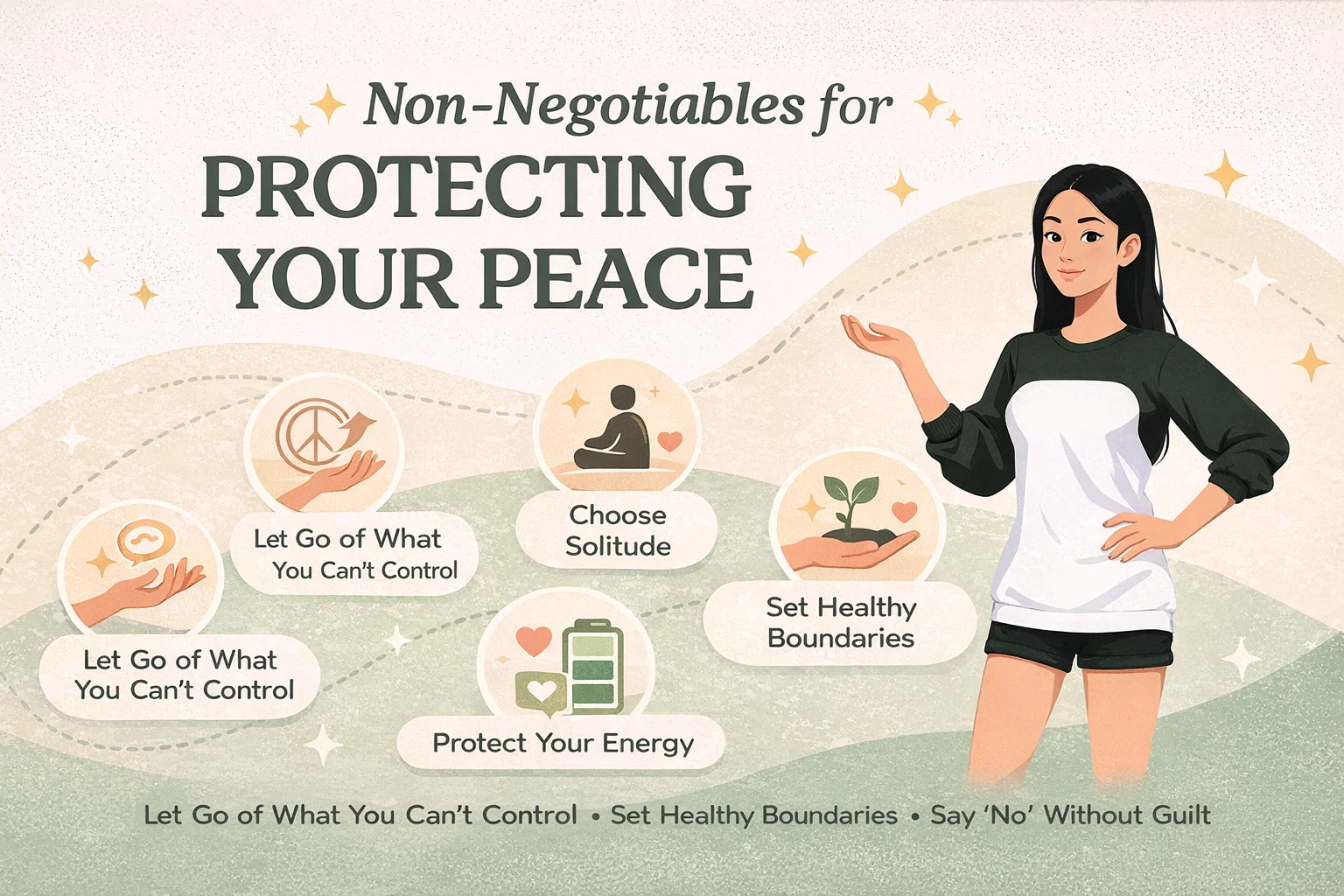
The image we are looking at today highlights several non-negotiables for protecting your peace. These are not just suggestions; they are foundational pillars that allow you to navigate life with intention and clarity. By adopting these mindset shifts, you move from a state of constant reaction to a state of conscious action. Let us dive deep into how these seven principles can transform your daily life and help you build a sanctuary within yourself.
Understanding the Power of Letting Go
One of the heaviest burdens we carry is the desire to control things that are simply beyond our reach. Whether it is the weather, the opinions of others, or the outcome of a global event, fixating on these external factors leads to chronic stress. The first step toward inner peace is the conscious decision to let go of what is out of your control. This does not mean you stop caring; it means you stop allowing these factors to dictate your internal state.
Focusing on Your Circle of Influence
Psychologists often talk about the circle of concern versus the circle of influence. When you spend your mental energy on things you cannot change, your circle of influence actually shrinks because you are too exhausted to manage your own life. When you focus on your own reactions, your habits, and your boundaries, you reclaim your power. Letting go is an act of trust in yourself and the process of life.
The Right to Filter Your Social Circle
The phrase not everyone deserves access to me might sound harsh at first, but it is a vital realization for anyone seeking emotional stability. Your energy is a finite resource. If you allow people who are toxic, manipulative, or constantly negative to have a front-row seat in your life, your peace will always be at risk. You have the right to be selective about who you spend time with and who you share your inner thoughts with.
Setting Digital and Physical Boundaries
In the digital age, access to you is easier than ever. Between social media tags, direct messages, and instant notifications, people can reach you 24/7. Protecting your peace means setting digital boundaries as well. You do not have to reply to every text immediately. You do not have to stay in group chats that make you feel anxious. By filtering your social circle, you create space for people who actually nourish your soul and support your growth.
Choosing Solitude Over Forced Connections
There is a massive difference between being lonely and being alone. Loneliness is a feeling of lack, while solitude is a state of fullness. Many of us stay in unfulfilling friendships or attend social events we dread simply because we fear the silence of being alone. However, forced connections are incredibly draining. They require you to wear a mask and perform a version of yourself that is not authentic.
The Benefits of Intentional Solitude
When you choose solitude over forced connections, you give yourself the gift of reflection. It is in these quiet moments that you can hear your own thoughts and rediscover your passions. Solitude allows you to recharge your social battery so that when you do engage with others, you are doing so from a place of genuine desire rather than obligation. It is better to be alone and at peace than to be in a room full of people and feel completely misunderstood.
The Necessity of Personal Growth
Growth is often uncomfortable, not just for you but for the people around you. As you evolve, you might start setting new boundaries, changing your habits, or speaking your truth more clearly. This shift can sometimes upset the status quo in your relationships. Some people may prefer the old version of you because that version was easier to manage or more predictable. However, you must allow yourself to grow even if it makes others uncomfortable.
Managing the Guilt of Evolution
It is common to feel a sense of guilt when your growth causes friction with friends or family. You might feel like you are being selfish or difficult. But remember: those who truly love you will celebrate your evolution, even if they have to adjust to the new boundaries you set. If someone tries to shame you for improving your life, it is a sign that their comfort was dependent on your stagnation. Keep moving forward anyway.
Recognizing Draining Spaces
Our environments have a profound impact on our nervous systems. Some spaces feel light, creative, and welcoming, while others feel heavy and suffocating. Protecting your peace involves the awareness to recognize when a space is no longer serving you. This could be a workplace, a specific social club, or even a certain room in your house. If a space consistently leaves you feeling drained, it is time to remove yourself from it.
Listening to Your Bodily Cues
Your body often knows you are in a draining space before your mind does. Pay attention to physical signs like a tight chest, a clenched jaw, or a sudden drop in energy levels. These are signals from your intuition telling you that your peace is being compromised. Removing yourself is not an act of weakness; it is an act of self-preservation. You cannot pour from an empty cup, and you cannot thrive in an environment that is constantly leaking your energy.
The Art of Saying No Without Explanation
For many of us, the word no is followed by a long paragraph of excuses. We feel the need to justify why we cannot attend an event or take on a new project. This over-explaining comes from a place of people-pleasing and a fear of being perceived as unkind. But no is a complete sentence. You do not owe anyone an elaborate story about your schedule or your mental state.
Practicing the Simple No
Start small by saying no to low-stakes requests without adding a because. You will find that most people accept a simple no with much less drama than you anticipated. Over-explaining actually gives people an opening to negotiate with your boundaries. When you provide a reason, they might try to solve the problem for you so that you can still say yes. By keeping it simple, you maintain control over your time and energy.
Investing Your Emotional Energy Wisely
Energy is the currency of your life. Every time you get into an argument on the internet, worry about a minor mistake, or obsess over someone else’s life, you are spending that currency. Protecting your peace means becoming a stingy investor with your emotional energy. You must save it for the things that actually matter: your health, your family, your career, and your personal joy.
Prioritizing What Truly Matters
Ask yourself daily: is this worth my peace? If the answer is no, then it is not worth your emotional investment. When you stop leaking energy into trivial matters, you suddenly find you have an abundance of vitality for the things that bring you fulfillment. This shift in focus is the ultimate key to a peaceful life. It is about being intentional with your heart and your mind every single day.
Building Your Personal Peace Plan
Knowing these non-negotiables is the first step, but implementing them requires a plan. You cannot change your life overnight, but you can start making small, consistent choices that prioritize your well-being. Start by identifying which of these seven areas is currently causing you the most stress. Is it a lack of boundaries? Is it a draining environment? Focus on that one area first.
Creating Daily Rituals
Incorporate small rituals that reinforce your peace. This might mean five minutes of silence in the morning before checking your phone, or a evening walk to clear your head. These rituals act as anchors, keeping you grounded even when the world around you is chaotic. The more you practice these non-negotiables, the more natural they will become. Eventually, protecting your peace will not feel like a chore; it will be your default way of living.
Conclusion: The Journey to a Peaceful Life
Protecting your peace is an ongoing journey, not a destination. There will be days when your boundaries are tested and days when you find yourself worrying about things you cannot control. That is okay. The goal is not perfection; it is awareness and a commitment to your own health. By letting go of control, filtering your circle, and learning the power of no, you are building a life that honors your true self.
Remember that you are the architect of your own atmosphere. You have the power to decide what stays and what goes. Do not apologize for prioritizing your mental health. In the end, a peaceful mind is the greatest wealth you can possess. Start today by choosing one non-negotiable and standing firm in it. Your future self will thank you for the boundaries you set today.