7 Psychological Skills to Become Unmanipulatable How to Set Boundaries and Stay in Control
Have you ever walked away from a conversation feeling slightly hollow, as if you were steered into a decision you didn’t actually want to make? Or perhaps you have felt the heavy weight of guilt after saying no to someone who constantly takes without giving back. Manipulation is often subtle, appearing as a helpful suggestion, a charming smile, or a strategic silence. However, the true power in any social dynamic does not belong to the loudest voice or the smoothest talker. It belongs to the person who has mastered their own psychological landscape. Understanding the mechanics of influence is not about becoming a cynic; it is about building a fortress around your mental peace so that your choices remain entirely your own.
The Foundation of Emotional Autonomy
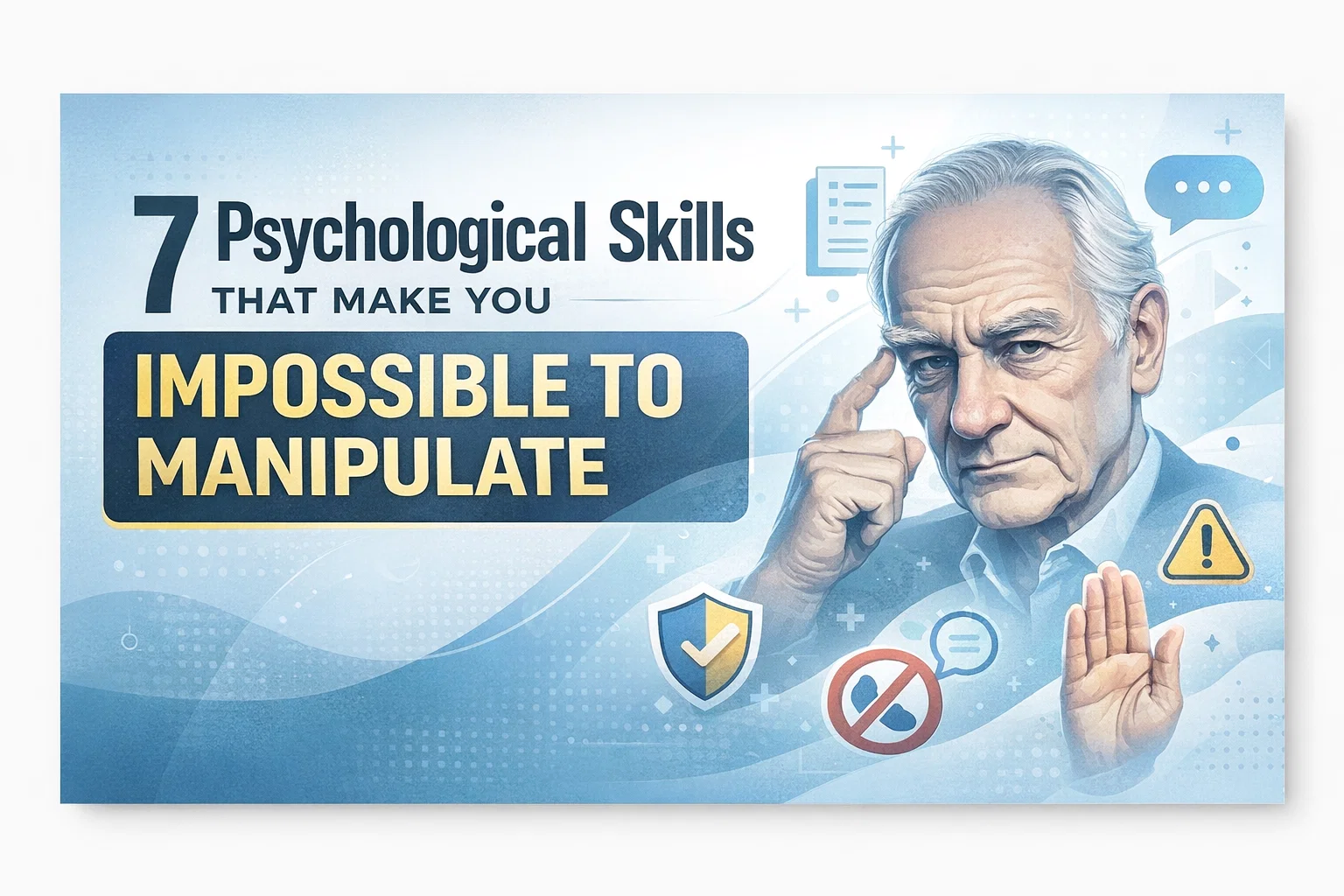
At the heart of every manipulative tactic is the desire to trigger a specific reaction. If a person can predict how you will react to guilt, anger, or praise, they can effectively pull the strings of your behavior. Developing psychological resilience starts with the realization that your internal world is your private property. When you take the time to analyze the viral infographic floating around social media regarding these 7 skills, you realize they aren’t just tricks. They are fundamental shifts in how you perceive your value in relation to the world around you.
Most of us are conditioned from a young age to be agreeable. We are taught that being “nice” is the ultimate social currency. While kindness is a virtue, it becomes a vulnerability when it lacks boundaries. To become truly impossible to manipulate, you must transition from a reactive state of being to a proactive one. This means moving away from the need for external validation and toward a sturdy sense of self-governance.
1. Controlling Your Reactions: The Art of the Pause
The first and perhaps most vital skill is the ability to manage your emotional output. Manipulators thrive on high-intensity emotions. Whether they are trying to make you feel panicked, defensive, or overly excited, they are looking for a crack in your armor. When you react impulsively, you provide them with a roadmap of your insecurities.
Why Management Trumps Suppression
It is a common misconception that controlling your reactions means having no feelings at all. In reality, it is about the “pause” between a stimulus and your response. By managing your emotions, you deny the other person the satisfaction of a predictable outcome. If someone insults you to get a rise out of you and you respond with calm, clinical observation, their power evaporates instantly. You are essentially telling them that their tools are blunt and ineffective against your composure.
2. The Strategic Use of Silence
Silence is one of the most underutilized tools in human communication. In a world that values constant noise and instant replies, silence can feel incredibly uncomfortable. Manipulators often use this discomfort to their advantage, pausing after a request to see if you will rush in to fill the void with concessions or explanations.
Making Space for Truth
When you get comfortable with silence, the dynamic shifts. If a person asks you for a favor that makes you uncomfortable, simply stating “I will have to think about that” and then remaining silent forces them to sit with their own request. Weak minds often rush to fill the space because they fear what the silence says about them. By holding your ground, you signal that you are not easily rattled and that you are thinking critically rather than reacting socially.
3. Ending the Cycle of Over-Explaining
Have you ever noticed that the more you try to justify your decisions, the more the other person finds ways to poke holes in them? Over-explaining is a hallmark of people-pleasing behavior. It stems from a subconscious belief that you need the other person’s permission to hold your own opinion. However, in the hands of a manipulator, your explanations are simply “material” they can twist to suit their narrative.
Keep Your Reasons Private
A simple “No, that doesn’t work for me” is a complete sentence. You do not owe anyone a detailed itinerary of your life or an itemized list of why you are making a specific choice. The less you say, the less there is for someone else to misinterpret or use against you. Maintaining a level of healthy mystery regarding your motives ensures that your boundaries remain firm and unyielding.
4. Saying No Without the Weight of Guilt
Guilt is the primary weapon of the emotional manipulator. They rely on your internal desire to be seen as a “good person” to nudge you into compliance. Setting boundaries is often painted as an act of aggression by those who benefit from your lack of them. In reality, a boundary is simply a map that shows others where your property begins and ends.
Boundaries as Self-Care
Learning to say no without guilt requires a rewrite of your internal software. You must understand that your time, energy, and mental health are finite resources. Every time you say “yes” to something you don’t want to do, you are saying “no” to your own well-being. People who truly care about you will respect your boundaries. Those who get angry or try to guilt-trip you are the very people the boundaries were designed to keep at a distance.
5. Observing Patterns over Words
Charm is easy to manufacture. Words are cheap. A person can tell you exactly what you want to hear while their actions move in the complete opposite direction. This is often called “future faking” or “love bombing” in toxic dynamics. To protect yourself, you must become a student of behavior rather than a listener of rhetoric.
The Consistency Test
If someone claims to value honesty but consistently withholds information, believe their actions. If someone says they respect you but constantly interrupts or dismisses your ideas, believe their actions. Intentions are often quiet and hidden behind a wall of loud, charming words. By focusing on the recurring patterns of a person’s behavior over months rather than their promises over minutes, you gain a much clearer picture of who they actually are.
6. Detaching from the Need for Approval
The need to be liked is the easiest leash to pull. If a manipulator knows that you crave their validation, they can control you simply by withholding it. They might give you the cold shoulder or offer backhanded compliments to keep you “performing” for their favor. This creates a cycle of dependency where your self-worth is tied to their fluctuating opinions.
Building Inner Validation
Detaching from approval does not mean becoming a hermit or being rude. It means moving the source of your validation from the outside to the inside. When you are confident in your own values and your own integrity, the opinions of others become “interesting data” rather than “absolute truth.” When you no longer care if someone finds you difficult or disagreeable for standing your ground, you become truly unhackable.
7. The Ultimate Power: The Willingness to Walk Away
In any negotiation, the person who is most willing to leave the table holds the most power. This applies to business deals, friendships, and romantic relationships alike. Manipulation only works if the manipulator believes you are too afraid of the alternative to leave. They rely on your fear of loneliness, failure, or conflict to keep you tethered to a situation that doesn’t serve you.
The Strength of Exit Strategy
Being willing to walk away is the ultimate safety net. It means you have done the hard work of building a life you enjoy regardless of who is in it. When you signal that you are perfectly capable of walking away from a toxic or manipulative dynamic, you change the rules of the game. You are no longer a victim hoping for better treatment; you are a sovereign individual who chooses where to invest their presence.
Cultivating a Mindset of Strength
Becoming impossible to manipulate is not a destination you reach overnight. It is a daily practice of checking in with yourself and reinforcing your psychological walls. It requires you to be honest about your own weaknesses and where you might be prone to falling for certain tactics. However, as you begin to implement these seven skills, you will notice a profound shift in your daily interactions. You will feel lighter, more confident, and significantly more in control of your destiny.
The goal is not to shut the world out, but to ensure that the people you let in are those who respect your autonomy. By controlling your reactions, embracing silence, and being willing to walk away, you create a life built on mutual respect rather than coercion. You deserve to be the primary architect of your own life, free from the subtle pulls of those who would rather see you follow their lead than your own intuition.
Protect your peace, honor your boundaries, and remember that your greatest strength lies in your ability to remain grounded in your own truth, no matter how loud the world gets around you.
Key Takeaways for Daily Life
- Internalize your value: Do not let your self-worth be a fluctuating stock price controlled by others.
- Practice the pause: Give yourself five seconds before responding to any emotionally charged request.
- Watch the feet, not the lips: Always prioritize what people do over what they say.
- Be your own advocate: If you don’t set your boundaries, someone else will set them for you.
The journey toward psychological independence is one of the most rewarding paths you can take. It leads to deeper relationships, more authentic self-expression, and a sense of calm that no manipulator can touch. Start small, stay consistent, and watch as your world transforms into a space where you are the one in charge.