Why Forgiveness Isnt Always the Answer How to Build Radical Acceptance for Real Healing
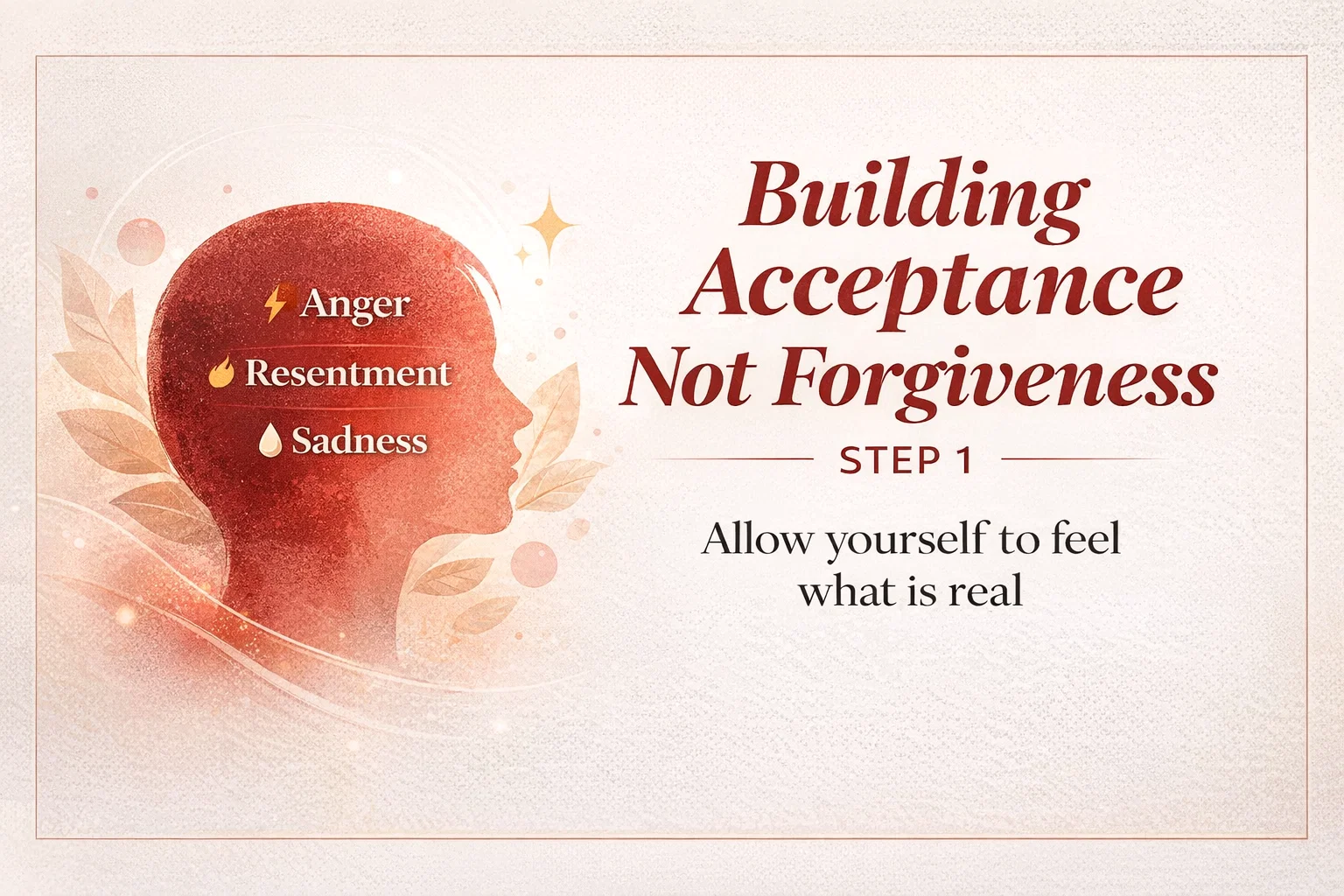
Welcome, fellow travelers on the winding path of personal growth! Are you tired of the generic advice to just forgive and forget as if healing were as simple as flipping a switch? If so, you are not alone, and you are in the right place. The image before us, from ‘Growing Through It,’ powerfully introduces a concept that resonates deeply with anyone struggling to find peace after hurt: ‘Building Acceptance, Not Forgiveness – Step 1.’ This isn’t just a catchy phrase; it’s a radical shift in perspective that honors your true experience. Today, we’re going to peel back the layers of forgiveness and acceptance, exploring why validation is the critical first step to authentic healing. Prepare to challenge the traditional narrative and embrace a process that finally feels honest and empowering.
The Forgiveness Trap: Unpacking the Pressure to Move On
For decades, society has conditioned us to believe that forgiveness is the ultimate peak of emotional intelligence and the essential prerequisite for healing. We’ve all heard it: forgiveness is for yourself, not the other person. While there is truth to this idea in certain contexts, the pressure to forgive can become its own source of pain and stagnation.
Think about the last time someone deeply hurt you. Perhaps a friend betrayed your trust, a partner was unfaithful, or a family member significantly disappointed you. Immediately, the well-meaning chorus begins: “You just need to forgive them,” or “Holding onto anger only hurts you.” The implication is that if you haven’t forgiven, you are holding yourself back, dwelling in negativity, or are somehow less evolved.
But what if you aren’t ready to forgive? What if the hurt is so profound that the very idea of extending forgiveness feels like a violation of your own sense of justice? This is where the forgiveness trap springs. The expectation to forgive before you’ve processed the pain forces you to rush, invalidate your own feelings, and often, to intellectually bypass the necessary emotional work.
The Misunderstanding of Forgiveness
Forgiveness, as typically understood, often gets tangled up with related but distinct concepts like pardoning, condoning, or reconciling. For many, to forgive feels like saying, “It’s okay,” “It wasn’t that bad,” or “I want things to go back to how they were.” It’s no wonder people resist it! Let’s clarify what true forgiveness is not:
- Forgiveness is not condoning: It doesn’t mean approving of or excusing harmful actions. The behavior was still wrong and hurtful.
- Forgiveness is not forgetting: It’s not about erasing the memory of the betrayal. Realistically, some events stick with us forever, and that’s okay.
- Forgiveness is not reconciliation: You can forgive someone without ever having them in your life again. Healing does not require reconciliation.
- Forgiveness is not immediate: It’s not a moment, but a complex, non-linear process that often comes at the end of a healing journey, not the beginning.
When we decouple forgiveness from these other ideas, we see that the push for immediate forgiveness is often premature and counterproductive. True healing, as the image suggests, requires something else entirely before forgiveness even becomes a consideration.
Introducing a Powerful Shift: Why Acceptance is Your Foundation
If forgiveness is a choice (and often a complex, long-term one), what do we do now with the raw, immediate, and potentially long-lasting pain? The image provides a profound answer: “But what you actually need is acceptance.” This single word contains the key to unlocking a healthier, more authentic, and ultimately, more compassionate way of dealing with hurt.
Many people mistake acceptance for resignation or passive compliance, thinking it means being a pushover or agreeing that the situation was acceptable. This couldn’t be further from the truth! Acceptance is not about liking what happened or giving up on yourself; it’s about acknowledging reality without fighting it.
The core concept from the image is that healing begins the moment you stop invalidating your own experience. Acceptance is the powerful, first act of validation. It is the brave choice to look your pain in the eyes and say, “I see you. You are real. I am not okay.” This distinction is absolutely pivotal.
Acceptance as Validation: Honoring Your Experience
The image beautifully articulates what acceptance truly means in practice:
“Acceptance means allowing yourself to feel what is real.” This is the anti-gaslighting prescription you’ve been needing! So often, when we are hurt, we are either explicitly told or implicitly taught to minimize or suppress our feelings. We feel wrong for being angry, dramatic for being sad, or petty for being resentful. We are conditioned to think we shouldn’t feel this way.
Imagine your feelings as guests knocking on your door. Forgiveness might ask you to pretend they aren’t there or to immediately welcome them in and give them tea. Acceptance, however, opens the door wide and says, “Oh, it’s you. I see you’re here. Come on in for a moment.” You are not agreeing with what brought them, but you are acknowledging their existence, and that is fundamentally powerful.
When you validate your own feelings, you stop the internal battle. You allow the natural flow of emotion instead of creating dams that only cause more internal pressure and suffering. You honor the reality of your experience, which is the cornerstone of building self-trust.
“The Anger, The Resentment, The Sadness”: Giving difficult emotions a seat at the table
Now, let’s get specific. Acceptance doesn’t just apply to happy thoughts; its real power lies in its ability to handle our most difficult and unwanted emotions. The image specifically calls them out: “The anger. The resentment. The sadness.”
We live in a culture that often views these “negative” emotions as problems to be fixed. We are taught that anger is scary, resentment is bitter, and sadness is weak. Consequently, when we experience these feelings, we try to get rid of them as quickly as possible, either through avoidance, intellectualizing, or rushing toward forgiveness as a neat and tidy way to sweep them under the rug.
But here’s the thing: these emotions are not defects; they are messengers. They are powerful signals that a boundary was crossed, a need was unmet, or a loss was experienced. Suppressing them is like ignoring the smoke alarm and simply fanning the smoke away, leaving the underlying fire unaddressed.
Why Acceptance is Crucial for “Negative” Emotions
- Honoring Boundaries through Anger: Your anger isn’t “bad.” It is your psyche’s protective response. It is the part of you that knows you deserve better. Accepting your anger allows you to honor your boundaries and acknowledge the injustice done to you. It provides clarity and the fuel for positive action, provided it’s expressed healthily.
- Understanding Hurt through Resentment: Resentment often indicates a persistent sense of unfairness. Accepting resentment isn’t about remaining bitter; it’s about recognizing the unresolved hurt that is still impacting your present. It points you toward what still needs to be healed.
- Processing Loss through Sadness: Sadness is the expression of your connection to what was lost. Accepting sadness allows you to grieve fully and move through the necessary cycles of healing from a profound disappointment or loss.
By giving these “difficult” emotions permission to exist and granting them validity, you strip them of their scary, uncontrollable power. They become less of an overwhelming monster to fight and more like waves to ride. You are no longer controlled by them because you are no longer resisting them.
Stop the Negotiation: Reclaiming Emotional Sovereignty
The next brilliant insight from the image is this: “You stop negotiating with yourself about what is “right” to feel. You stop minimizing what hurt you just because no one acknowledged it.” This speaks to the profound relief and power that comes with radical acceptance.
How much energy have you wasted debating whether your reaction was “appropriate”? How many times have you downplayed your pain because the other person offered a weak apology, or because you thought, “Well, other people have it worse,” or “It was so long ago, I should be over it”? This is the endless internal negotiation – the constant second-guessing of your own internal compass.
The need for external validation can be a massive barrier to healing. We often feel like our pain isn’t “real” or “justified” unless the person who hurt us admits it, or unless our friends and family completely agree. But what if they never do? What if they remain defensive, oblivious, or minimizing? Are you supposed to just exist in a state of unacknowledged suffering? Absolutely not!
The Power of Self-Acknowledgement
Acceptance frees you from this dependence. You reclaim your emotional sovereignty by becoming your own validator. You decide that your hurt is real simply because you feel it. Period. Full stop.
Imagine a world where you never need to justify your feelings to anyone, including yourself. If you are angry, you accept it. If you are sad, you accept it. No negotiation required. This inner confidence is built upon a foundation of deep self-trust and self-compassion. You create a safe internal harbor for your experiences, regardless of what the outside world thinks or says.
By stopping the negotiation, you also stop the damaging cycle of minimizing your own hurt. Downplaying your pain doesn’t make it go away; it just drives it deeper, where it can fester and re-emerge in unhealthy ways. Owning the true magnitude of your experience is not dramatic; it is realistic and the necessary precondition for addressing it head-on.
“You Let the Truth Exist”: Building Your Unshakable Foundation
This point from the image is incredibly profound: “You let the truth exist without trying to rewrite it.” It addresses the core of why acceptance is the true starting point for healing. Before you can build a new future, you must accurately acknowledge the landscape of your past and present.
So much pain comes from the internal resistance to what has happened. We ruminate, asking, “Why did they do that?” or “If only things were different!” We replay events in our minds, hoping for a different outcome, or we intellectually rewrite the story to make it more palatable, less painful, or to make ourselves seem less affected.
This resistance, this attempt to “rewrite the truth” by dwelling on what should have been or what could be, is incredibly draining. It tethers you to the painful event in a loop of suffering. It is a refusal to accept the reality of the present moment.
Building Your House of Healing on Solid Ground
Acceptance isn’t about liking the truth or agreeing with it; it is simply about acknowledging it as fact. It is looking at the history of the event and saying, “This happened. It cannot be undone. And because it happened, I am feeling this way now.”
This acts as a powerful container. When you let the truth exist, you stop allocating energy to rewriting the past or wishing things were different. You are finally able to uncouple your identity and your future from the event because you have clearly defined its boundaries.
Imagine trying to build a new life with bricks made of denial, minimized pain, and wishing. That foundation is shaky, unstable, and will inevitably crumble. Acceptance provides a different kind of brick – a solid, unshakable foundation built from the true, unfiltered reality of your experience. Only upon this honest, solid ground can you truly begin to construct a future that is resilient, authentic, and genuinely healed.
Conclusion: The Radical Path to Real Healing Begins Now
So, there you have it, fellow seekers of authenticity. Today, we’ve unraveled the pressure cooker of the “forgiveness first” mentality and discovered the profound, foundational power of ‘Building Acceptance, Not Forgiveness.’ We’ve explored how acceptance acts as your powerful, internal validator, honoring your right to feel your true feelings without negotiation or minimization. We’ve seen how giving voice to “difficult” emotions is an act of sovereignty, not weakness, and how letting the truth exist provides the only stable ground from which true healing can grow.
Remember, healing is not a performance for anyone else. It is an intimate, inner journey of self-discovery and restoration. Rushing toward forgiveness to look “healed” or “evolved” often only drives the underlying pain deeper. Building acceptance, while perhaps less “pretty” and tidy on the surface, is a much more robust, compassionate, and ultimately, effective process.
This is Step 1. It’s an invitation to a different kind of practice – one of self-compassion, radical honesty, and brave vulnerability. For today, perhaps your work isn’t to forgive someone who hurt you. Perhaps your work is simply to say to yourself, “I am deeply hurt. My pain is real, and that is okay. I accept that this happened and that I feel this way.” Embrace this profound act of self-love, and watch as it creates the space for a much more genuine, resilient, and lasting form of healing to take root in your life. The path of acceptance may not be the easiest, but it is undoubtedly the path to truth, and therein lies the key to true freedom. You’ve got this!