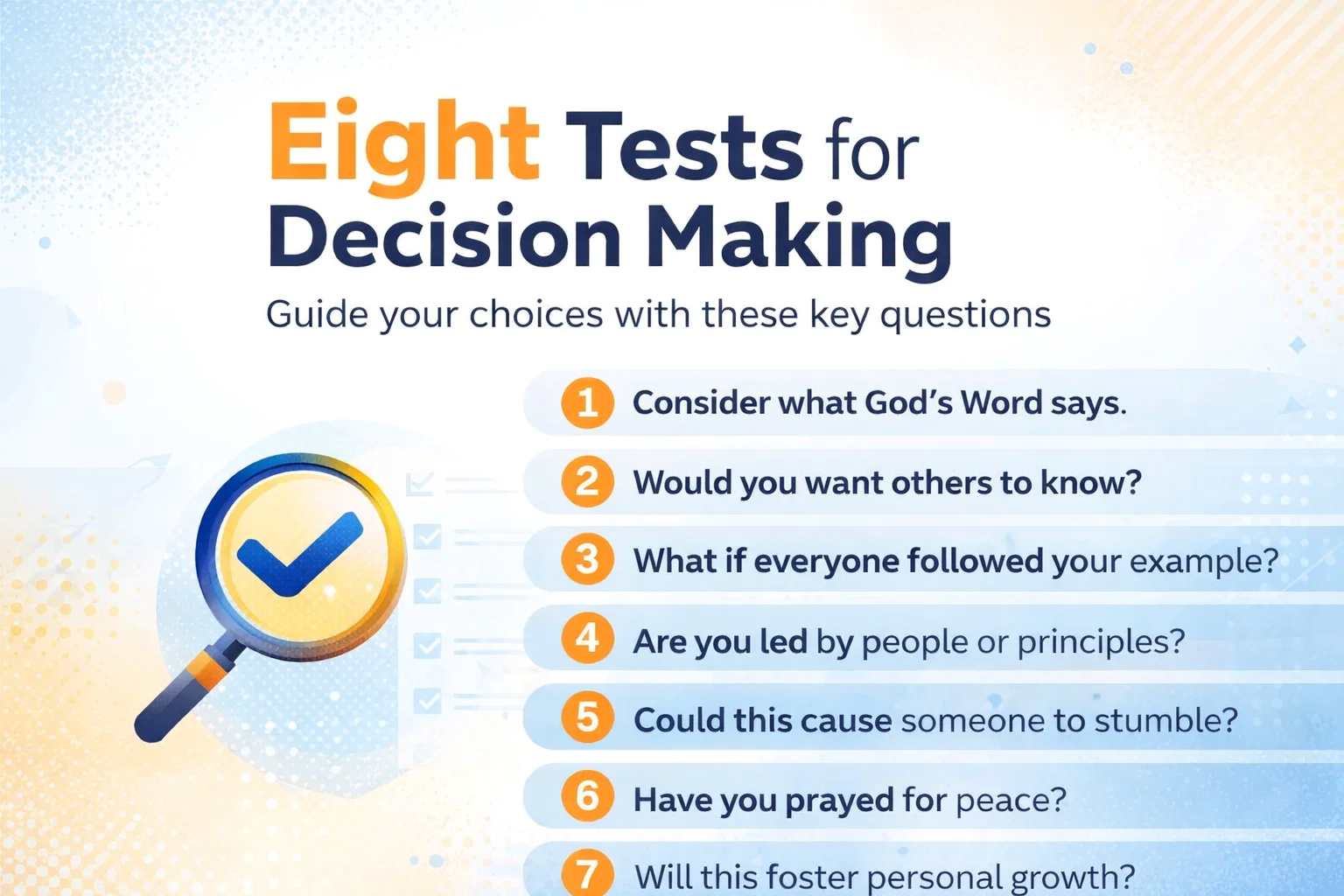
How to Make Better Decisions 8 Biblical Tests for Spiritual Growth and Christian Wisdom
Making decisions is one of the most frequent and challenging tasks we face every single day. From the small choices like what to eat for breakfast to life-altering decisions regarding careers, relationships, and finances, the weight of choosing the right path can often feel overwhelming. For those seeking to live a life aligned with their faith, the stakes feel even higher. We don’t just want to make a choice that works; we want to make a choice that honors God and reflects the character of Christ. However, in a world filled with noise and conflicting advice, how do we discern the right path?
The image we are analyzing today provides a profound framework for this exact dilemma. Titled Eight Tests for Decision Making, it offers a structured, biblical approach to evaluation. By running our choices through these specific filters, we can move away from impulsive or fear-based reactions and move toward a state of spiritual clarity. This guide isn’t just about following rules; it’s about developing a heart that is sensitive to the leading of the Spirit. Let’s dive deep into these eight pillars of biblical wisdom and see how they can transform your decision-making process.
1. The Scriptural Test: Starting with the Foundation
The first and most vital step in any decision-making process is the Scriptural Test. As the image points out, the core question here is: Has God already spoken about it in His Word? This is based on 2 Timothy 3:16, which reminds us that all Scripture is God-breathed and useful for teaching, rebuking, correcting, and training in righteousness.
Many times, we spend hours agonizing over a decision that the Bible has already clearly addressed. If a choice involves something that God has explicitly commanded or forbidden, the decision is already made. For example, if a business opportunity requires a lack of integrity or dishonesty, the Scriptural Test tells us immediately that this is not the right path. This test provides a solid, unchanging boundary that protects us from making choices that lead to moral or spiritual compromise. Before looking for a sign in the sky, we must look at the ink on the page.
2. The Secrecy Test: Evaluating Integrity
Integrity is often defined as who you are when no one is looking. The Secrecy Test asks: Would it bother me if everyone knew this was my choice? Drawing from Proverbs 11:3, this test forces us to look at our motives and the potential for shame. If we find ourselves wanting to hide our actions or hoping that certain people never find out what we’ve decided, that is a significant red flag.
Light thrives in transparency, while poor decisions often hide in the shadows. When we are proud of our choices and willing to stand by them in the public square, it usually indicates that our conscience is clear. This test is particularly helpful in the digital age, where privacy feels fleeting. If you wouldn’t want your decision posted on the front page of a social media site or explained to your mentors, it’s worth reconsidering the path you are on.
3. The Survey Test: Considering the Ripple Effect
None of us live in a vacuum. Every decision we make creates a ripple effect that touches the lives of those around us. The Survey Test asks: What if everyone followed my example? This is rooted in 1 Timothy 4:12, which encourages believers to be an example in speech, conduct, love, faith, and purity.
This is a powerful perspective shift. Instead of asking what is best for us in the moment, we ask what the world would look like if our choice became the standard. If your decision involves cutting corners or treating others poorly, and you wouldn’t want your children or your peers to mimic that behavior, then it fails the Survey Test. This filter helps us prioritize long-term influence over short-term convenience.
4. The Spiritual Test: Discerning Your Influence
In a world of social media and constant peer pressure, it is easy to make choices based on the expectations of others. The Spiritual Test asks: Am I being people-pressured or spirit-led? Galatians 1:10 is the foundational verse here, where Paul asks if he is trying to win the approval of human beings or of God. If he were still trying to please people, he would not be a servant of Christ.
This test requires deep honesty and self-reflection. Are you choosing a certain career because it’s what your parents expect? Are you staying in a situation because you’re afraid of what people will say if you leave? When we allow people-pleasing to drive our decisions, we often miss the unique calling God has for our lives. The Spiritual Test helps us realign our focus, ensuring that our primary audience is always our Creator.
5. The Stumbling Test: Protecting the Vulnerable
Love is the highest calling for a believer, and that love should extend to how our choices affect the spiritual walk of others. The Stumbling Test asks: Could this cause another person to stumble? Romans 14:21 reminds us that it is better not to do anything that will cause a brother or sister to fall.
This is perhaps one of the most selfless tests in the list. Sometimes, a decision might be technically “allowed” or not inherently sinful, but it might be unwise because of the impact it has on someone else’s journey. For example, your freedom to engage in a certain activity might be a source of confusion or temptation for a younger believer or a friend struggling with that specific area. The Stumbling Test calls us to exercise our freedom with responsibility and a heart of protection for our community.
6. The Serenity Test: The Gift of Internal Peace
God often communicates His will through a sense of peace. The Serenity Test asks: Have I prayed and received peace about this decision? Philippians 4:6-7 encourages us not to be anxious about anything, but in every situation, by prayer and petition, with thanksgiving, present our requests to God. The promise is that the peace of God, which transcends all understanding, will guard our hearts and minds.
If a decision leaves you feeling frantic, unsettled, or constantly anxious, it may be a sign to wait. While some big decisions naturally come with a level of nerves, there is a distinct “spiritual peace” that remains even in the midst of uncertainty. This test reminds us to slow down and wait for that internal green light from the Holy Spirit before moving forward. If you lack peace, you may lack the timing or the direction God intended.
7. The Sanctification Test: Prioritizing Growth
Every choice we make is either moving us closer to the image of Christ or further away from it. The Sanctification Test asks: Will this keep me from growing in the character of Christ? 2 Corinthians 3:18 describes the process of being transformed into His image with ever-increasing glory. Our decisions are the building blocks of our character.
Think about the long-term impact of your choice on your soul. Will this decision foster fruits of the Spirit like patience, kindness, and self-control? Or will it cultivate seeds of bitterness, greed, or pride? When we prioritize our sanctification over our comfort, we ensure that our lives are on a trajectory of spiritual maturity. If a decision stunts your spiritual growth, it isn’t worth the price.
8. The Supreme Test: The Ultimate Goal
Finally, we reach the most important filter of all: The Supreme Test. It asks the ultimate question: Does this glorify God? 1 Corinthians 10:31 states clearly: So whether you eat or drink or whatever you do, do it all for the glory of God. This is the lens through which every other test must be viewed.
If a decision passes all other tests but doesn’t ultimately bring honor to God’s name, it falls short of our purpose. Glorifying God means making His character known through our actions. When people look at the result of your decision, do they see a reflection of God’s goodness, justice, and love? By keeping the glory of God as our north star, we find the ultimate clarity in our decision-making journey.
Practical Tips for Applying the Eight Tests
Create a Decision Journal
When you are facing a major choice, don’t just run through these tests in your head. Write them down. Create a page in a journal with these eight headings and honestly record your thoughts for each one. This process of externalizing your thoughts helps you spot patterns of bias or areas where you might be ignoring a red flag.
Seek Wise Counsel
While these tests are personal, they are best applied within a community. Share your findings with a trusted mentor or a small group. Sometimes, others can see where we might be failing the Secrecy Test or the Stumbling Test more clearly than we can ourselves. Proverbs reminds us that there is safety in the multitude of counselors.
The Power of Waiting
If a decision fails even one of these tests, or if you feel unsure about several of them, the best choice is often to wait. We frequently feel pressured by the world to make “split-second” decisions, but spiritual wisdom often requires a slower pace. Waiting on the Lord allows the dust to settle and gives the Holy Spirit space to provide the clarity you need.
Conclusion: Living with Purpose and Clarity
The Eight Tests for Decision Making are more than just a checklist; they are a lifestyle of intentionality. By filtering our choices through Scripture, integrity, influence, and the glory of God, we protect ourselves from the pitfalls of impulsive living. We move from a place of confusion to a place of conviction. This framework empowers us to walk through life with a sense of purpose, knowing that our steps are guided by principles that are timeless and true.
As you move forward into your week, take one decision you are currently facing and run it through these eight filters. You might be surprised at how quickly the “noise” disappears, leaving you with a clear path forward. Remember, the goal of decision-making isn’t just to find the easiest way out, but to find the way that leads to deeper faith and greater character. Trust the process, lean into the Word, and watch how your life begins to reflect the peace and wisdom of Christ in every choice you make.