How Long-Term Emotional Abuse Impacts the Nervous System Complex PTSD Recovery Tips
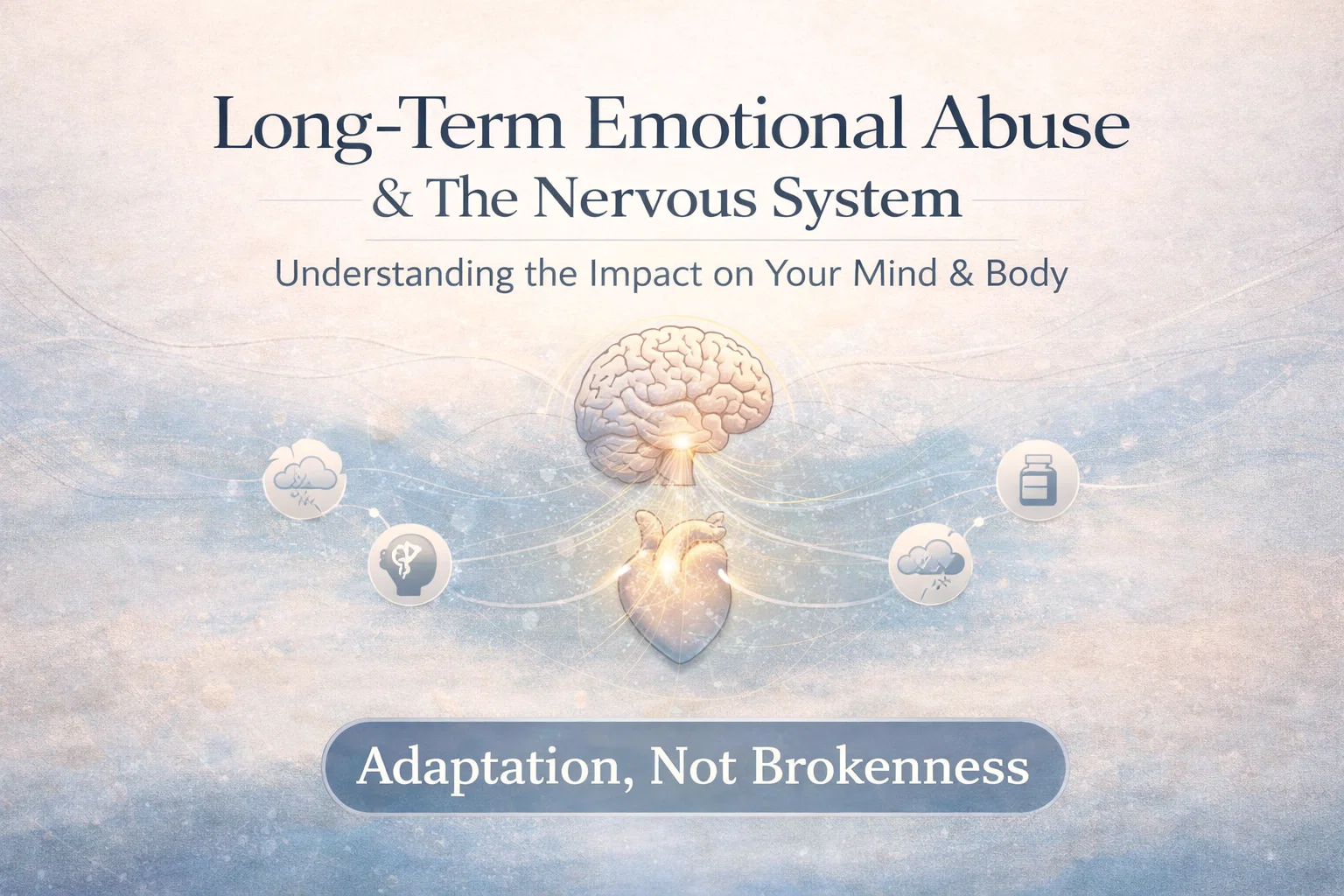
Understanding the intricate relationship between our life experiences and our physical biology is one of the most empowering shifts a person can make on their healing journey. When we look at the effects of long term emotional abuse, it is easy to feel like something is fundamentally broken within us. However, the image we are analyzing today offers a profound reframe: what we often call symptoms are actually brilliant adaptations. Your nervous system did exactly what it was designed to do to keep you safe in an unsafe environment. This perspective shifts the narrative from “What is wrong with me?” to “How did my body help me survive?”
The Science of Survival: How the Brain Stores Fear
The human brain is wired for one primary goal: survival. When a person is subjected to repeated emotional abuse or chronic stress, the brain enters a persistent state of survival mode. In this state, the amygdala (the brain’s alarm system) becomes hyper-active, while the pre-frontal cortex (the logical, reasoning center) often goes offline. This is why many survivors feel like their body reacts before their logic can catch up.
PTSD and the Body’s Memory
Post-Traumatic Stress Disorder (PTSD) is essentially a memory processing issue. When fear is repeated, the brain struggles to file those memories away in the past. Instead, they remain “live” in the nervous system. This results in flashbacks and an exaggerated startle response. As the infographic suggests, the body remembers what the mind tries to forget. You might find your heart racing or your breath catching without a clear logical reason, simply because your nervous system detected a familiar pattern of danger.
Understanding Complex PTSD (C-PTSD)
While standard PTSD is often linked to a single traumatic event, Complex PTSD arises from relational trauma that is ongoing and inescapable. This usually happens in childhood or long term adult relationships where there is a power imbalance. Because the trauma is relational, it deeply affects the core pillars of a person’s existence, including their identity, self worth, and ability to trust others.
When you are told, directly or indirectly, that your needs do not matter over a long period, your brain adapts by changing how you view yourself. This is not a character flaw. It is a protective mechanism designed to minimize conflict and keep you attached to the people you depend on, even if those people are the source of the pain.
The Spectrum of Nervous System Responses
The nervous system has several ways to handle perceived threats. Depending on the environment and the individual, these responses can manifest as anxiety, dissociation, or emotional dysregulation.
Anxiety and Hypervigilance
If your environment felt dangerous or unpredictable, your brain learned to scan for threats constantly. This is known as hypervigilance. You might become an expert at reading “micro-expressions” on people’s faces or overthinking every text message you receive. In this state, the nervous system never truly gets to rest. It is like a car idling at a very high RPM, ready to floor it at the slightest sign of trouble.
Dissociation: The Mental Escape
When physical escape is not an option, the brain creates a mental escape. Dissociation is a biological “cutoff switch” that allows a person to endure overwhelming pain by feeling numb or detached. Survivors often describe this as feeling foggy or like they are watching their life from behind a glass wall. It is a highly effective survival tool during abuse, but it can make it difficult to feel present and joyful once the danger has passed.
Emotional Dysregulation and Attachment Trauma
In unstable environments, love can feel like a rollercoaster. This is often seen in “hot and cold” dynamics where affection is intense one moment and withdrawn the next. This cycle creates a fragmented sense of security. Because the nervous system is constantly trying to “find the floor,” emotions can feel incredibly big and difficult to manage.
It is important to note that attachment trauma can often mimic personality disorders. When a person’s foundation is built on instability, their behavior reflects that lack of safety. Context matters deeply here. Many people find that once they are in a truly safe environment and begin regulating their nervous system, the “symptoms” that looked like a personality disorder begin to soften and change.
The Role of Depression and Substance Use
When the nervous system is tired of fighting or fleeing, it eventually shuts down to conserve energy. This is often where depression sets in. It is less about sadness and more about a profound state of exhaustion and hopelessness. The system simply does not have the resources to keep the “alarm” going anymore.
To cope with this intense internal pressure, many people turn to substance use. From a clinical perspective, this is often a form of self medication. When the internal alarm system won’t turn off, or when the numbness of depression becomes too heavy to bear, people look for external ways to find relief. Understanding this as a search for safety rather than a moral failure is a vital step in the recovery process.
Moving from Survival to Healing
The most beautiful message in the infographic is the final one: “You adapted to survive. Now you get to adapt to heal.” The same neuroplasticity that allowed your brain to change in response to trauma also allows it to change in response to safety and healing.
Practical Steps for Nervous System Regulation
- Grounding Techniques: Use your five senses to bring your brain back to the present moment when you feel a flashback or anxiety rising.
- Co-Regulation: Spending time with safe people or even pets can help “reset” your nervous system through social engagement.
- Boundary Setting: Learning to say no is a physical act of safety for your nervous system. It signals to your body that you are now the protector.
- Mindfulness and Breathwork: Slow, intentional breathing can physically signal the vagus nerve to move the body from “fight or flight” into “rest and digest.”
The Path Forward: Context is Everything
If you have spent years feeling like you are “too sensitive” or “broken,” please take a moment to look at your history through the lens of biology. You are a survivor of chronic stress, and your body has done a magnificent job of keeping you here. Healing is not about fixing something that is broken, but rather about teaching a very tired nervous system that it is finally safe to let down its guard.
Recovery takes time, and it is rarely a straight line. There will be days when the old adaptations resurface, and that is okay. The goal is not perfection, but rather an increasing sense of agency over your own internal world. By understanding the mechanics of your nervous system, you gain the tools to steer your life toward the peace and stability you have always deserved.
Conclusion
Long term emotional abuse leaves deep tracks in the mind and body, but those tracks do not have to define your future. By recognizing these symptoms as survival adaptations, you can begin to treat yourself with the compassion and patience necessary for true transformation. You have already done the hardest part, which was surviving. Now, you have the opportunity to build a life where you don’t just survive, but truly thrive. Remember, your nervous system is on your side, and with the right tools and support, you can guide it back to a state of balance and peace.