Stop Overthinking Start Manifesting How to Shift Your Mindset for the Better
The human mind is a storytelling machine. From the moment we wake up until the second we drift off to sleep, our brains are constantly narrating our experiences, predicting outcomes, and analyzing every social interaction. However, for many of us, that narration often takes a dark and anxious turn. We become experts at catastrophe. We can visualize a failed presentation, a broken relationship, or a financial setback with startling clarity. This phenomenon is known as overthinking, and while it is often treated as an uncontrollable burden, there is a revolutionary perspective hidden within the struggle. If you have the mental stamina to overthink the worst-case scenario, you possess the exact same creative capacity to overthink the best.
Understanding the Mechanics of the Anxious Mind
To change how we think, we must first understand why we think the way we do. Overthinking isn’t just a bad habit; it is often a survival mechanism gone into overdrive. Our ancestors stayed alive by predicting threats. The brain that imagined a predator behind every bush was the brain that survived to pass on its genes. In the modern world, those “predators” have been replaced by work deadlines, social awkwardness, and future uncertainties.
When we overthink the worst, we are engaging in a process called “catastrophizing.” We take a single event and spin it into a web of negative outcomes. This requires an incredible amount of imagination, focus, and cognitive energy. The tragedy is that we often use this superpower against ourselves. We build elaborate mental prisons, decorating the walls with our deepest fears, and then we wonder why we feel trapped and exhausted.
The Energy Behind the Thought
Think about the last time you stayed up late worrying about something. Your heart rate likely increased, your muscles tensed, and your mind raced through a thousand different “what if” scenarios. This proves one vital thing: your mind is incredibly powerful. It can create physical physiological responses based purely on imagined concepts. The energy required to fuel an anxious spiral is the same energy required to fuel a visionary dream. The only difference is the direction in which that energy is pointed.
The Art of Positive Overthinking
The concept of “overthinking the best” might sound like simple toxic positivity, but it is actually a grounded psychological shift. It isn’t about ignoring reality or pretending that problems don’t exist. Instead, it is about giving equal airtime to the possibility of success. If you are going to spend twenty minutes imagining how a conversation could go wrong, you owe it to your mental health to spend twenty minutes imagining how it could go right.
Positive overthinking is essentially intentional manifestation through visualization. When you focus on the “best” scenario, you aren’t just being hopeful; you are priming your brain to recognize opportunities. The Reticular Activating System (RAS) in your brain acts as a filter. When you obsess over failure, your RAS looks for evidence of failure. When you obsess over success, your brain starts to notice the small open doors and lucky breaks that you would have otherwise walked right past.
Flipping the Script on What If
The phrase “What if?” is the foundation of all overthinking. Usually, it is followed by something negative. To practice this new mindset, you must consciously complete the sentence with a positive outcome. Consider these shifts:
- Instead of: What if I lose my job? Try: What if this leads to a career path I actually love?
- Instead of: What if they don’t like me? Try: What if we become best friends and inspire each other?
- Instead of: What if I fail this project? Try: What if this project becomes the cornerstone of my professional reputation?
By forcing your brain to play out the positive movie to its conclusion, you break the cycle of anxiety and begin to build a cycle of anticipation and excitement.
Visualizing the Two Paths
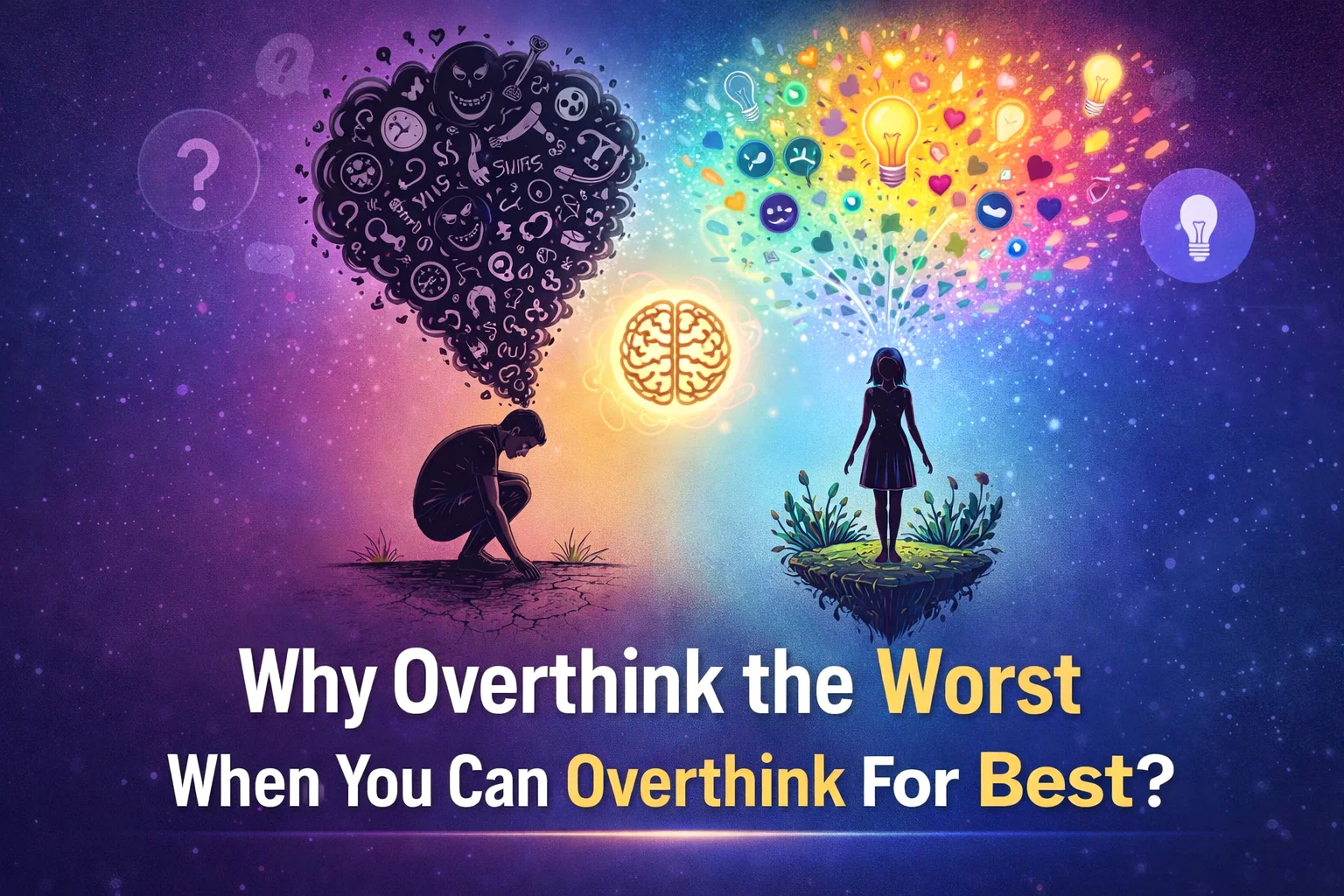
The image of a person hunched over, burdened by a cloud of chaos, versus a person standing tall, surrounded by growth and light, is a perfect representation of our internal state. The man on the left is digging into the dark earth of his own doubts. His thoughts are sharp, jagged, and overwhelming. The woman on the right is blooming. Her thoughts are organized into beauty, connection, and nature. Both individuals are using their minds; they are just inhabiting different mental ecosystems.
The Weight of the Dark Cloud
Overthinking the worst feels heavy. It creates a physical sensation of being weighed down, as if the air around you is thicker. It isolates you. When you are lost in a dark mental loop, you are less present for the people you love and less capable of performing your best work. It is a drain on your most precious resource: your attention.
The Light of the Garden
Conversely, overthinking the best feels expansive. It feels like growth. When you imagine the best outcomes, you are planting seeds in a mental garden. These thoughts produce feelings of hope, which in turn lead to pro-active behaviors. You are more likely to take a calculated risk or reach out to a new person when you have already “pre-lived” a successful version of that interaction in your mind.
Practical Steps to Shift Your Mindset
Shifting from chronic worry to constructive dreaming doesn’t happen overnight. It requires consistent practice and a bit of self-compassion. Here are a few strategies to help you navigate this transition.
The Five Minute Swap
Whenever you catch yourself in a negative overthinking spiral, don’t try to stop it immediately, as that often creates more tension. Instead, set a timer for five minutes. Allow yourself to worry as much as you want during those five minutes. When the timer goes off, you must spend the next five minutes “overthinking the best.” Use the same level of detail, the same intensity, and the same focus to imagine everything going perfectly. This teaches your brain that it can switch tracks at will.
The Evidence Journal
We often overthink the worst because we believe our fears are more “realistic” than our hopes. To combat this, keep a journal of times when things actually went right. Write down the times you were worried about an outcome and it turned out to be better than expected. Referencing this “evidence” helps convince your logical brain that the best-case scenario is just as likely as the worst-case scenario.
Surround Yourself with Visual Cues
Our environment heavily influences our internal dialogue. Use art, quotes, and symbols that remind you of your capacity for positive thought. Seeing a visual representation of the “blooming mind” can serve as a powerful pattern interrupter when you feel a dark cloud starting to form. It reminds you that you have a choice in where you plant your mental feet.
The Role of Connection and Community
In the illustration, the positive side is filled with icons of people and connection. This is a crucial point. Overthinking the worst often happens in isolation. We get stuck in our own heads, and our fears echo and grow louder. When we move toward the “best,” we often find ourselves moving toward others. Positive overthinking includes imagining how we can help others, how we can collaborate, and how we can find joy in community.
Sharing your dreams and positive “what ifs” with friends or mentors can also help solidify them. When you speak a positive possibility out loud, it becomes more real. It moves from a fleeting thought to a stated intention. This social accountability can be the extra push you need to keep your thoughts focused on the garden rather than the thorns.
Conclusion: Choosing Your Mental Landscape
At the end of the day, your mind is your most intimate home. You spend every second of your life inside your own thoughts. While you cannot always control the first thought that pops into your head, you have immense power over the second, third, and fourth thoughts. You are the architect of your own mental landscape.
If you have been a lifelong overthinker, do not view it as a flaw. View it as a sign of an incredibly active and creative mind. You have the hardware necessary for greatness; you just need to update the software. Start today by challenging your negative narratives. Every time you find yourself spiraling into the dark, remember the image of the garden. Remember that you have the soil, the water, and the sun necessary to grow something beautiful. It is time to stop being a victim of your imagination and start being its master. If you can overthink the worst, you can absolutely overthink the best. The choice is yours, and the possibilities are endless.