Life Wisdom Recalculating Your Route Inspirational Growth Mindset Quote Motivation
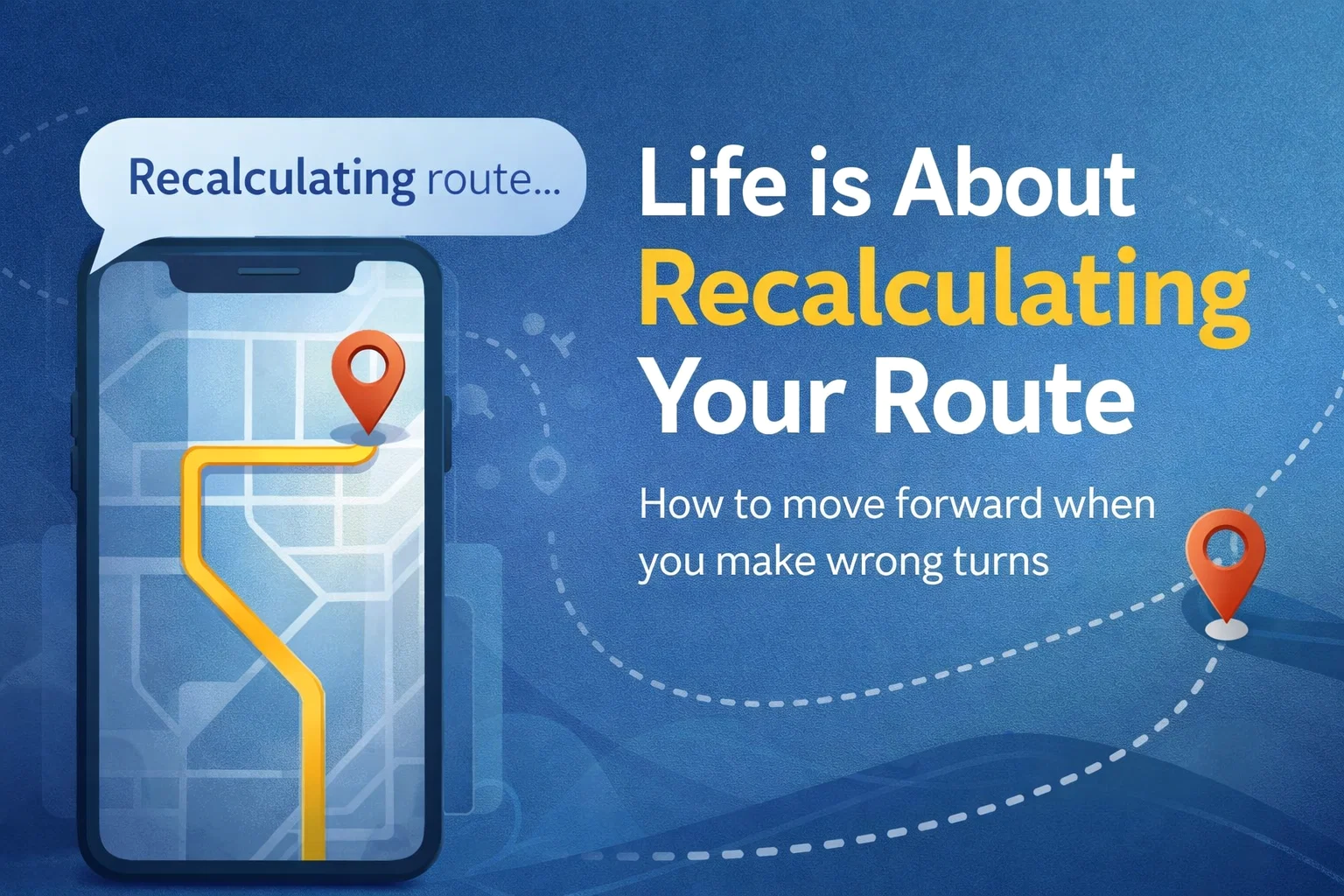
The image above carries a message that is as profound as it is simple. In a world where we are constantly pressured to be perfect, to follow a straight line, and to never falter, the humble GPS offers a perspective that we often overlook. When you take a wrong turn while driving, the voice from your dashboard does not sigh in frustration. it does not tell you that you are a failure or that you should just give up and park the car. Instead, it calmly states that it is recalculating the route. This perspective is exactly what most of us need to navigate the complexities of modern life.
Life is rarely a straight line from point A to point B. It is more like a winding mountain road with unexpected detours, construction zones, and occasional dead ends. The beauty of the GPS analogy is that it removes the stigma of the mistake and replaces it with the necessity of the adjustment. When we understand that a wrong turn is simply a data point rather than a character flaw, we unlock a level of resilience that can carry us through almost any challenge.
The Psychology of Recalculating
Why is it so hard for humans to behave like a GPS? From a young age, many of us are conditioned to fear making mistakes. In school, a wrong answer results in a lower grade. In sports, a missed play can mean a loss. In our careers, a failed project can feel like a threat to our livelihood. This conditioning creates a rigid mindset where any deviation from the planned path feels like a catastrophe.
When we hit a roadblock, our internal dialogue often becomes toxic. We tell ourselves that we should have known better or that we have wasted valuable time. This mental friction actually prevents us from finding the new route. By contrast, the GPS approach is purely functional. It accepts the current location as the new starting point and looks for the best way forward from there. This is the essence of a growth mindset.
Moving From Regret to Resourcefulness
Regret is a backward-looking emotion. It keeps your eyes fixed on the rearview mirror while you are trying to drive forward. Resourcefulness, on the other hand, is entirely forward-looking. When you decide to recalculate, you are choosing to be resourceful. You are asking yourself what the best next step is, given where you are right now.
This shift in thinking requires a certain level of detachment. You have to be able to look at your situation objectively. If a business venture fails, you aren’t a failed entrepreneur. you are an entrepreneur who is currently recalculating. If a relationship ends, you aren’t a failure at love. you are recalculating your path toward personal happiness. This terminology changes the narrative from one of ending to one of evolving.
Applying the GPS Philosophy to Your Career
The modern career landscape is perhaps the best place to apply the recalculating mindset. Gone are the days when a person would join a company at twenty and retire from the same company forty years later. Today, careers are fluid. Industries are disrupted overnight, and new roles are created that didn’t exist five years ago.
In this environment, if you view every job change or industry shift as a mistake, you will live in a state of constant stress. However, if you view these shifts as recalculations, you become more adaptable. Maybe you spent five years in a field only to realize it doesn’t fulfill you. That wasn’t five years wasted. it was five years of collecting data that helped you understand what you don’t want, which is essential for finding what you do want.
The Power of the Pivot
In the startup world, this is often called a pivot. Some of the most successful companies in the world started as something entirely different. They realized their initial route wasn’t working, so they recalculated. Slack started as a tool for a gaming company. Instagram started as a complex check in app called Burbn. These companies didn’t view their initial ideas as mistakes. they viewed them as the necessary steps to find the right route.
You can do the same with your personal brand and professional development. Every skill you learn, even if it seems irrelevant to your current path, is a tool in your kit for the next time you need to recalculate. The more diverse your experiences, the more routes your internal GPS can find when the main road is blocked.
Navigating Personal Growth and Relationships
Personal development is rarely a linear journey. We often set goals for our health, our habits, or our mental well-being, only to find ourselves slipping back into old patterns. This is where the GPS analogy becomes truly life-saving. When you miss a day at the gym or lose your temper, the GPS doesn’t tell you to go back to the beginning of your life and start over. It just says, Start from here.
Self-compassion is the fuel for this recalculation. If you are too hard on yourself, you run out of energy to find the new path. By accepting that detours are a natural part of the human experience, you can return to your goals much faster. The time spent beating yourself up is time that could have been spent driving toward your destination.
Building Resilient Connections
Relationships also require frequent recalculations. People change, circumstances change, and conflict is inevitable. A rigid relationship is one that breaks when it hits a snag. A resilient relationship is one where both parties are willing to say, This isn’t working, let’s recalculate how we communicate or how we spend our time.
Viewing relationship hurdles as routing issues rather than fundamental failures allows for growth. It encourages problem-solving rather than blame. When both people are focused on finding the new route together, the journey becomes more important than the specific turns taken along the way.
Why We Fear the Detour
If recalculating is so beneficial, why do we resist it so much? Usually, it comes down to the fear of the unknown and the fear of judgment. We worry about what others will think if they see us changing direction. We worry that the new route will be longer, harder, or less scenic than the one we planned.
The truth is that the detour often holds the most valuable lessons. It takes us through neighborhoods we never would have seen and introduces us to people we never would have met. Some of the greatest discoveries in history were the result of a recalculation after a perceived mistake. Columbus was looking for a route to the East Indies when he found the Americas. That was a major recalculation that changed the world.
Overcoming the Sunk Cost Fallacy
A major obstacle to recalculating is the sunk cost fallacy. This is the tendency to continue on a path because we have already invested time, money, or effort into it, even if that path is clearly no longer the best one. We stay in the wrong jobs or the wrong projects because we don’t want to feel like we wasted what we put in.
A GPS doesn’t care about the miles you’ve already driven in the wrong direction. It only cares about the miles you have left to go. To live effectively, we must adopt this same logic. Your past investment is gone. The only question that matters is: What is the best use of my resources from this moment forward?
Practical Steps to Recalculate Your Life
If you feel like you are currently off-track, here are a few ways to start the recalculation process without the weight of guilt or shame:
- Acknowledge Your Current Coordinates: Be honest about where you are. You can’t find a new route if you are pretending you aren’t lost.
- Silence the Inner Critic: When the voice in your head starts calling you a failure, replace it with the neutral tone of a GPS. Remind yourself that you are simply adjusting.
- Identify the New Destination: Sometimes the destination changes along with the route. Ask yourself if what you wanted a year ago is still what you want today.
- Take the Smallest Next Step: You don’t need to see the whole route to start moving. You just need to make the first turn.
The Importance of Flexibility
Flexibility is a superpower in the twenty-first century. The more rigid your plans, the more likely they are to break. When you build the expectation of recalculation into your life, you become much harder to discourage. You start to see obstacles as puzzles to be solved rather than signs that you should stop.
Think of your life as a long-distance road trip. You wouldn’t expect to go 3,000 miles without hitting a single red light or having to take a detour for roadwork. Expecting perfection is unrealistic. Expecting to recalculate is practical and empowering.
Conclusion: Enjoying the Ride
At the end of the day, the goal isn’t just to reach the destination. it is to navigate the journey with some level of grace and curiosity. If we spend the whole trip screaming at the dashboard because we missed a turn, we arrive at our destination exhausted and bitter. If we accept the recalculations as part of the adventure, the journey becomes much more enjoyable.
The message in the image is a reminder to be kind to yourself. You are the driver, but you are also the navigator. When things go wrong, don’t waste time looking for someone to blame or reasons to feel bad. Just listen for that quiet, internal voice that says the route is being recalculated. Take a deep breath, grip the steering wheel, and follow the new path. You’ll get where you’re going, and the story of how you got there will be much more interesting because of the turns you didn’t expect to take.
Life is a series of adjustments. Every time you think you’ve made a mistake, remember that it’s just an opportunity to find a different, and perhaps even better, way forward. Keep driving, keep growing, and always be ready to recalculate.