12 Weird Habits to Calm Your Anxious Body Regulate Your Nervous System Instantly
Have you ever found yourself sitting in your car for twenty minutes after arriving home, staring at the steering wheel in total silence? Or perhaps you have caught yourself swaying rhythmically while waiting in a long line, almost like a pendulum. To an outsider, these behaviors might look a little bit strange. However, to your nervous system, they are sophisticated survival mechanisms. Our bodies are constantly seeking ways to find equilibrium in a world that feels increasingly loud, fast, and demanding. When traditional advice like “take a deep breath” feels too clinical or simply does not work, these “weird” habits step in to provide the somatic relief we actually need.
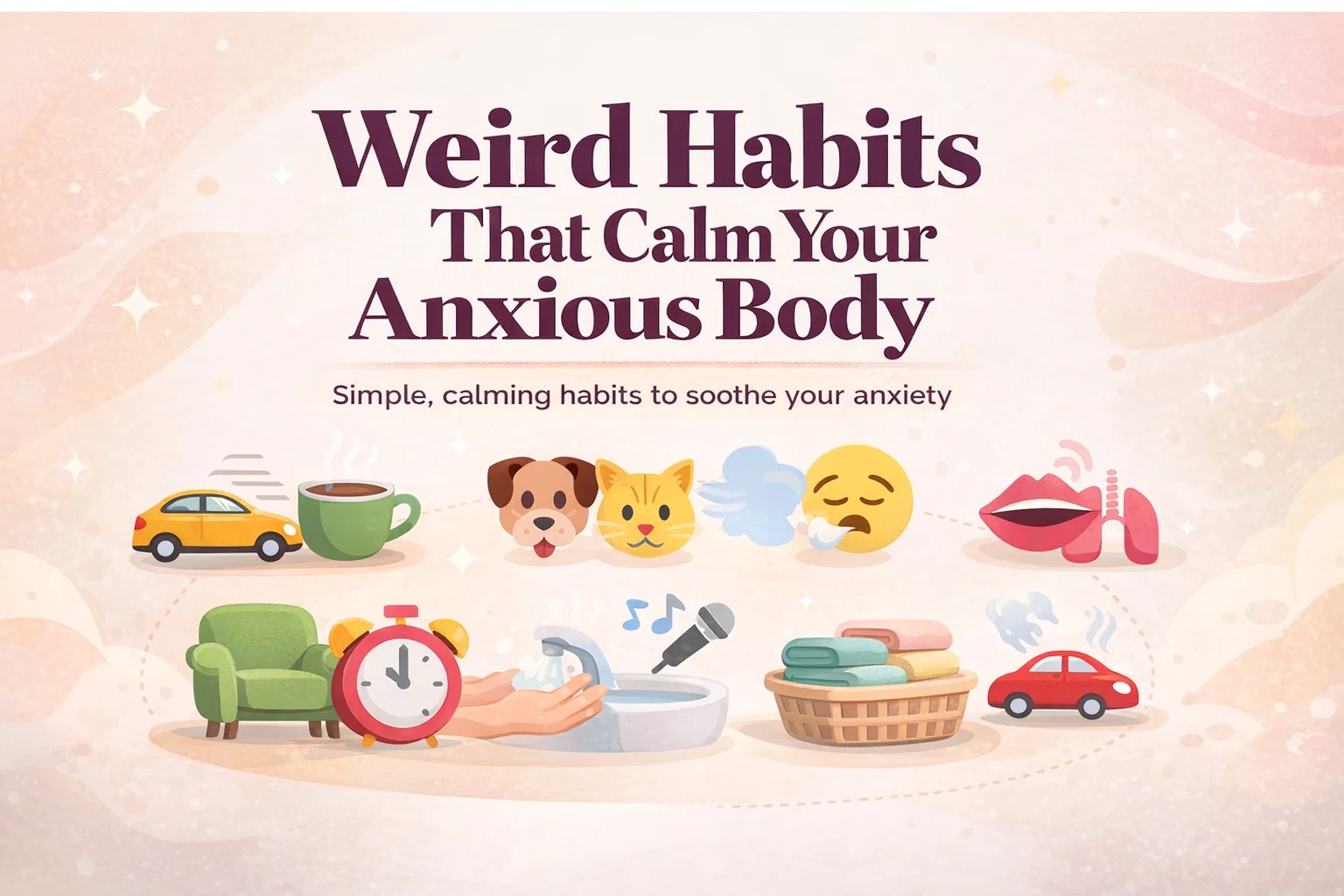
The image we are looking at today highlights twelve unconventional but scientifically grounded ways to calm an anxious body. These are not just random quirks; they are sensory inputs that communicate directly with the vagus nerve and the brain’s emotional processing centers. By understanding why these habits work, we can stop feeling self-conscious about them and start using them as a dedicated toolkit for emotional regulation. Let’s dive deep into the science and soul of these unique grounding techniques.
The Power of Somatic Movement: Swaying and Softening
The first few habits on our list involve subtle physical shifts that change how our body perceives its environment. When we are anxious, our muscles often lock up in a state of “bracing.” This is a primal response designed to protect our vital organs from a perceived threat. Unfortunately, staying in a braced state tells the brain that the danger is still present, creating a feedback loop of stress.
Swaying Side-to-Side
Swaying is a form of self-soothing that mirrors the rocking motion humans find comforting from infancy. When you sway side-to-side, you are engaging your vestibular system, which is responsible for balance and spatial orientation. This rhythmic movement can be incredibly grounding because it provides a predictable physical sensation. It creates a “container” for your energy, allowing the nervous system to shift from a state of high-alert back into a social engagement state. If you feel overwhelmed in a public space, a gentle sway can be your invisible anchor.
Letting Your Jaw Hang Open
We hold an incredible amount of tension in our masseter muscles, which are the primary muscles used for chewing. In moments of stress, we instinctively clench our teeth. By consciously letting your jaw hang open for a few breaths, you are sending a physical signal to your brain that you are not in a fight. It is nearly impossible for the body to maintain a peak “fight or flight” response when the jaw is fully relaxed. This tiny act of defiance against tension can trigger a cascade of relaxation throughout the neck and shoulders.
Rethinking Daily Environments: The Floor and the Car
Sometimes, the best way to change your internal state is to change your physical perspective. Traditional furniture like couches and chairs are designed for comfort, but they do not always provide the sensory feedback an anxious body craves.
Sitting on the Floor
There is a reason why “grounding” is the term used for emotional stability. Sitting on the floor increases the surface area of your body in contact with a solid, unmoving plane. This provides a sense of “rootedness” that a soft couch cannot replicate. For many, sitting on the floor encourages a more natural spinal alignment and allows for gentle stretching. It pulls you out of the “elevated” headspace of work and chores and literally brings you down to earth. Next time you feel a panic attack or a wave of worry, try moving your activities to the rug.
The “Car Decompression” Ritual
The car is a unique transitional space. It is a small, enclosed pod that belongs entirely to you. Sitting in your car after parking is a way of reclaiming your time before transitioning from one role (like employee or commuter) to another (like parent or partner). This “liminal space” allows your heart rate to slow down and your mind to process the day’s events. It is a boundary-setting exercise that protects your home environment from the residual stress of the outside world.
Sensory Regulation Through Temperature and Breath
Our skin is our largest organ, and it is packed with receptors that talk to the brain. We can use these receptors to manually override a stress response through simple sensory changes.
Washing Hands in Warm Water
Warm water has a naturally sedative effect on the nervous system. When you wash your hands in warm water longer than necessary, you are engaging in a form of hydrotherapy. The warmth expands blood vessels and promotes circulation, while the tactile sensation of the water provides a focused point of mindfulness. It is a “micro-spa” moment that costs nothing but provides an immediate sense of comfort and cleanliness, both physically and energetically.
Exhaling Longer Than You Inhale
Most of us have heard that breathing helps anxiety, but the specific ratio is what matters. When you inhale, you slightly stimulate the sympathetic nervous system (the “gas pedal”). When you exhale, you stimulate the parasympathetic nervous system (the “brake pedal”). By making your exhales significantly longer than your inhales, you are effectively “pumping the brakes” on your heart rate. This physiological hack is one of the fastest ways to lower cortisol levels in the blood.
Cognitive Shifts: Talking to Pets and Narrating Tasks
Anxiety often thrives in the “what if” of the future or the “if only” of the past. To stop the mental tailspin, we need to bring our focus back to the present moment using logic and connection.
Talking to Your Pet Like a Person
Pets are the ultimate non-judgmental listeners. When we talk to a cat or dog as if they are a “reasonable person,” we are practicing externalization. We are taking the tangled thoughts in our heads and turning them into spoken language. Because pets offer unconditional positive regard, this interaction releases oxytocin, the “bonding hormone.” It reminds us that we are not alone and provides a safe outlet for the social side of our brain that might be feeling isolated or misunderstood.
Saying What You Are Doing Out Loud
This is a technique often used in mindfulness practices to combat dissociation. When you say, “I am making tea” or “I am walking to the sink,” you are creating a bridge between your mind and your body. Anxiety often makes us feel like we are “floating” or disconnected from our actions. Narrating your life in real-time forces the brain to acknowledge the physical reality of the present. It stops the “auto-pilot” mode that allows ruminating thoughts to take over.
Embracing Inefficiency and Doing Nothing
We live in a culture obsessed with productivity. For an anxious person, the pressure to be “efficient” can be a major trigger. These “weird” habits challenge the idea that every second must be optimized.
Deliberate Inefficiency
Folding laundry slowly or taking the long way home is an act of rebellion against the “rush.” When we move slowly on purpose, we are telling our internal alarm system that there is no emergency. If there were a lion chasing us, we would not be folding towels with precision. Therefore, by slowing down, we prove to our bodies that we are safe. This practice builds patience and helps us find beauty in the mundane tasks we usually try to skip over.
Stopping Mid-Task for 10 Seconds
This is a “pattern interrupt.” If you are in the middle of a stressful email or a chaotic house cleaning session, stopping for exactly ten seconds and doing absolutely nothing can reset your momentum. It prevents the “snowball effect” of stress where one task leads to another until you are completely burnt out. It is a tiny window of silence that reminds you that you are the one in control of your movement, not the tasks themselves.
Visual and Physiological Release: Eyes and Yawns
Finally, we can look at the way our face and eyes process the world. High stress often leads to “tunnel vision,” where we are hyper-focused on a single problem.
Softening Your Eyes
When we are stressed, we tend to stare intensely at screens or objects. This “hard focus” is associated with the sympathetic nervous system. By consciously softening your gaze—allowing your peripheral vision to expand—you signal to the brain that the environment is safe to scan. It reduces the strain on the optic nerve and can even help alleviate tension headaches. It is the visual equivalent of taking a deep breath.
Exaggerating a Yawn
Yawns are fascinating because they are contagious and deeply physiological. An exaggerated yawn forces a massive intake of oxygen and a big stretch of the jaw and throat. It also helps cool the brain, which can get “overheated” during periods of intense cognitive load. Even a fake yawn can often trigger a real one, leading to an involuntary release of tension that feels like a reset button for your face and lungs.
Conclusion: Building Your Personalized Comfort Menu
Managing anxiety is not always about big lifestyle changes or expensive therapy sessions. Often, it is about the small, “weird” things we do in the privacy of our own homes to feel just a little bit more human. Whether you choose to sit on the floor, talk to your cat, or wash your hands in warm water, remember that these habits are valid forms of self-care. They are your body’s way of looking out for you.
The next time you feel the hum of anxiety starting to rise in your chest, do not reach for your phone to scroll away the feeling. Instead, try one of these somatic tools. Allow yourself the grace to be a little bit unconventional. By embracing these quirky habits, you are building a resilient nervous system that knows how to find its way back to peace, no matter how chaotic the world becomes. Start small, stay curious, and listen to what your body is asking for. You might be surprised at how much wisdom is hidden in your “weirdest” instincts.