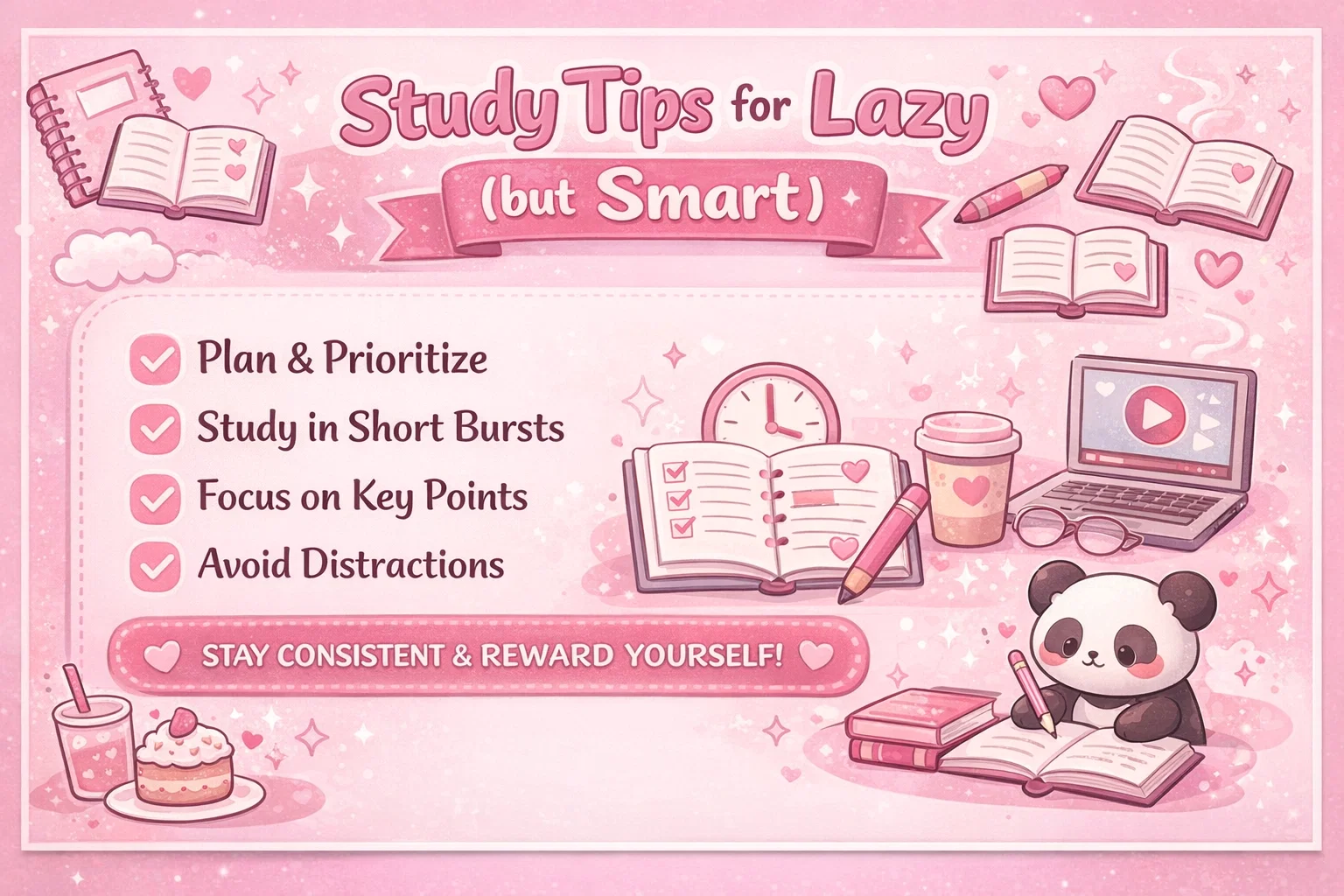
Smart Study Hacks for Lazy Students Productivity Tips Study Motivation for Better Grades
Let’s face it: the traditional idea of being a ‘perfect’ student often feels intimidating and, well, a little bit exhausting. We picture someone who studies twelve hours a day, wakes up at dawn, and sacrifices all their social life. But here’s the quiet truth that many successful students know: you don’t actually have to work that hard. You just have to work smart.
That is the whole philosophy behind this ultimate guide for “lazy but smart” students. Being lazy doesn’t mean you lack ambition or intelligence; it often means you value your time and energy, and you’re always looking for the most efficient path. What if we reframe “lazy” not as a flaw, but as a superpower that forces you to optimize your learning? Instead of brute-forcing your way through studying, we’re going to embrace clever strategies, powerful psychology, and effective time-saving techniques that deliver maximum results for minimum effort.
If you’ve ever felt overwhelmed by your workload, burnt out by inefficient methods, or just wanted more time for yourself without sacrificing your grades, this is for you. We’re breaking down essential study hacks into simple, actionable steps that will transform how you approach your education. Let’s make learning easier, more effective, and—dare we say it—even enjoyable.
Strategy 1: Plan & Prioritize with Effortless Flow
When you have a mountain of work, the initial reaction is often either paralysis or a chaotic, unstructured panic. The smart, efficient student doesn’t dive in blindly. They know that a little upfront planning saves exponentially more time and stress later. The goal isn’t to create an overwhelming, minute-by-minute schedule that you’ll feel guilty for breaking. The goal is clarity.
Master the Art of the Simple to-Do List
There’s immense power in a simple, well-organized to-do list. Forget complex apps; often, just writing things down on a piece of paper or a basic digital list is all you need. The trick is how you structure it. Instead of writing vague tasks like “Study History,” try break it down into manageable, specific actions such as “Review pages 45-60 of Chapter 3 notes” or “Write outline for essay introduction.” This small shift makes the task less intimidating and gives you a clear starting point.
Identify and Conquer High-Impact Tasks
Not all study tasks are created equal. This is where prioritization becomes your best friend. A core secret of effective studying is identifying which tasks will yield the biggest return on your investment of time. What topics are most likely to be on the exam? Which assignment contributes the most to your final grade? A useful tool is the Eisenhower Matrix, which helps you categorize tasks based on urgency and importance. Focus your best energy on the important (but not always urgent) tasks that drive your true academic progress, rather than getting distracted by urgent-seeming distractions.
Planning gives you a map, but prioritization ensures you’re hiking the right trail. By knowing exactly what you need to do and in what order, you remove the decision fatigue that often leads to procrastination. It’s the ultimate way to conserve your mental energy and use it only where it counts.
Strategy 2: Study in Short Bursts—The Power of Focus and Rest
Let’s talk about the dreaded “cram session.” Forcing yourself to sit and study for four hours straight is a recipe for diminishing returns, burnout, and distraction. Your brain isn’t built for that kind of prolonged, intense focus. The smart and efficient student recognizes this limitation and works with their biology, not against it. This is where the magic of focused bursts—popularized by techniques like the Pomodoro Method—comes in.
Why 25-30 Minutes is Your Brain’s Sweet Spot
The core concept is brilliantly simple: you set a timer for a short period, traditionally 25 or 30 minutes. During that time, you dedicate yourself 100% to a single, specific task with zero interruptions. You don’t check your phone, you don’t scroll social media, you don’t switch to another subject. This intense focus allows your brain to enter a state of flow where deep, meaningful work happens. By knowing you only have to maintain this focus for a limited, manageable time, you make it far easier to start and resist the urge to procrastinate.
Maximize Your Recovery with Active Breaks
The second part of this strategy is just as crucial: the break. When the timer goes off, you immediately stop what you’re doing and take a genuine, restorative break of 5-10 minutes. This is not the time to jump online; that kind of mental stimulation won’t allow your brain to rest. Instead, step away from your workspace. Stretch, walk into another room, get a glass of water, or simply close your eyes for a moment. This active rest is when your brain processes the information you just took in, allowing it to consolidate and form stronger memories. After four of these focused cycles, you earn a longer, well-deserved break of 15-30 minutes. This rhythm of intense focus followed by active rest keeps your mental energy high throughout your study session.
By studying in this way, you make consistent, effective progress while avoiding the exhaustion of marathon sessions. You’re giving your brain the regular recharging it needs to stay sharp and productive, making the entire process feel more manageable and far more rewarding.
Strategy 3: Focus on Key Points—Learning More in Less Time
When you open a textbook or look at your notes, the overwhelming amount of information can be daunting. The truth is, not everything on the page is of equal importance. The traditional, inefficient approach is trying to memorize every word, which is incredibly slow and mentally taxing. The smart student doesn’t try to know everything; they try to know the right things. This is about working with precision and maximizing your understanding with minimal effort.
The Art of Effective Highlighting and Summarizing
Highlighting can be a fantastic tool, but many people use it incorrectly. Instead of turning whole paragraphs bright yellow, a more effective technique is to be highly selective. Aim to highlight only key concepts, essential definitions, and central ideas. A great guideline is to limit your highlighting to no more than 10-15% of the page. This forces you to critically evaluate which information is truly critical, rather than mindlessly marking everything. After you’ve strategically highlighted, the next powerful step is summarization. Don’t simply rewrite your notes; instead, close the book and try to summarize the main ideas from memory, or convert your highlighted points into a simplified, organized outline using your own words. This process of active recall significantly strengthens your understanding and memory retention.
The “Teach It to Learn It” Secret Weapon
One of the most potent—yet often underutilized—study hacks is the Feynman Technique. This powerful method operates on the principle that you truly understand a topic only if you can explain it in simple, clear terms. After you’ve reviewed a concept, imagine you’re teaching it to someone who has no prior knowledge of the subject. Use simple language and clear examples. This exercise forces you to break down complex ideas into their core components and, crucially, to identify any gaps in your understanding. Wherever you struggle to explain clearly, you’ve found an area you need to review. This method is incredibly efficient because it targets your weak points precisely, saving you from wasting time relearning things you already know well.
By shifting your focus to key points and active learning, you’ll find you can achieve a deeper understanding in less time. You’re not just consuming information passively; you’re actively processing and refining it, which is the key to true, efficient learning and high performance.
Strategy 4: Use Your Resources Wisely—Smarter, Not Harder
In our connected world, we have access to an incredible array of tools and resources that can revolutionize the way we study. The smart, efficient student doesn’t rely solely on dense textbooks and manual note-taking; they strategically leverage technology and alternative learning methods to make the process faster, more engaging, and incredibly effective.
Leverage the Power of Visual Learning
Not everyone learns best by reading walls of text. If you find yourself disengaged or struggling to grasp a concept from your notes, it’s time to change your approach. Visual learning is a powerful shortcut for many students. For almost any topic imaginable, from cell biology to economics to literature, there are high-quality, free video summaries and tutorials available online. Platforms like YouTube offer a vast ocean of simplified explanations that use clear visuals and dynamic presenting. Watching a concise, 10-minute video can often provide a clearer understanding of a complex topic than an hour spent struggling through a textbook chapter. Think of it as a jumpstart for your learning that allows you to absorb key concepts with much less effort.
Harness Digital Tools for Efficient Management and Review
Modern technology offers a wealth of tools designed for seamless productivity. Instead of complex apps, think about how you can use simple digital tools more effectively. Simple, shared document apps allow for easy collaborative note-taking and revision. Digital flashcard systems like Anki use powerful algorithms for spaced repetition, ensuring you review information exactly when you’re about to forget it, making your study sessions extraordinarily efficient. Even basic project management tools can help you visualize your larger assignments and break them down into non-intimidating tasks. The key is to find tools that simplify, not complicate, your workflow.
The days of struggling through inefficiency are over. By embracing the right resources—from engaging videos to streamlined digital tools—you can significantly cut down on the friction in your study routine, freeing up your mental energy for genuine understanding and better results.
Strategy 5: Avoid Distractions and Protect Your Focus
In our always-on digital age, our greatest enemy in the fight for focus is often sitting right in our pockets or open on another browser tab. For the smart student, focus isn’t just about will power; it’s about creating an environment that encourages deep work. Understanding that our mental energy is finite, the efficient student proactively removes obstacles to concentration rather than trying to battle them constantly.
The Gentle But Powerful Art of Phone-Free Zones
Your smartphone is a marvel of technology, but it’s also a portal to endless distraction. Every single notification—be it a text, social media alert, or game update—is designed to pull your attention away and fracture your focus. The most effective strategy is deceptively simple: put it away. For the duration of your short, focused study bursts (Strategy 2), make your phone inaccessible. Place it in another room, in a drawer across your workspace, or use a “Do Not Disturb” mode that silences all non-essential alerts. When you’re done with your focused burst, you get to check your phone. This creates a clear separation between intense focus and well-deserved rest, protecting your mental energy.
Tackle Procrastination by Making Tasks Seem Smaller
Procrastination often stems from feeling overwhelmed. When a task feels too big and intimidating, we automatically avoid it by reaching for an easier activity. The smart student fights procrastination not with force, but with clever strategy. Start by breaking your big goal down into its absolute smallest possible action. Instead of “Write research paper,” try “Write the first 2-3 sentences of the introduction” or “Read one abstract.” The commitment required for these tiny tasks is minimal, making it far easier to overcome the initial hurdle of starting. Often, just starting that first small piece is all you need to build momentum. Suddenly, the larger task feels much more manageable, and your focus naturally shifts to continuing your progress.
By protecting your focus, you’re not trying to become a machine. You’re just ensuring that the time you do spend studying is incredibly productive and effective, so you can finish sooner and go back to doing the things you truly enjoy.
Strategy 6: Review Regularly and Beat the Forgetting Curve
The biggest, most frustrating myth about studying is that learning happens only once. The reality is that your brain is constantly filtering out information to save energy. There is a well-known psychological concept called the “forgetting curve,” which illustrates that we forget the vast majority of what we learn within days of first encountering it. The smart and truly efficient student knows they can’t avoid this curve, so they work with it, ensuring that information is moved from short-term to long-term memory with minimal effort.
The Power of a Quick, Low-Effort Note Review
You don’t need intense, all-night cram sessions right before an exam. The most efficient review strategy is consistent and small. The single most powerful habit you can build is to take just 10-15 minutes at the end of each day, or before you start a new study session, to quickly go over your notes from the day before or the previous week. This rapid, low-stakes review signals to your brain that this information is important and needs to be retained. This is often all it takes to keep concepts fresh in your mind and dramatically reduce the amount of time you need for focused revision later.
Embrace Spaced Repetition and Simple Self-Testing
A highly-effective variation on consistent review is spaced repetition. Instead of reviewing the same material every single day, you review it at increasing intervals. This concept is incredibly powerful because it builds stronger, more durable memories. The simple method is to build a system where you review notes after one day, then three days, then a week, and then a month. If you combine this with simple self-testing—like using flashcards to test definitions or concepts—you make the process of review incredibly efficient. The “teach-it” technique we discussed earlier (Strategy 3) is another excellent form of active self-testing. This consistent, spaced recall builds stronger neurological connections, making information easy to access and ensuring you’re genuinely ready when exam day arrives.
Regular review is the ultimate way to study smart, not hard. It turns learning into a smooth, manageable process rather than a stressful, last-minute emergency, saving you hours of frantic work while giving you a rock-solid understanding and true confidence.
Stay Consistent & Reward Yourself! The Key to Lasting Motivation
We’ve broken down these powerful, smart-student strategies, but none of them will work without the foundation of all success: consistency. The most powerful productivity secret isn’t a complex hack; it’s showing up and doing the work, day in and day out. But “showing up” doesn’t have to be daunting. The goal is to build simple habits that make studying feel almost automatic.
How do we build these habits? That’s where the critical, often-overlooked final step comes in: rewarding yourself. Your brain is driven by incentives, and when it associates effort with a reward, it’s more likely to repeat that behavior in the future. This is about building a positive, healthy relationship with studying, not just pushing through.
Build a Reward System That Actually Works
The key to a successful reward system is that the reward must be satisfying and, ideally, somewhat immediate. Don’t set a reward of “A great vacation in six months” for today’s two focused study bursts. Instead, make the reward relevant to the effort. After you complete one successful Pomodoro cycle (25 minutes), your reward might be five minutes of listening to your favorite song or enjoying a small, thoughtful treat. After two or three productive sessions, you might give yourself longer, more substantial rewards, like watching an episode of your favorite show, going for a short walk, or enjoying a delicious smoothie.
Connecting Your Efforts to Genuine Pleasure
The ultimate goal is to connect the effort of studying with a genuinely positive feeling. When you associate focused work with small, consistent, and satisfying pleasures, you’re not just tolerating studying; you’re actively building a positive feedback loop that strengthens your motivation. Suddenly, starting your study session isn’t a chore to be avoided; it’s the gateway to your chosen treat and the satisfaction of a goal accomplished. This consistency, fueled by regular, positive reinforcement, is the true engine of sustainable, efficient success.
Conclusion
There you have it—a powerful, comprehensive blueprint for the “lazy but smart” student. We’ve replaced the image of the burnt-out, exhausted student with something far better: an efficient, productive powerhouse who achieves incredible results without the constant hustle. The goal isn’t to be busy; it’s to be effective. The goal isn’t to work the most hours; it’s to make every single hour count.
You don’t need to implement all of these strategies overnight. Start by choosing just one or two that resonate most with you. Perhaps you want to start using the 25-minute focus burst, or maybe you’ll try a single, quick daily review. The path to efficient, effortless success starts with one small, consistent step. Embrace your inner smart student, trust your intelligence, and start working smarter, not harder. You’ve got this!