Understanding Trauma in the Body Nervous System Survival Responses and Somatic Healing Tips
Have you ever felt your heart race for no apparent reason, or found yourself snapping at a loved one before you even realized you were angry? It can be deeply frustrating to feel like your body has a mind of its own. Many of us spend years trying to logic our way out of anxiety or “fix” our personalities, only to find that the same patterns keep repeating. The truth is that trauma is not just a collection of memories stored in the brain. It is a physical blueprint, a survival pattern that your nervous system learned long before you had the words to describe what was happening. When we understand that our reactions are protective reflexes rather than character flaws, the path to healing finally begins to open up.
The Science of Why Your Body Reacts Before You Can Think
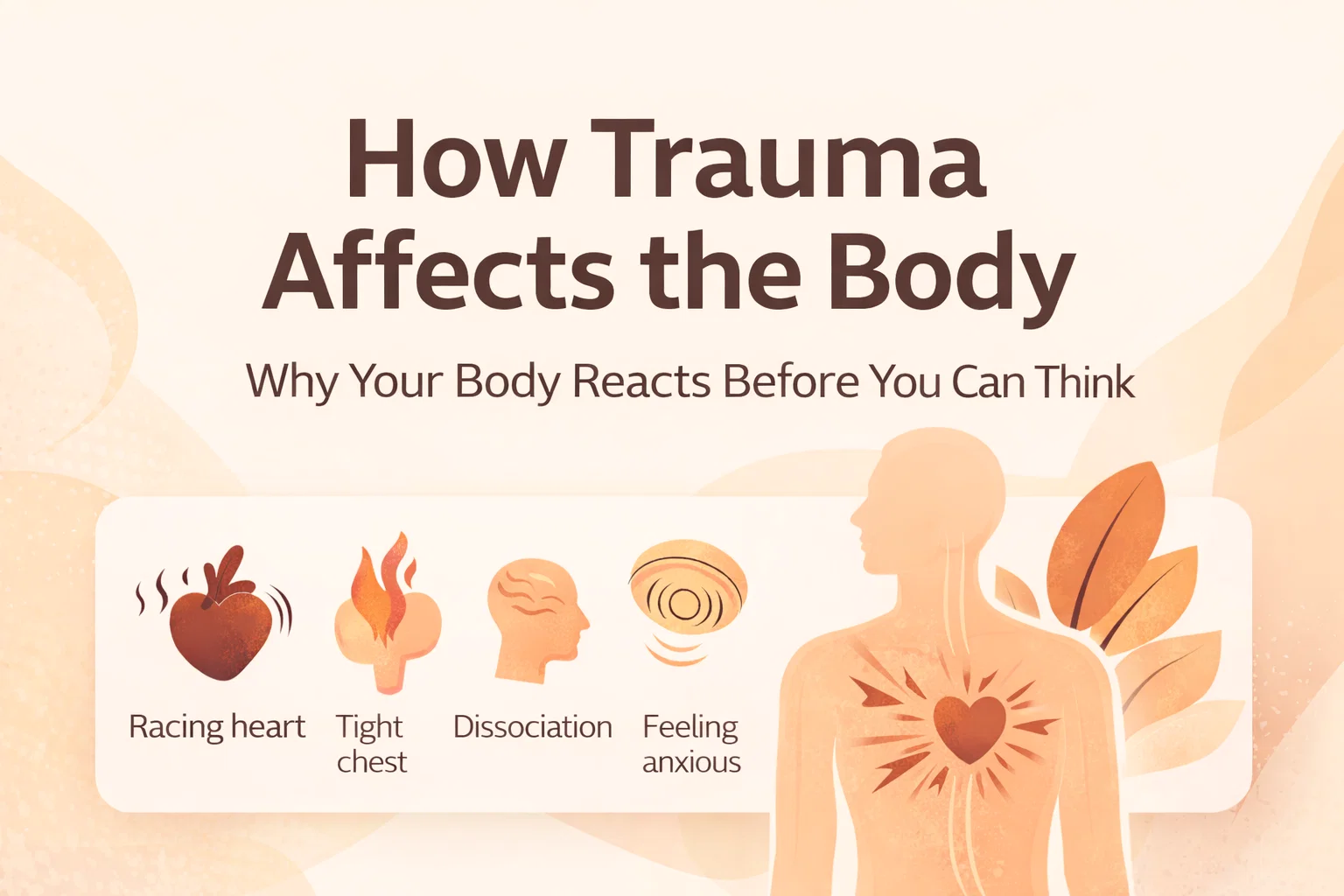
Our bodies are wired for survival above all else. When we experience something overwhelming or threatening, the brain’s amygdala acts as an alarm system, triggering the autonomic nervous system to take over. This happens in milliseconds, far faster than the prefrontal cortex—the thinking part of the brain—can process information. This is why you might find yourself in the middle of a “fight” or “flight” response before you have even identified the threat. Your body is not being dramatic; it is being efficient. It has learned through past experience that speed is the key to safety, and it would rather overreact to a false alarm than underreact to a real danger.
For those who have survived chronic stress or acute trauma, this alarm system can become stuck in the “on” position. This state, often called hypervigilance, means your body is constantly scanning the environment for threats. You might notice physical symptoms like a tight chest, a knotted stomach, or a heart that pounds at the slightest noise. These are not just “feelings.” They are physiological shifts in your heart rate, digestion, and hormone levels designed to prepare you for battle or escape. Recognizing these signs as biological signals is the first step in moving from self-criticism to self-compassion.
Beyond Fight or Flight: Understanding the Four Trauma Responses
Most people are familiar with fight or flight, but the human survival toolkit is much more diverse. Depending on the nature of the trauma and what worked for us in the past, our nervous systems might choose from four primary responses: Fight, Flight, Freeze, or Fawn. Each of these serves a specific protective purpose, and none of them are choices made by the conscious mind.
The Fight Response: Protective Activation
The fight response is an influx of energy meant to ward off a threat. In a modern context, this rarely looks like a physical brawl. Instead, it might manifest as intense irritability, a need for control, or a tendency to become highly argumentative. If your body believes that the only way to stay safe is to be the most powerful force in the room, it will keep you in a state of high mobilization. Understanding this can help reframe “anger issues” as a protective mechanism that is trying to keep you from being hurt again.
The Flight Response: Urgent Escape
Flight is the drive to get away from discomfort. This can be physical, such as literally leaving a room when things get tense, but it is often mental or behavioral. Chronic busyness, workaholism, and perfectionism are all forms of flight. By staying constantly in motion, the body attempts to outrun the underlying feelings of unease or pain. If you find it impossible to sit still or relax, your nervous system might be stuck in a flight loop, convinced that stopping means being caught by the “predator” of your past experiences.
The Freeze Response: Involuntary Pause
When a threat feels inescapable, the body may choose to shut down entirely to minimize pain. This is the freeze response. It often feels like numbness, brain fog, or a heavy sense of “spacing out” known as dissociation. People in a freeze state are often mislabeled as lazy or unmotivated, but in reality, their nervous system has hit the brakes so hard that they are physically unable to move forward. It is a profound state of internal paralysis designed to help a person survive an overwhelming situation by checking out mentally.
The Fawn Response: Appeasing to Stay Safe
Fawning is perhaps the most misunderstood survival response. It involves abandoning one’s own needs and boundaries to appease others and avoid conflict. If you grew up in an environment where your safety depended on the moods of others, your body learned that “people-pleasing” was a vital survival skill. Fawning isn’t about being “nice.” It is a sophisticated strategy to neutralize a threat by making oneself useful or non-threatening to an aggressor. Healing from a fawn response involves slowly relearning that it is safe to have boundaries and a voice of your own.
Reframing Coping Mechanisms and Substance Use
When the internal state of the body becomes too loud, too painful, or too chaotic, we naturally look for ways to dampen the noise. For many survivors, substances or compulsive behaviors become essential coping tools. It is important to look at these behaviors through a lens of compassion rather than judgment. Whether it is alcohol, food, or digital distractions, these tools are often used to temporarily soften overwhelming internal states. They are an attempt to achieve what the nervous system cannot do on its own: find a moment of peace.
People may turn to these tools to quiet internal noise, numb emotional or physical pain, or regain a sense of control in a world that feels dangerous. While these methods may have negative long-term consequences, they often started as a brilliant short-term solution for a body on high alert. Shifting the narrative from “What is wrong with me?” to “What happened to me?” allows us to address the underlying trauma rather than just fighting the symptoms of our coping mechanisms.
The Path to Somatic Healing: Learning Safety Again
If trauma lives in the body, then the body is where the healing must happen. Traditional talk therapy is incredibly valuable, but sometimes talking about a memory can actually re-trigger the nervous system if the body doesn’t feel safe. Somatic healing focuses on “bottom-up” processing, which means we work with the body’s sensations to communicate safety to the brain. Healing doesn’t come from force or “powering through.” It comes from repeated, tiny moments of safety that eventually convince the nervous system it is no longer in danger.
The Power of Grounding and Breathwork
Grounding is the practice of pulling your focus away from internal chaos and back to the present physical environment. This can be as simple as feeling the weight of your feet on the floor or naming five things you can see in the room. Similarly, intentional breathwork can manually override the “fight or flight” signal. By slowing down the exhale, you send a direct message to the vagus nerve that the emergency is over. Over time, these practices help expand your “window of tolerance,” allowing you to handle stress without immediately spiraling into a survival response.
Gentle Movement and Sensory Tools
Because trauma often involves a sense of being trapped, movement is a powerful medicine. This doesn’t mean a high-intensity workout; often, gentle movement like stretching, yoga, or even shaking out your limbs can help release stored energy. Sensory tools, such as weighted blankets, calming scents, or soothing textures, provide the nervous system with the external “warmth and comfort” it craves. These tools act as a physical hug for a weary nervous system, helping it transition from a state of high alert to a state of rest.
Building a Life Beyond Survival
Living in a state of constant survival is exhausting. It drains your energy, clouds your judgment, and makes it difficult to connect with others. But it is important to remember that your reactions make sense in the context of what you survived. Your body learned its lessons well, and those lessons kept you alive. Now, the goal is to teach the body that those extreme measures are no longer necessary. This process is rarely linear. There will be days when the old reflexes take over, and that is okay. The goal isn’t perfection; it is a gradual return to your own body.
Building safety is a practice of self-care and safe connection. Finding people who make you feel seen and secure can help co-regulate your nervous system. When we are around someone who is calm and grounded, our own bodies often begin to mirror that state. This is why supportive community and trauma-informed care are so vital. You don’t have to carry the weight of your survival patterns alone, and you certainly don’t have to apologize for the ways your body chose to protect you.
Conclusion: Honoring Your Journey
Understanding trauma in the body is a journey of returning home to yourself. It requires us to stop viewing our symptoms as enemies and start seeing them as messengers. Every racing heart and every moment of shutdown is a sign that a part of you is still trying to keep you safe. By greeting these responses with curiosity and kindness, we begin to take the power back from the past. You are not broken, and you are not your trauma. You are a person whose body did something incredible: it survived. Now, with patience, breath, and support, you can begin the beautiful work of learning how to thrive.