12 Hidden Emotions Behind Your Irritation Why You Are Actually Frustrated and Annoyed
Have you ever found yourself snapping at a loved one over a misplaced set of keys, or felt a surge of white-hot frustration because a coworker took slightly too long to reply to an email? In those moments, we usually label the feeling as simple irritation. We tell ourselves we are just having a bad day or that the people around us are being particularly difficult. However, what if that prickliness is actually a sophisticated shield? Modern psychology suggests that irritation is frequently a top-layer emotion, a fast and familiar protective mechanism that our nervous system uses to guard us against deeper, more vulnerable feelings that we aren’t quite ready to face.
The Anatomy of the Irritability Shield
To understand why we get irritated, we first have to look at the role of the nervous system. Our bodies are hardwired for survival, and that includes emotional survival. When we encounter a situation that makes us feel exposed, rejected, or powerless, our brain often perceives this as a threat. Sitting with the raw ache of being unappreciated or the heavy weight of shame is incredibly taxing. It requires a high level of emotional bandwidth and a sense of safety that we might not possess in the heat of the moment.
Irritation, on the other hand, feels active. It provides a temporary sense of control and distance. By focusing our energy outward through annoyance, we successfully distract ourselves from the tender, internal wounds that are actually driving the reaction. It is a biological shortcut designed to keep us moving, even when we are emotionally compromised. The problem is that while irritation protects us in the short term, it leaves the underlying issue unaddressed, leading to a cycle of chronic frustration and strained relationships.
Deconstructing the Layers: What Lies Beneath?
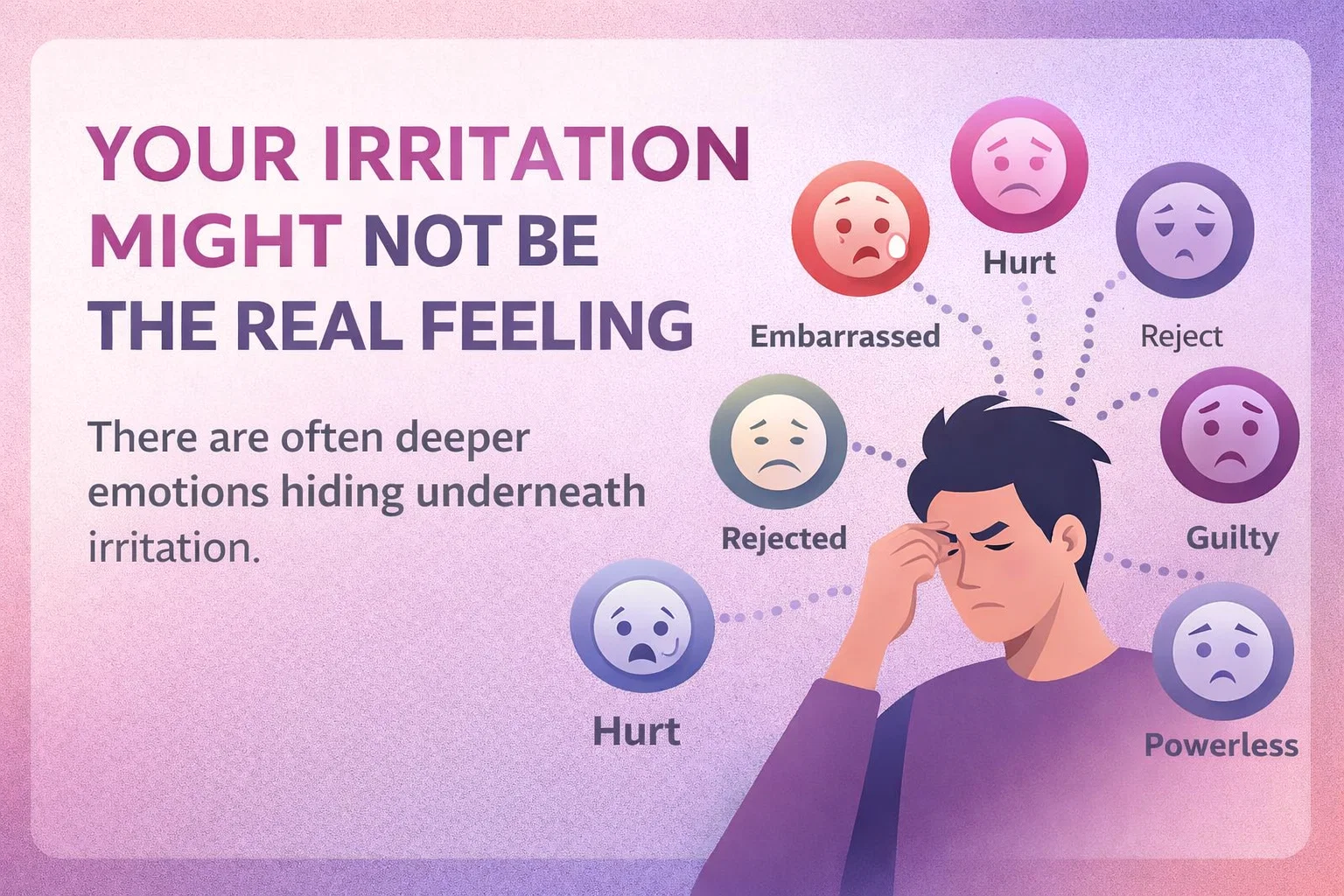
When we look past the surface level of a “bad mood,” we often find a complex map of human needs and missed connections. The image provided highlights several key emotions that frequently masquerade as irritation. By identifying these specific states, we can begin to apply the right kind of self-care and communication to resolve the tension.
The Weight of Feeling Unappreciated
One of the most common drivers of irritability is the sense that our efforts are invisible. When you go above and beyond at work or keep the household running without a single word of thanks, the resulting feeling isn’t just “annoyance.” It is the deep sting of being undervalued. We become irritable because we are trying to signal that we have reached our limit, but because we aren’t naming the need for appreciation, the cycle continues.
Powerlessness and the Loss of Agency
Nothing triggers a protective emotional response quite like feeling stuck. When you are in a situation where you have no influence over the outcome, your nervous system may enter a state of high alert. This often manifests as being “short” with people. You aren’t actually mad at the person asking you what is for dinner; you are reacting to a broader life circumstance where you feel you have no say.
The Role of the Nervous System in Emotional Regulation
Our nervous system operates on a spectrum between “rest and digest” and “fight or flight.” Irritation is a mild form of the fight response. When we are overwhelmed by too much input or too many demands, our capacity to process information diminishes. At this point, even the smallest additional request feels like an attack. This is why a messy kitchen can feel like a personal affront when you are already past your mental capacity.
Understanding this biological component is crucial because it shifts the narrative from “I am a mean person” to “My nervous system is overwhelmed.” When we view our irritation through the lens of biology, we can start to implement physical solutions. This might include deep breathing, stepping away from a stimulating environment, or simply acknowledging that we are in a state of sensory or emotional overload.
Identifying Your Emotional Triggers
To break the habit of falling into irritation, you must become an investigator of your own internal landscape. This requires a practice of pausing. The next time you feel that familiar heat rising in your chest, ask yourself a few direct questions. Am I actually mad about this specific event, or do I feel misunderstood? Did that comment hurt my feelings, and am I using anger to hide that hurt? Am I feeling guilty and trying to shift the responsibility onto someone else?
The Trap of Misunderstanding
We all have a fundamental desire to be seen and known. When our points are distorted or we feel we cannot clarify our intentions, the resulting frustration is immense. Irritation becomes a way to protest the lack of connection. If you find yourself frequently irritated during conversations, it might be worth exploring whether you feel truly heard by the people in your life.
Managing the Feeling of Being Controlled
Pressure and management from outside sources can lead to a feeling of being backed into a corner. For many, the natural response to being pressured is to push back with a prickly exterior. This is a boundary-setting mechanism, albeit an indirect one. Recognizing that you value your autonomy can help you set clearer, calmer boundaries rather than relying on irritation to keep people at bay.
Moving Toward Emotional Authenticity
The goal isn’t to never feel irritated again, but rather to use irritation as a signal to look deeper. When we allow ourselves to feel the “tender” emotions like disappointment, hurt, or embarrassment, we open the door to genuine healing. It takes a significant amount of courage to admit, “I’m not actually mad; I’m just really disappointed that you didn’t follow through.”
This level of vulnerability is the foundation of healthy relationships. It allows the people around us to understand what we actually need, rather than forcing them to navigate a minefield of unexplained annoyance. It also fosters a sense of internal peace. You no longer have to carry the heavy armor of irritation when you are comfortable standing in the truth of your actual experience.
Practical Strategies for Processing Irritation
Transitioning from reactive irritation to proactive emotional awareness takes time and practice. You can start by implementing a few simple habits into your daily routine. First, try naming the emotion. Research shows that “naming it to tame it” can significantly reduce the intensity of a feeling. Even if you only say it to yourself, acknowledging that you feel “invalidated” rather than “annoyed” changes the chemistry of the experience.
Second, look for patterns. Do you find yourself most irritable at a certain time of day or with a specific person? This often points toward a recurring theme of being overwhelmed or feeling unappreciated in a particular area of your life. Once the pattern is identified, you can address the root cause during a time when you are feeling calm and regulated.
The Power of Self-Compassion
It is important to remember that these protective mechanisms exist for a reason. You aren’t “wrong” for feeling irritated. Your brain is simply trying to look out for you. By approaching your irritation with curiosity rather than judgment, you create the safety necessary for those deeper feelings to surface. Treat yourself with the same kindness you would offer a friend who is struggling to articulate their pain.
Conclusion: The Path to Emotional Freedom
Irritation is a powerful messenger, but it is a poor master. While it serves as a fast and familiar shield for our more sensitive parts, it ultimately keeps us isolated and stuck in a loop of frustration. By taking the time to peer beneath the surface and examine the twelve common drivers of irritation, from feeling rejected to feeling guilty, we can begin to dismantle the defensive walls we have built.
The journey toward emotional clarity is not about being perfect; it is about being present. It is about recognizing when your nervous system is sounding the alarm and having the tools to navigate that alarm with grace. As you learn to identify and express the real feelings hiding under your irritation, you will find that your relationships become deeper, your stress levels decrease, and your sense of self-awareness grows. Tomorrow, when that first spark of annoyance flares up, take a breath and ask what is really going on. You might be surprised by the beautiful, tender truth waiting to be heard.