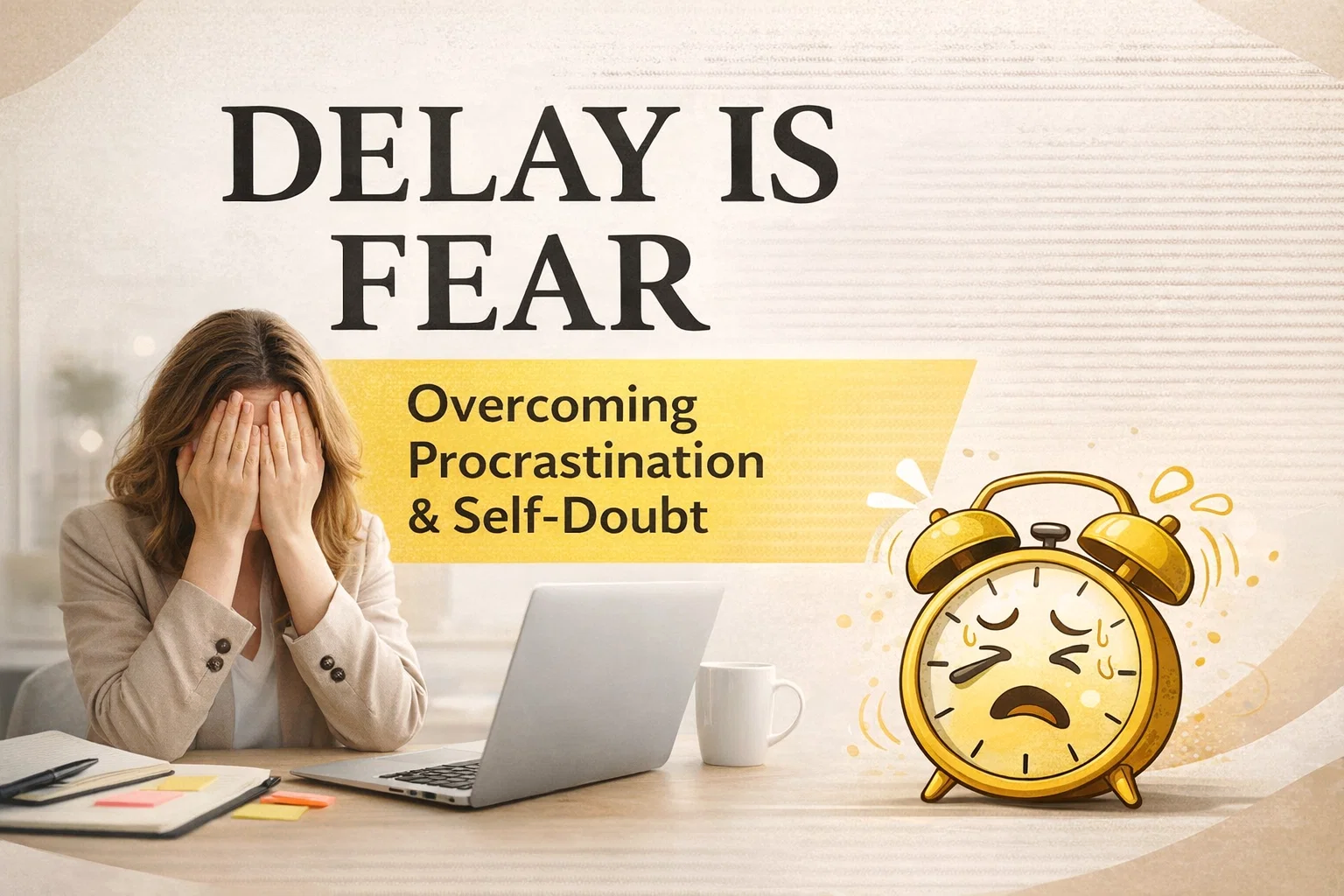
Stop Procrastinating Why Delaying Is Actually Fear of Failure How to Overcome It
We have all been there. You have a project sitting on your desk, a dream tucked away in a notebook, or a difficult conversation you have been avoiding for weeks. You tell yourself you are just waiting for the right moment, or perhaps you just need one more coffee before you dive in. But if we are being honest, that wait is rarely about timing. As the insightful Codie Sanchez points out, delay is often just a sophisticated mask for fear. It is a protective mechanism designed to keep us safe from the one thing we dread most: the realization that we might not be good enough.
Procrastination is frequently misunderstood as a character flaw or a lack of discipline. In reality, it is an emotional regulation problem. We avoid tasks that make us feel anxious, insecure, or overwhelmed. By pushing the task into the future, we get a temporary hit of relief. But that relief is a trap. It builds a wall between who we are and who we want to be. Understanding the deep connection between delay and fear is the first step toward reclaiming your productivity and, more importantly, your self-worth.
The Psychology of Procrastination: Why We Hide Behind Delay
To stop the cycle of delay, we must first look under the hood of our own psychology. Most people believe they procrastinate because they are lazy. However, research suggests that procrastination is actually an avoidance strategy. When we face a task that challenges our self-image, our brain’s amygdala triggers a fight-or-flight response. Since we cannot literally run away from a spreadsheet or a business plan, we “run” by scrolling through social media or cleaning the kitchen instead.
The Perfectionist’s Paradox
Perfectionism is one of the leading causes of fear-based delay. If you believe that your work must be flawless to have value, the stakes become impossibly high. If you don’t start, you can’t fail. In the mind of a perfectionist, a project that hasn’t been started yet still holds the potential for perfection. Once you put pen to paper, that potential is replaced by reality, which might include mistakes. Therefore, delay becomes a way to preserve the fantasy of being “naturally gifted” or “perfect” without ever having to prove it.
Protecting the Ego
At the core of the image we analyzed is a powerful truth: procrastination protects the part of you that is scared of being inadequate. This is known as self-handicapping. By delaying a task until the very last minute, you create a built-in excuse. If the final product isn’t great, you can tell yourself, “Well, I only spent two hours on it.” This protects your ego from the devastating thought that you gave it your all and still fell short. It is a defense mechanism that keeps your potential “safe” but your progress stagnant.
The Real Cost of Playing It Safe
While delay feels like safety in the short term, it carries a heavy price tag in the long run. Every time you choose to delay, you are sending a message to your subconscious that you don’t trust yourself to handle the outcome. This erodes self-confidence and creates a chronic state of low-level anxiety. You aren’t actually relaxing when you procrastinate; you are just enduring a “dark playground” where the fun is tainted by the looming shadow of the unfinished task.
The Myth of “I Work Better Under Pressure”
Many chronic procrastinators claim they need the adrenaline of a deadline to perform. While the stress of a looming cutoff can force focus, it rarely produces your best work. More importantly, it prevents you from experiencing the “flow state” where true creativity and innovation happen. When you work under pressure, you are merely surviving the task. When you give yourself time, you are mastering it. Delay robs you of the opportunity to see what you are truly capable of when you are not in survival mode.
The Regret of the Untried Path
Not trying is the real failure. This is perhaps the most stinging part of the quote in the image. Failure is a data point; it tells you what didn’t work and how to pivot. But delay is a void. It provides no feedback, no growth, and no movement. Years from now, you are unlikely to regret the times you tried and stumbled. You are, however, almost certain to regret the things you never started because you were too busy waiting to feel “ready.”
Strategies to Turn Fear into Action
If delay is fear, then the antidote is not “better time management” alone. The antidote is courage and a shift in perspective. You have to learn how to move forward while the fear is still present. Action is not what happens after fear leaves; action is what eventually invites fear to take a back seat.
The Five Minute Rule
One of the most effective ways to bypass the fear response is to lower the barrier to entry. Tell yourself you will work on the task for only five minutes. After five minutes, you are legally allowed to stop. Usually, the hardest part of any task is the transition from doing nothing to doing something. Once you break the seal of “not doing,” the fear often dissipates because the brain realizes the task isn’t the existential threat it imagined it to be.
Focus on Process Over Outcome
To beat the perfectionism trap, shift your focus away from the final result and toward the immediate process. Instead of saying “I need to write a brilliant blog post,” say “I am going to write three paragraphs today.” By making the goal about the activity rather than the quality of the outcome, you take the pressure off your ego. You give yourself permission to be “good enough” for today, which is the only way to eventually become great.
Reframing Failure as a Tool for Growth
We fear failure because we view it as a verdict on our identity. We think “I failed” means “I am a failure.” To overcome the urge to delay, we must reframe failure as an essential part of the learning process. In the world of tech and startups, there is a common phrase: “Fail fast, fail often.” This is because the faster you fail, the faster you learn what works.
Building Resilience through Small Wins
Confidence is not something you are born with; it is something you build through a history of kept promises to yourself. Every time you face a task you were tempted to delay and do it anyway, you earn a “win.” These small wins accumulate over time into a sense of self-efficacy. You begin to realize that even if you aren’t “good enough” yet, you have the capacity to learn and improve. The fear doesn’t necessarily go away, but your belief in your ability to handle it grows much larger.
The Power of “Yet”
When that voice in your head says “I’m not good enough,” add one simple word to the end: “Yet.” This shifts your mindset from a fixed one to a growth one. You might not be a master of your craft yet. You might not have the perfect business plan yet. That is okay. Growth requires a period of being “not good.” Delay only prolongs that uncomfortable period; action is the only way through it.
Creating an Environment for Success
While the root of procrastination is emotional, your physical and digital environment can either help or hinder your efforts to overcome fear. If your workspace is cluttered and your phone is buzzing with notifications, you are giving your fear an easy escape route. By designing an environment that minimizes distractions, you make it easier to stay with the discomfort of the task until it passes.
Digital Minimalism and Focus
Social media is the ultimate refuge for the fearful mind. It provides instant validation and a quick dopamine hit that temporarily numbs the anxiety of a challenging task. When you are ready to do deep work, put your phone in another room. Use website blockers to restrict your access to distracting sites. By removing the easy “outs,” you force yourself to confront the task at hand. You will find that when there is nowhere else to go, your brain eventually settles into the work.
The Importance of Self-Compassion
Paradoxically, being hard on yourself for procrastinating usually makes you procrastinate more. Guilt and shame are heavy emotions that only add to the “fear” pile. If you had a bad day and got nothing done, forgive yourself and start fresh the next hour. Self-compassion allows you to acknowledge that you are human and that starting is hard. It lowers the emotional temperature and makes it easier to try again without the weight of yesterday’s failures holding you back.
Conclusion: Choosing Courage Over Comfort
The message in the image is a call to arms for anyone who has been waiting on the sidelines of their own life. Delay is a comfortable prison. It feels safe because it protects us from the vulnerability of being judged or falling short. But that safety is an illusion that leads to a life of “what ifs” and unfulfilled potential. The real failure is not the mistake you might make; it is the life you never lived because you were too afraid to begin.
Moving forward requires a radical acceptance of imperfection. It requires you to look at that task, that dream, or that goal and say: “I might not be good enough yet, and I might fail, but I am going to do it anyway.” When you stop delaying, you stop living in fear. You reclaim your agency and your future. So, take that first step today. It doesn’t have to be a big step; it just has to be a real one. Break the cycle of delay, face the fear, and watch as your world begins to expand in ways you never thought possible.
Would you like me to generate a list of actionable “micro-tasks” to help you start your next big project without the overwhelm?