How to Stop Overthinking Build Emotional Stability 20 Mental Health Tips
We have all been there. It is 2:00 AM, the house is silent, but your mind is running a marathon at full speed. You are replaying a conversation from three years ago, worrying about a meeting that has not happened yet, or dissecting a minor text message for hidden meanings. This mental loop is more than just a nuisance; it is a significant drain on your emotional energy. Overthinking is the art of creating problems that werent even there, and when it becomes a habit, it erodes your mental health and leaves you feeling constantly on edge.
The good news is that emotional stability is not a fixed personality trait that you either have or you dont. It is a skill set. Just like physical fitness, your mental resilience can be built through consistent, intentional practice. By learning to navigate your thoughts rather than being controlled by them, you can create a sense of internal calm that remains steady even when life gets chaotic. This guide explores twenty practical, transformative strategies to help you quiet the noise and reclaim your peace.
The Anatomy of Overthinking
Before we dive into the solutions, it is helpful to understand what is actually happening in your brain when you overthink. Often, overthinking is a misguided attempt at self-protection. Your brain believes that if it analyzes every possible variable or rehearses every potential disaster, it can keep you safe from pain or failure. However, this process usually leads to analysis paralysis, where the fear of making the wrong choice prevents you from making any choice at all.
The Cycle of Rumination
Rumination is the repetitive focus on the causes and consequences of your distress. Unlike active problem solving, which looks for a way out, rumination just keeps you stuck in the hole. It turns a single bad moment into a global disaster. Breaking this cycle requires a shift from “Why is this happening?” to “What is happening right now?” and “How can I respond with kindness?”
20 Practical Strategies for a Calmer Mind
Building emotional stability starts with small, daily shifts in how you interact with your own mind. Here are twenty ways to start reducing the mental clutter today.
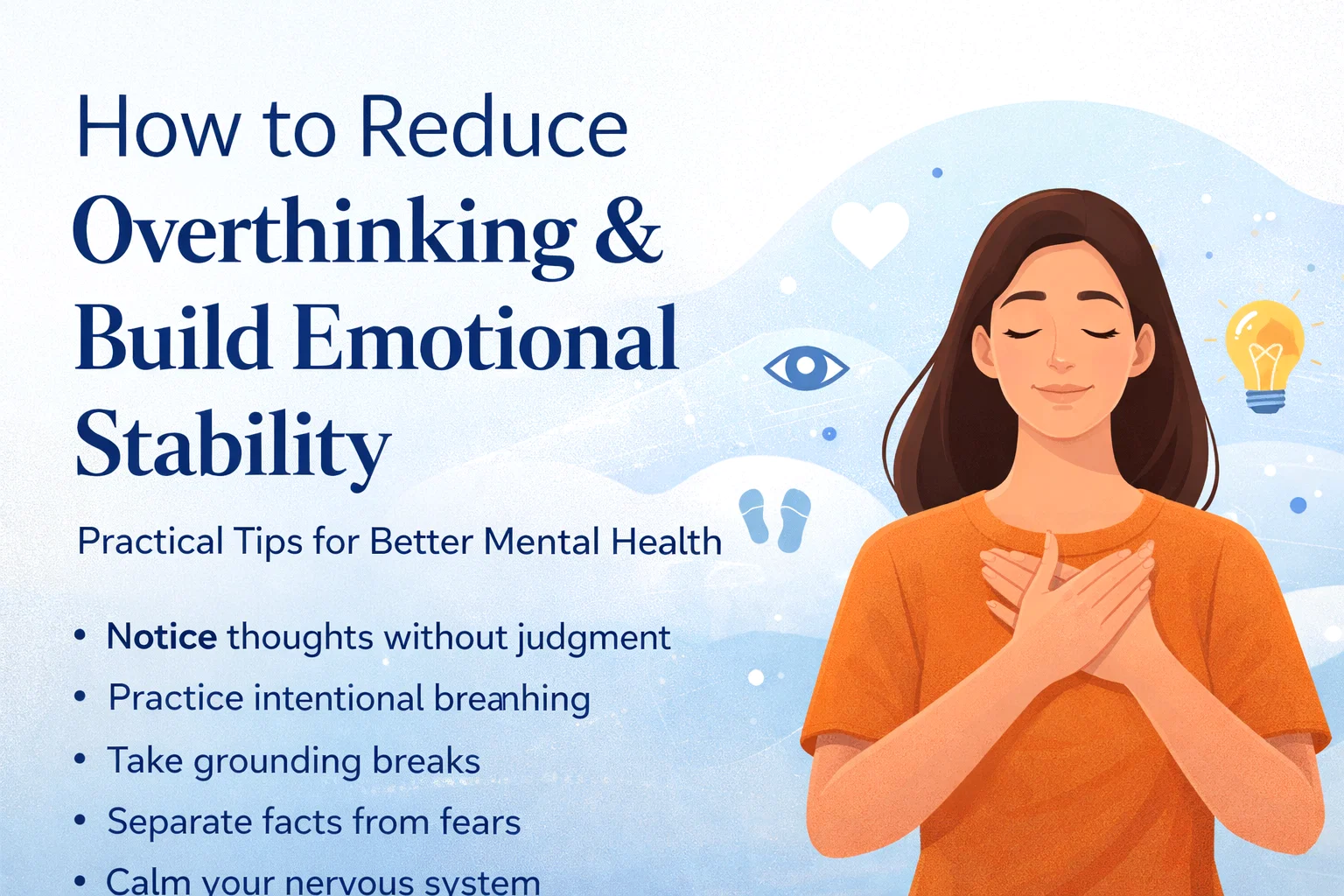
1. Notice Your Thoughts Without Judging Them
Most of our mental distress comes from our reaction to our thoughts, not the thoughts themselves. When a negative thought pops up, try to observe it like a passing cloud. Instead of saying, “I shouldn’t be thinking this,” try saying, “I am noticing a thought about being unprepared.” This creates a healthy distance between you and your mind.
2. Pause Before Reacting to Emotions
Emotions are like waves; they peak and then they recede. When you feel a surge of anger, anxiety, or sadness, give yourself a mandatory sixty-second pause before you speak or act. This brief window allows your logical brain to catch up with your emotional center, preventing impulsive reactions that you might regret later.
3. Focus on Slow Intentional Breathing
Your breath is the remote control for your nervous system. When you overthink, your breathing usually becomes shallow and fast, signaling a “fight or flight” response. By consciously slowing your breath and extending your exhales, you send a physical signal to your brain that you are safe, which naturally quietens anxious thoughts.
4. Accept Discomfort Without Resisting It
Paradoxically, the more we fight against feeling uncomfortable, the more intense the discomfort becomes. Emotional stability comes from the realization that you can be uncomfortable and okay at the same time. Accepting a difficult feeling does not mean you like it; it just means you are no longer wasting energy trying to wish it away.
5. Stop Searching for Perfect Answers
Overthinkers often get stuck looking for the “perfect” solution that guarantees zero risk. The truth is that life is inherently uncertain. Aim for “good enough” rather than “perfect.” Making a decision and adjusting as you go is almost always better than staying frozen in place.
6. Limit Mental Rehearsing of Scenarios
While a little preparation is good, rehearsing an argument or a presentation fifty times in your head does not make you more prepared; it just makes you more exhausted. When you catch yourself in a rehearsal loop, gently tell yourself, “I have done enough thinking for now. I will handle the situation when it actually arrives.”
7. Separate Facts from Imagined Fears
Our brains are world-class storytellers. When someone doesnt text back, the fact is: “They haven’t replied.” The imagined fear is: “They are mad at me and the friendship is over.” Practice catching yourself when you add a story to a simple fact. Stick to what you know for sure.
8. Take Small Grounding Breaks Daily
You do not need to meditate for an hour to find peace. Take thirty seconds several times a day to feel your feet on the floor, listen to the sounds around you, or notice the temperature of the air. These tiny “micro-breaks” prevent stress from building up to an unmanageable level.
9. Release Unrealistic Expectations Gently
Much of our overthinking stems from “shoulds.” I should be further along in my career, I should be happier, or I should be more productive. These rigid expectations create constant friction. Try replacing “I should” with “I would like to,” and watch how the pressure begins to lift.
10. Speak Kindly to Yourself Internally
Notice the tone of your inner voice. Would you speak to a dear friend the way you speak to yourself? If the answer is no, it is time for a change. Self-compassion is a powerful antidote to overthinking because it reduces the fear of failure that fuels the mental loop.
11. Avoid Over-Analyzing Minor Details
Ask yourself: “Will this matter in five years? In five months? Even in five days?” If the answer is no, give yourself permission to stop thinking about it. Not every detail deserves a seat at the table of your attention.
12. Trust Your Ability to Cope
Emotional stability is not about knowing that nothing bad will ever happen. It is about knowing that if something bad does happen, you have the inner resources to handle it. Reflect on past challenges you have overcome to remind yourself of your resilience.
13. Stay Present in Simple Tasks
Washing the dishes, walking to the car, or drinking a cup of coffee are all opportunities for mindfulness. When your mind starts to wander into the past or future, bring it back to the sensory experience of the task at hand. The present moment is the only place where overthinking cannot survive.
14. Let Go of Constant Reassurance Seeking
It is natural to want a second opinion, but constantly asking others for validation can actually increase anxiety because it teaches your brain that you cannot trust your own judgment. Practice making small decisions entirely on your own and sitting with the results.
15. Calm Your Nervous System First
You cannot think your way out of a physiological state of panic. If your heart is racing and your palms are sweaty, stop trying to “figure things out.” Instead, use cold water on your face, a weighted blanket, or a quick walk to calm your body first. Once the body is calm, the mind will follow.
16. Reduce Exposure to Stressful Inputs
We live in an era of information overload. If the news or social media is triggering your overthinking, set firm boundaries. You do not need to be accessible to the world’s problems 24/7 to be an informed and caring person.
17. Keep Decisions Simple and Clear
Complexity is the playground of the overthinker. When faced with a choice, try to boil it down to the most basic elements. What is the core goal? What is the very next step? Ignore everything else until that step is taken.
18. Allow Silence Without Filling It
Many of us use constant noise (podcasts, music, TV) to drown out our thoughts. While this works temporarily, it prevents us from processing our emotions. Practice sitting in silence for a few minutes each day. It might be uncomfortable at first, but it is essential for building a peaceful relationship with your mind.
19. Rest When Your Mind Feels Heavy
Sometimes, overthinking is simply a sign of mental fatigue. Just as your muscles need rest after a workout, your brain needs downtime. If you are stuck in a loop, it might be that you just need a nap, an early night, or a day away from screens.
20. Return Attention to the Present
The mind will always wander; that is what minds do. The practice of emotional stability is not about having a perfectly still mind, but about getting really good at noticing when you have wandered off and gently bringing yourself back to the “now” over and over again.
Building a Sustainable Practice
Implementing all twenty of these strategies at once would likely lead to more overthinking! The key is to choose one or two that resonate with you and practice them consistently for a week. Maybe you start with the “sixty-second pause” or focusing on your breath during your morning commute. Over time, these small actions rewire your brain, making calm the new default setting rather than chaos.
Emotional stability is a journey, not a destination. There will be days when the mental loops feel louder than others, and that is perfectly okay. The goal is not to become a robot who never feels stress, but to become a person who knows how to navigate stress without being consumed by it.
Conclusion: Your Peace is Worth the Effort
Reducing overthinking is one of the greatest gifts you can give to your mental health. It frees up the energy you used to spend on “what ifs” and allows you to invest it in the things that actually matter: your relationships, your passions, and your well-being. By practicing mindfulness, setting boundaries with your thoughts, and treating yourself with the kindness you deserve, you create a foundation of emotional stability that can weather any storm.
Remember that you are the observer of your thoughts, not the thoughts themselves. You have the power to choose where your attention goes. Start small, be patient with yourself, and watch as the mental fog clears to reveal a more centered, peaceful version of you. Your mind is a beautiful place to be; it just takes a little practice to keep it that way.