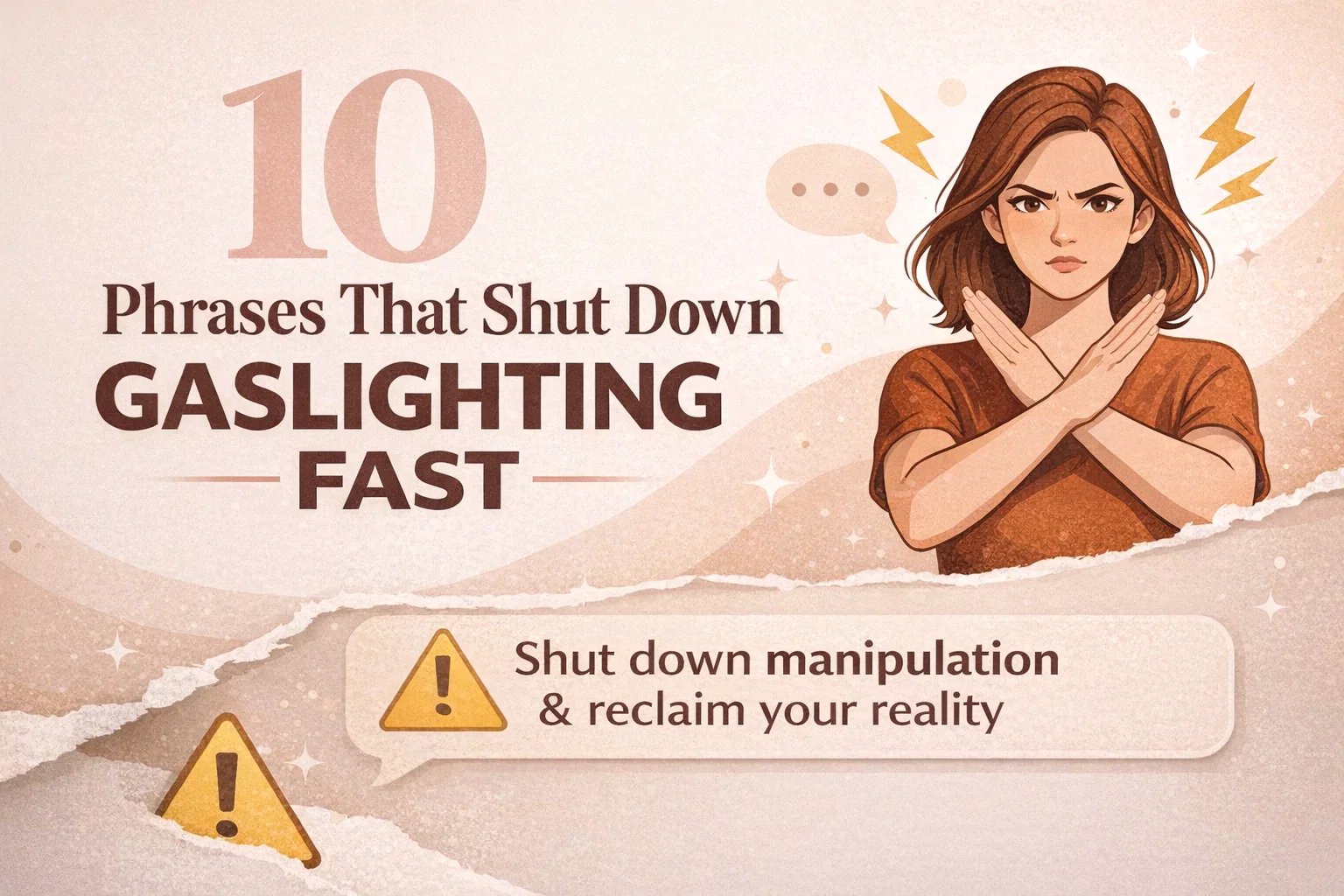
10 Powerful Phrases to Shut Down Gaslighting and Reclaim Your Reality
Gaslighting is one of the most insidious forms of emotional manipulation because it strikes at the very core of your identity: your trust in yourself. It is a slow, methodical process where one person makes another question their own perceptions, memories, and sanity. Whether it happens in a romantic relationship, a toxic workplace, or even within a family dynamic, the impact is the same. You feel unsteady, confused, and perpetually apologetic for things you didn’t even do. But here is the truth: you are allowed to trust your own mind. You are allowed to hold onto your reality, even when someone else is trying desperately to rewrite it.
The image above highlights ten powerful phrases that act as a shield against these tactics. These are not just words; they are boundaries. They are a way to signal to a manipulator that their tactics are no longer working. In this guide, we are going deeper into why these phrases work, how to identify the signs of gaslighting, and how to reclaim your power when someone tries to dim your light.
Understanding the Mechanics of Gaslighting
Before we can effectively use these phrases, we have to understand what we are up against. Gaslighting is not just a simple lie. It is a repetitive pattern of behavior designed to gain power and control. The goal of the gaslighter is to make the victim dependent on the gaslighter’s version of reality.
The Three Stages of Gaslighting
- Disbelief: In the beginning, you might notice something is off. You think, “That’s weird, I’m sure I said that,” but you shrug it off as a misunderstanding.
- Defense: This is where you start to argue. You spend hours trying to prove your point or showing evidence to the gaslighter. You are still fighting for your reality, but you are exhausted.
- Depression: By this stage, you have lost your spark. You stop arguing because you believe they might be right. You start to apologize constantly and lose touch with your own intuition.
Breaking this cycle requires a firm shift in how you communicate. You have to stop trying to “win” the argument and start focusing on protecting your peace. The phrases in the image are designed to do exactly that by ending the debate before it drains you.
Analyzing the 10 Phrases to Reclaim Your Reality
Let’s break down why these specific responses are so effective at shutting down manipulation. Each one targets a specific tactic used by gaslighters, from denial to shifting blame.
1. “That’s not what happened and I won’t pretend it is.”
This is a direct strike against “countering,” a tactic where the manipulator challenges your memory. By using this phrase, you are refusing to participate in a false narrative. You aren’t asking for permission to remember correctly; you are stating a fact. It ends the negotiation over what is true.
2. “Your denial doesn’t change my reality.”
Gaslighters rely on the idea that if they deny something long enough, it ceases to exist. This phrase reinforces that your internal truth is independent of their external validation. It is a powerful reminder that you do not need them to agree with you to know what you experienced.
3. “I trust my memory more than your version.”
One of the hardest things to maintain in a toxic dynamic is self-trust. By saying this out loud, you are performing an act of self-reclamation. You are choosing yourself over the manipulator’s influence. It signals that their attempts to make you feel “crazy” or “forgetful” are failing.
4. “If you wanted clarity, you wouldn’t twist my words.”
This phrase addresses “diversion.” Manipulators often take a valid point you made and twist it into something unrecognizable to put you on the defensive. This response calls out the behavior directly, identifying that their goal is confusion, not communication.
5. “You’re avoiding accountability not correcting me.”
Gaslighters often mask their manipulation as “help” or “correction.” They act as if they are simply trying to help you see the “truth.” This phrase strips away that mask and identifies the behavior as a deflection of responsibility.
The Importance of Emotional Boundaries
Setting boundaries is not about changing the other person’s behavior; it is about deciding what you will tolerate. When you are dealing with someone who uses gaslighting, you have to realize that you cannot logic them out of a position they didn’t logic themselves into. They are using these tactics because they work to keep them in control.
6. “My emotions aren’t irrational just because you don’t like them.”
A common gaslighting move is to label the victim as “too sensitive” or “hysterical.” This is called “trivializing.” By asserting that your emotions are valid, you stop the manipulator from using your feelings as a weapon against you. Your feelings are data, and they are always valid indicators of your internal state.
7. “Invalidating me won’t make me agree with you.”
This phrase is about the “bottom line.” It tells the gaslighter that their strategy is ineffective. If they realize that their pressure isn’t resulting in your submission, they may eventually stop, or at the very least, you will have preserved your integrity.
8. “You act confused when the truth makes you uncomfortable.”
Have you ever noticed that a gaslighter is suddenly “confused” when you bring up a clear fact? This is “feigning ignorance.” This phrase shines a light on that performance. It acknowledges that the confusion is a choice, not a lack of understanding.
Identifying the Signs: Are You Being Gaslit?
Sometimes it is hard to see the forest through the trees. If you aren’t sure if you need these phrases, look for these internal red flags in your daily life:
- Constant Second-Guessing: You find yourself checking old texts or emails constantly to verify that you aren’t imagining things.
- The “Am I Too Sensitive?” Loop: You ask yourself this question multiple times a day.
- Social Withdrawal: You stop telling friends or family about your relationship because you don’t want to explain the “misunderstandings” or you’re embarrassed by how you’re being treated.
- The Apology Reflex: You find yourself saying “I’m sorry” even when you know you did nothing wrong, just to keep the peace.
If these feel familiar, it is time to start practicing the final two phrases from our list.
9. “You’re not misunderstood you’re manipulative.”
This is perhaps the boldest phrase on the list. It stops the “poor me” act that many manipulators use. They often claim they are just “misunderstood” to garner sympathy. This phrase calls the behavior exactly what it is, removing the victim status from the perpetrator.
10. “This conversation ends where your honesty does.”
This is the ultimate boundary. It is an exit strategy. It informs the other person that you will only engage in a reality-based conversation. If they choose to lie or manipulate, you choose to leave. It places the power back in your hands.
Building Your “Reality Toolkit”
Words are a great start, but healing from gaslighting requires a holistic approach. Beyond using these phrases, you need to rebuild the foundation of your self-esteem. Here are a few ways to strengthen your connection to reality:
Keep a “Reality Journal”
When something happens that feels “off,” write it down immediately. Include the date, what was said, and how you felt. When the gaslighting starts later, you don’t have to rely on your memory alone. You have a written record that belongs only to you. This is for your eyes only; do not show it to the gaslighter, as they will likely try to dismiss the journal itself.
Reconnect with Your Support System
Gaslighters thrive in isolation. They want to be your only source of information. Reach out to friends, a therapist, or a support group. Hearing a neutral third party say, “That sounds really unfair,” can be the “aha” moment that breaks the spell of manipulation.
Practice Mindful Grounding
Gaslighting makes you feel like you are floating or untethered. Grounding exercises help bring you back into your body. Simple things like noticing five things you can see, four things you can touch, and three things you can hear can pull you out of the mental fog and back into the present moment.
Conclusion: Your Truth Is Non-Negotiable
Reclaiming your life from gaslighting is not an overnight process. It takes courage to stand up and say, “I trust myself,” especially when you have been told for a long time that you shouldn’t. However, every time you use one of these phrases, you are doing more than just winning an argument. You are rebuilding your soul. You are teaching yourself that your voice matters and that your perspective is valid.
Remember that you do not have to convince the other person that you are right. You only have to be convinced yourself. If someone consistently refuses to meet you in a place of honesty and respect, the most powerful thing you can do is walk away. You deserve relationships built on transparency, safety, and mutual respect. Don’t let anyone convince you otherwise. Your reality is yours to keep, and it is worth protecting with everything you have.