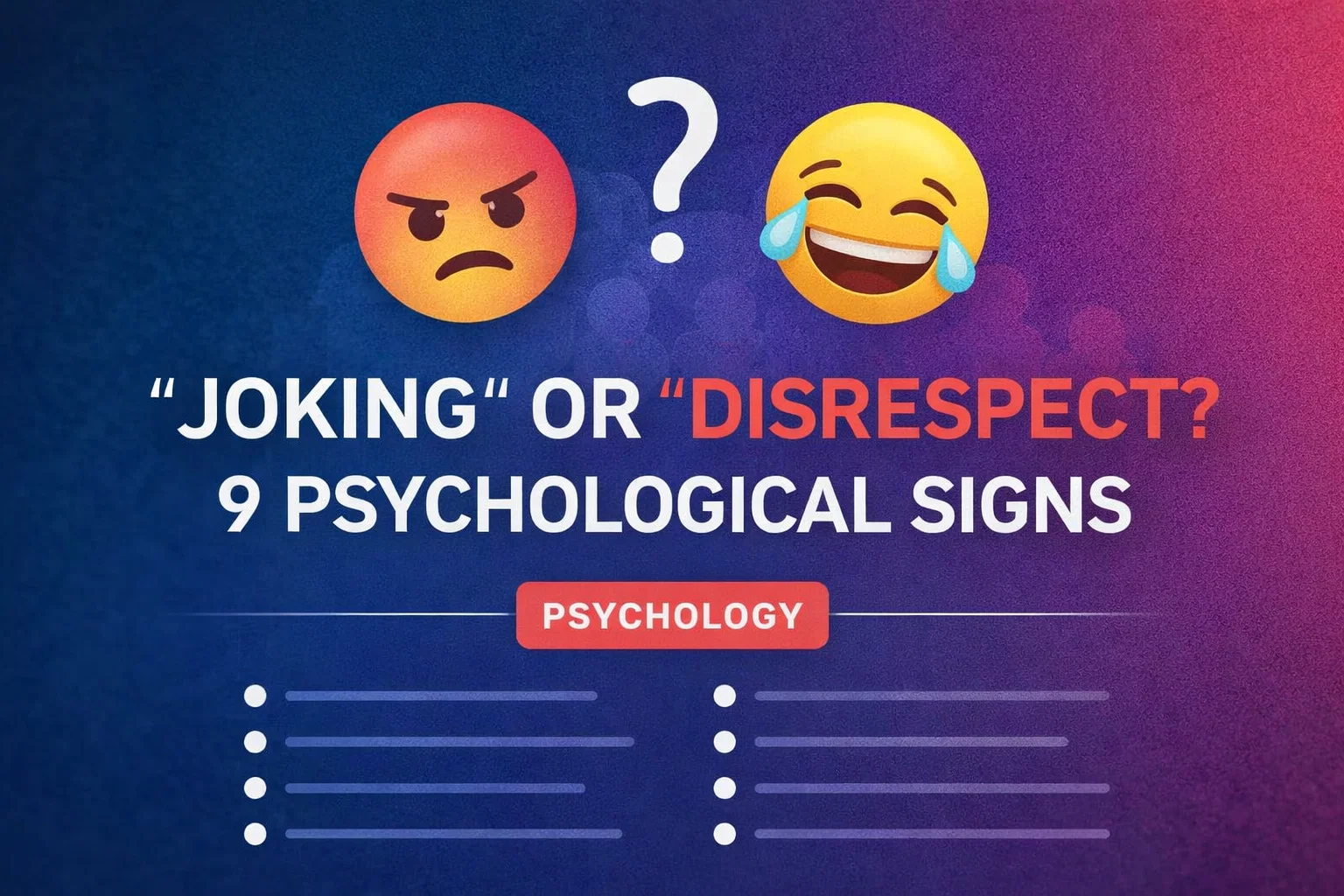
9 Signs Its Not a Joke But Disrespect Identifying Toxic Behavior and Hidden Red Flags
Have you ever walked away from a conversation feeling slightly deflated, only to be told that you are being too sensitive or that it was just a joke? It is a common experience that can leave you questioning your own perception of reality. Navigating the murky waters of social interactions requires more than just a good sense of humor; it requires a high level of emotional intelligence to distinguish between playful banter and subtle disrespect. Understanding the psychological truths behind these interactions is essential for maintaining your mental wellness and fostering self-love. When we recognize the patterns that undermine our value, we empower ourselves to set firmer boundaries and surround ourselves with people who truly uplift us.
The Fine Line Between Humor and Hostility
Humor is one of the most powerful tools for human connection. It breaks the ice, relieves stress, and builds a sense of camaraderie. However, humor can also be used as a shield or a weapon. When someone uses a joke to deliver a pointed critique or a personal attack, they are often engaging in a form of passive-aggressive behavior. The psychological impact of this is significant because it puts the recipient in a “no-win” situation. If you speak up, you are the one who cannot take a joke. If you stay silent, you absorb the disrespect.
The key to identifying these moments lies in the intent and the aftereffect. Genuine joking feels inclusive and lighthearted. Disrespect, even when wrapped in a laugh, feels exclusionary and heavy. By paying attention to how your body reacts—perhaps a tightening in the chest or a sudden dip in energy—you can begin to identify when a boundary has been crossed. Developing this internal radar is a vital part of your personal growth journey.
Decoding the Interrogation Style
Communication should be a two-way street, a flow of information and empathy. However, some individuals use an interrogation style that mimics a conversation but feels more like a cross-examination. In this dynamic, the person asks questions not because they are curious about your perspective, but because they are looking for a hole in your logic or a weakness in your argument. It is a subtle power move designed to make you feel defensive.
When you are being interrogated rather than engaged, the atmosphere shifts from collaborative to combative. This tactic is often used to assert intellectual dominance. If you find yourself constantly explaining your choices or defending your thoughts against a barrage of “why” questions that feel like traps, take a step back. Recognize that you are not obligated to win a debate just to have your feelings or ideas validated.
The Impact of Constant Comparison
Comparison is often called the thief of joy, but when it is weaponized by someone else, it becomes a tool for inadequacy. The comparison trap involves someone constantly pointing out others who are doing better, working harder, or achieving more. While it might be framed as “motivation,” the underlying message is often that you are not enough as you are.
This behavior is a red flag for a lack of respect for your unique path and pace. Everyone has their own timeline for success and personal development. A true peer or mentor encourages you based on your own potential, not by measuring you against a curated version of someone else. Breaking free from this trap requires a strong foundation of self-care and the realization that your value is inherent, not comparative.
The Quiet Signs of Disregard
Not all disrespect is loud. In fact, some of the most damaging behaviors are the ones that happen in the silences. Consider the “subtle sigh”—that heavy, audible exhale that occurs right as you begin to speak. It is a non-verbal cue that signals boredom, impatience, or a lack of value for what you have to contribute. Over time, these small gestures can erode your confidence in sharing your thoughts.
Similarly, the “plans destroyer” behavior reflects a fundamental lack of respect for your time. We all have emergencies, but a pattern of last-minute cancellations with weak excuses suggests that your schedule is a low priority. Respecting someone’s time is a basic tenet of a healthy relationship. When your time is consistently treated as disposable, it is a clear sign that the balance of respect is off.
Unsolicited Corrections and Public Dominance
Have you ever been in the middle of a story only to have someone stop you to correct your grammar or a minor, irrelevant fact? Doing this in public is rarely about being helpful; it is almost always about asserting dominance. It shifts the focus from the substance of what you are saying to a mistake you made, effectively stripping you of your authority in that moment.
This tactic, known as the unsolicited correction, is a way for someone to signal that they are more knowledgeable or observant than you. It creates a hierarchy where you are the student and they are the teacher. In a respectful partnership or friendship, these minor slips are either ignored or handled privately and gently. Recognizing this as a power move helps you see the behavior for what it is: an insecurity on their part rather than a failure on yours.
Protecting Your Success and Your Peace
Success shaming is a particularly painful form of disrespect because it targets your highlights. This happens when someone makes you feel guilty for your achievements or minimizes your hard work. They might bring up your past failures to “keep you humble” or suggest that your success was merely a stroke of luck. This behavior usually stems from a desire to keep you small so that they do not feel diminished by your growth.
True supporters celebrate your wins as if they were their own. They understand that your success does not take away from theirs. If you find yourself dimming your light to make someone else comfortable, it is time to re-evaluate that connection. Surround yourself with people who are inspired by your progress and who encourage you to aim even higher.
The Importance of Information Equality
In any healthy partnership, whether personal or professional, information is a shared resource. Information hoarding—keeping important news or updates from you until the very last second—is a way to maintain control. It prevents you from being a full participant in decision-making and keeps you in a reactive state. This behavior signals that the other person does not view you as a true peer or partner.
When you are kept in the dark, it is impossible to plan effectively or feel secure in your role. Transparency is a cornerstone of respect. Insisting on open communication and timely updates is not being “demanding”; it is a requirement for a functional and respectful dynamic. You deserve to be in the loop, especially when the information directly affects your life or work.
Building a Culture of Respect
Recognizing these psychological truths is the first step toward change. Once you see the patterns, you can no longer “un-see” them. This awareness allows you to stop taking the behavior personally and start seeing it as a reflection of the other person’s character or current emotional state. From this place of clarity, you can begin to implement strategies for self-protection and healthy communication.
- Set Clear Boundaries: When someone disrespects your “no,” it is a final warning. Be firm in your limits and do not feel the need to over-explain them.
- Practice Self-Validation: Do not rely on others to confirm your worth. Engage in daily self-care practices that remind you of your strengths and achievements.
- Seek Reciprocity: Look for relationships where there is a mutual exchange of respect, time, and support.
- Address the Behavior: Sometimes, people are unaware of their habits. Use “I” statements to express how a specific behavior makes you feel without being accusatory.
By prioritizing your mental wellness and emotional intelligence, you create a life where respect is the baseline, not the exception. This journey of personal growth involves weeding out toxic influences and nurturing the seeds of self-love. Remember, you have the right to be heard, the right to be respected, and the right to walk away from any situation that makes you feel small.
Conclusion: Empowering Your Path Forward
Understanding the difference between a joke and disrespect is a powerful act of self-advocacy. By identifying red flags like the interrogation style, success shaming, and information hoarding, you equip yourself with the knowledge needed to navigate complex social landscapes with grace and confidence. Your time, your thoughts, and your achievements are valuable, and they deserve to be treated as such by everyone in your life.
As you move forward, keep these psychological truths in mind as a compass for your interactions. Focus on building a community that values holistic health and authentic connection. When we choose to stand in our truth and demand respect, we not only improve our own lives but also set a standard for how others should be treated. Embrace your journey of habit formation and emotional growth, and never settle for anything less than the respect you give to others. Your peace of mind is worth the effort of setting those boundaries today.