Writing Tips How to Vary Sentence Length for Better Rhythm and Flow
Have you ever read a piece of writing that felt like a monotone hum? It might have been grammatically correct and full of great information, but something about the delivery made your eyes glaze over. Writing is more than just conveying data; it is an art form that relies heavily on rhythm, pace, and melody. The iconic quote by Gary Provost perfectly illustrates how the length of your sentences can transform a robotic sequence of words into a symphony that captures the reader’s heart and mind. When we vary the length of our sentences, we create a living, breathing piece of work that resonates with the natural patterns of human thought and speech.
The Power of Rhythm in Written Communication
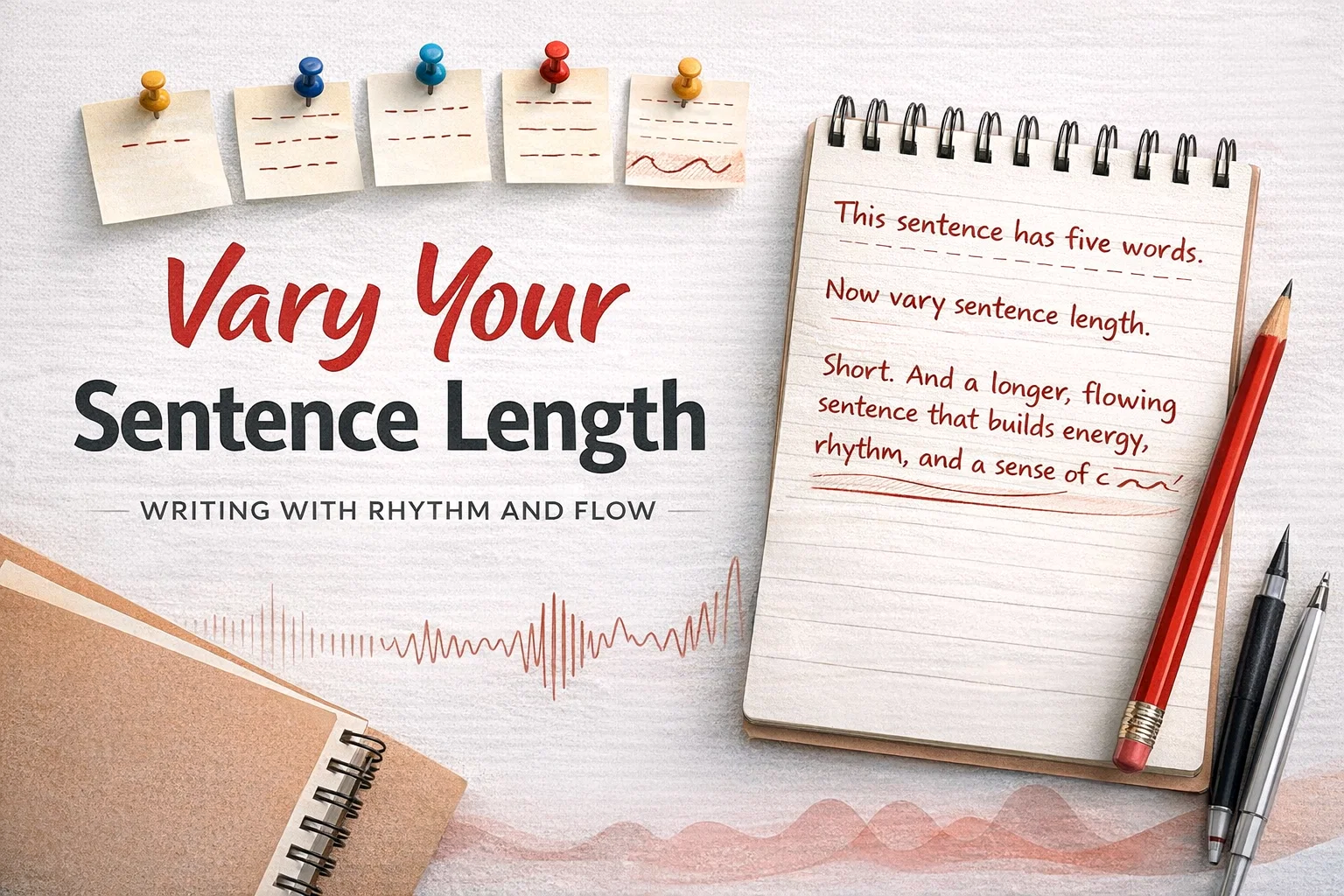
Rhythm is often associated with music or poetry, but it is just as vital in prose. When every sentence in a paragraph is the same length, the reader’s brain begins to predict the pause. This predictability leads to a loss of focus. Short sentences are punchy. They deliver a point with precision and force. They are the heartbeat of your writing. However, a string of only short sentences can feel choppy and aggressive, like a series of constant interruptions. On the other hand, long sentences allow for nuance, detail, and a sense of wandering exploration. They provide the space for complex ideas to unfold. The magic happens when these two styles dance together.
Breaking the Monotony of Uniformity
Most writers fall into a comfortable “mid-range” sentence length. While this is safe, it rarely inspires. Imagine a drummer hitting the same snare at the exact same volume and interval for five minutes straight. You would likely walk out of the room. Your readers will do the same if your writing lacks dynamic range. By intentionally placing a three-word sentence after a thirty-word sentence, you create a “sonic” shift that re-engages the brain. This technique is especially useful in digital content where attention spans are limited. A sudden short sentence acts as a physical reset for the reader, pulling them back into the narrative before they have a chance to drift away.
How to Construct a Musical Narrative
Creating “music” with your words requires a level of awareness that goes beyond spelling and syntax. You have to listen to the words as if they were being spoken aloud. Even when people read silently, they have an internal narrator that hears the cadence of the text. To master this, you must learn to play with the different “instruments” at your disposal: the short, the medium, and the long sentence.
The Role of the Short Sentence
Short sentences are for emphasis. They are for clarity. They are for truth. Because they lack the fluff of transition words and subordinate clauses, they stand naked and powerful. Use them when you want to make a definitive statement. If you have just finished a long, winding explanation of a complex theory, follow it up with a short sentence that summarizes the core takeaway. It acts like a period at the end of a long musical phrase, providing a sense of completion and “aha” for the reader.
The Versatility of Medium Sentences
Medium-length sentences are the workhorses of your blog post. They handle the bulk of your storytelling and information delivery. They are long enough to provide context but short enough to remain easily digestible. These sentences create the steady “lilt” that Gary Provost mentions. They keep the reader moving forward at a comfortable pace, providing enough detail to stay interesting without becoming overwhelming. Think of these as the verses of a song that lead up to the big chorus.
The Grandeur of the Long Sentence
The long sentence is your crescendo. This is where you allow your creativity to shine. A well-constructed long sentence uses commas, conjunctions, and descriptive imagery to build a sense of momentum. It should feel like a wave building up in the ocean, growing larger and more powerful until it finally crashes onto the shore. These sentences are perfect for evoking emotion, describing a beautiful scene, or connecting several related ideas into one cohesive thought. The key to a successful long sentence is clarity; it must never feel like a “run-on” that leaves the reader breathless and confused.
Improving Readability Through Structural Variety
When you look at your blog post from a distance, the visual structure should also reflect this variety. Walls of text are intimidating. By mixing your sentence lengths, you naturally create more white space and a more inviting visual flow. This is a critical component of SEO and user experience. If a visitor lands on your page and sees varied paragraph lengths and dynamic sentence structures, they are statistically more likely to stay and read the entire piece.
Tips for Auditing Your Own Writing
- Read it Out Loud: This is the single best way to find “clunky” areas. If you find yourself gasping for air, the sentence is too long. If you feel like a robot, your sentences are too uniform.
- Look for Repetitive Starters: Often, monotonous writing comes from starting every sentence with the same type of word (e.g., “The”, “I”, “He”). Mix up your openings to naturally change the rhythm.
- The Five-Word Rule: Look for any section where you have more than three sentences of the exact same length in a row. Break one apart or combine two to disrupt the pattern.
- Use Punctuation as Notation: Commas are soft pauses, semicolons are bridges, and periods are full stops. Use them like a composer uses rests and notes.
The Psychological Impact of Better Flow
Why does this matter so much? Because writing is a bridge between two minds. When you write with a pleasant rhythm, you are showing respect for the reader’s cognitive load. You are making it easier for them to enjoy your content. A balanced flow creates a sense of authority and professionalism. It suggests that you are in total control of your craft and that you have put thought into not just what you are saying, but how you are saying it. This builds trust, which is the most valuable currency in the world of blogging and content creation.
Connecting with the Reader’s Inner Voice
Every person has a unique internal rhythm. However, there are universal patterns that we all find pleasing. We like the rule of threes. We like a surprising twist at the end of a paragraph. When you vary your writing, you tap into these subconscious preferences. You turn a standard “how-to” guide or informational article into an experience. The reader doesn’t just learn; they feel the energy of the text. This is what separates a ghostwriter from a storyteller.
Beyond Sentences: Paragraph and Section Variation
The principle of variety doesn’t stop at the period. You should also look at how your paragraphs are structured. A very long, descriptive paragraph followed by a single-sentence paragraph can have a massive impact. This visual “shout” draws the eye and ensures that your most important points are never missed. In WordPress especially, where many readers are on mobile devices, these “micro-paragraphs” are essential for maintaining engagement as users scroll through the content.
Using Subheadings as Rests
In music, a rest is just as important as a note. In a blog post, your subheadings are your rests. They give the reader a moment to pause, process what they have just learned, and prepare for the next “movement” of the article. Ensure that your subheadings are descriptive and engaging, acting as a roadmap for the rhythmic journey you are taking them on. This keeps the momentum high and the “bounce rate” low.
Mastering the Art of the Build-Up
One of the most effective ways to use sentence variety is to “earn” your long sentences. Don’t start a post with a fifty-word sentence. Instead, start with something short and engaging. Build the reader’s confidence. Once they are “rested” and comfortable with your voice, you can lead them into those longer, more complex thoughts. This is the “crescendo” Gary Provost speaks of. It is the roll of the drums and the crash of the cymbals. It is the moment where you deliver the “important” information with all the impetus of a well-timed musical climax.
Finding Your Unique Voice
As you practice these techniques, you will start to find your own natural rhythm. Some writers lean toward a more sparse, Hemingway-esque style with lots of short, sharp sentences. Others prefer a more flowery, Victorian style with long, winding prose. Both are valid, provided they incorporate variety. Your unique “voice” is essentially the specific way you choose to mix these lengths. It is your signature melody in a world full of noise.
Conclusion: Writing That Sings
In the end, writing is meant to be felt. By stepping away from the “stuck record” of uniform sentence lengths, you open up a world of creative possibilities. You move from being a mere provider of information to a creator of music. Remember that your reader’s ear demands variety. Give them the short sentences to keep them grounded, the medium sentences to keep them moving, and the long sentences to make them soar. When you master this balance, your writing will do more than just sit on a screen; it will sing, it will lilt, and it will stay with your audience long after they have finished reading. Start practicing today, listen to the rhythm of your words, and watch as your prose transforms into a beautiful, energetic crescendo.