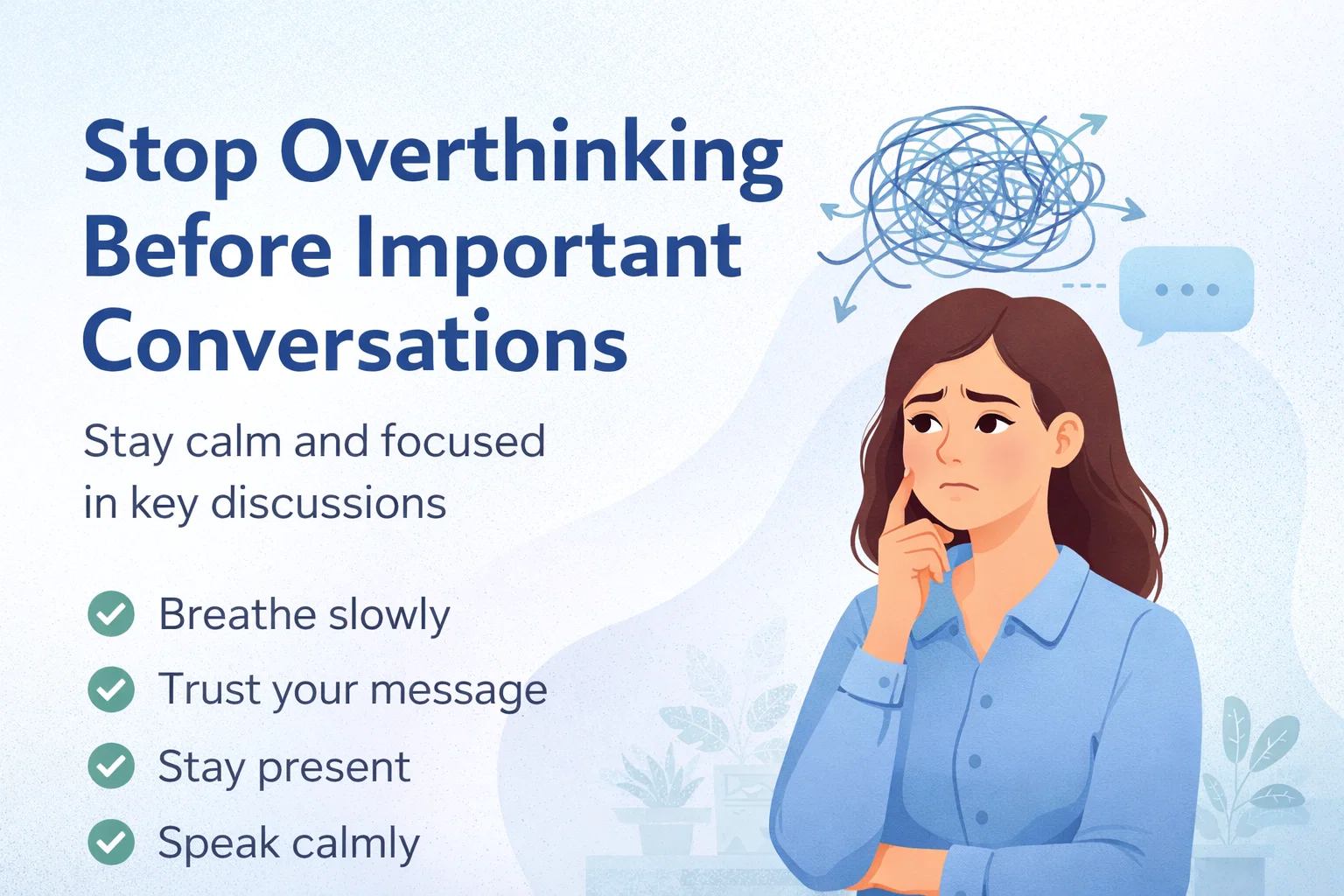
How to Calm Overthinking Before Big Conversations Stop Anxiety Speak Confidently
We have all been there. You are sitting in your car, or perhaps staring at a blank video call screen, and your mind is running a hundred miles an hour. You are rehearsing every possible sentence, predicting every potential negative reaction, and imagining a dozen different ways the conversation could go wrong. This mental loop is not just exhausting; it actually pulls you away from the very person you are trying to connect with. Overthinking before an important conversation is a common hurdle, but it is one that you can overcome with the right mindset and a few grounding techniques.
When we overthink, we are essentially trying to control the future. We want to guarantee a specific outcome or ensure that we are perceived in a perfect light. However, true communication is not about control. It is about connection. By shifting your focus from perfection to presence, you can transform a high-pressure situation into an opportunity for growth and mutual understanding. This guide will walk you through the essential steps to calm your mind, trust your voice, and navigate your next big talk with peace and integrity.
The Anatomy of Overthinking
Before we dive into the solutions, it is helpful to understand why our brains go into overdrive before a significant dialogue. Usually, it stems from a fear of judgment or a desire to avoid conflict. When the stakes feel high, our “fight or flight” response can kick in, leading us to over-analyze every word. This hyper-vigilance creates a barrier between us and the other person. Instead of listening, we are waiting for our turn to speak or searching for “clues” that we are failing.
The image we are looking at today provides a beautiful roadmap for dismantling this anxiety. It emphasizes moving away from the internal “noise” and toward a centered, external focus. By recognizing that overthinking is simply a protective mechanism that has gone a bit too far, you can start to give yourself permission to let go of the script and trust the process.
Simplifying Your Message
Focus on Your Main Message Clearly
One of the biggest traps of overthinking is getting lost in the weeds. You might feel the need to provide twenty different justifications for your point of view, but this often leads to confusion. Before you enter the room, ask yourself: What is the one thing I want the other person to walk away with? When you have a clear “North Star” for your conversation, you don’t need to worry about every minor detail. If you get off track, you can always bring it back to that core message.
Keep Your Words Simple and Honest
Complexity is often a shield we use when we are nervous. We use jargon or long-winded explanations to sound more professional or to soften the blow of a difficult truth. However, simplicity is where the power lies. Honest communication is direct without being unkind. When you speak simply, you leave less room for misinterpretation and you show the other person that you respect their time and their intelligence. Don’t hide behind a wall of words; say what you mean with kindness.
Releasing the Need for Approval
Release the Need to Impress
Much of our pre-talk anxiety comes from the ego. We want to be seen as smart, capable, or “right.” When you release the need to impress, you take a massive weight off your shoulders. The goal of an important conversation should be clarity and resolution, not a performance that earns you a standing ovation. Remember that the person you are talking to is just as human as you are, with their own insecurities and hopes. When you stop trying to “win,” you start trying to understand.
Stop Predicting Negative Reactions
Your brain is an excellent storyteller, but it is a terrible psychic. We often spend hours worrying about a specific frown or a defensive comment that may never even happen. This “future-tripping” keeps you stuck in a reality that doesn’t exist. Instead of assuming the worst, try to approach the conversation with “neutral curiosity.” You don’t know how they will react, and that is okay. You are only responsible for your own words and intentions, not their emotional response.
Grounding Techniques for Immediate Calm
Ground Yourself Through Slow Breathing
Overthinking is a mental process, but it manifests in the body. Your heart rate increases, your chest tightens, and your breath becomes shallow. You can reverse-engineer this stress response by focusing on your breath. Taking three slow, deep breaths into your belly tells your nervous system that you are safe. This physical reset is one of the fastest ways to quiet a racing mind. It brings you back into the present moment, where the conversation is actually happening.
Relax Your Body Before Speaking
Check in with your physical state. Are your shoulders up near your ears? Is your jaw clenched? Is your posture rigid? Taking a moment to consciously drop your shoulders and uncurl your fingers can have a profound effect on your mental state. A relaxed body leads to a relaxed mind. When you enter a conversation physically open, you are more likely to be emotionally open as well.
The Power of Presence During the Talk
Listen More Than You Analyze
The best communicators are not the best talkers; they are the best listeners. When you are overthinking, you are usually listening to your own internal monologue instead of the person in front of you. Challenge yourself to truly hear what they are saying. Notice their tone, their body language, and the underlying feelings. When you focus intensely on the other person, there is no room left in your brain for overthinking. This is the secret to staying present.
Let Silence Exist Naturally
Silence can feel awkward when we are nervous, leading us to fill the gaps with “word vomit” or over-explaining. However, silence is a vital part of communication. It gives both parties time to process what has been said. If there is a pause, resist the urge to jump in and fix it. Let the silence breathe. Often, the most important insights come during those quiet moments when both people are thinking deeply.
Trusting Yourself and the Process
Trust Your Intention and Integrity
At the end of the day, if you are entering a conversation with a good heart and an honest intention, you have nothing to fear. You may not say everything perfectly, and the other person may not agree with you, but your integrity remains intact. Trust that your preparation and your character are enough. You don’t need a perfect script when you have a solid foundation of truth.
Accept That Small Mistakes Are Normal
Perfectionism is the enemy of connection. You might stumble over a word, forget a minor point, or get a bit emotional. Guess what? That is part of being human. Often, showing a little bit of vulnerability or making a mistake makes you more relatable and trustworthy. Don’t let the fear of a small slip-up prevent you from speaking your truth. The “perfect” conversation is the one where both people were real with each other.
Moving Forward with Peace
Release Imagined Judgment Afterward
The overthinking doesn’t always stop when the conversation ends. We often engage in a “post-game analysis,” picking apart everything we said and imagining what the other person is thinking now. Once the talk is over, let it go. You did your best with the information and energy you had at the time. Replaying it over and over won’t change the outcome; it only steals your peace in the present.
Focus on Connection Not Perfection
If you take only one thing away from this, let it be this: The goal is connection. If the conversation resulted in a better understanding, a cleared-up misconception, or even a respectful disagreement, it was a success. Communication is a bridge between two worlds. As long as you are trying to build that bridge with honesty and respect, you are doing exactly what you need to do.
Conclusion: Your Voice Matters
Calming the storm of overthinking is a practice, not a one-time fix. Every time you choose to breathe instead of rehearse, or listen instead of analyze, you are strengthening your communication muscles. Important conversations are the building blocks of strong relationships and successful careers. They deserve your presence, but they don’t require your perfection.
Next time you feel that familiar knot in your stomach before a big talk, remember these steps. Ground yourself in your body, simplify your message, and trust in your own integrity. You have something valuable to say, and the world is ready to hear it. Approach your next dialogue with a calm heart and an open mind, and watch how much more smoothly the words flow when you finally stop standing in your own way. You’ve got this!