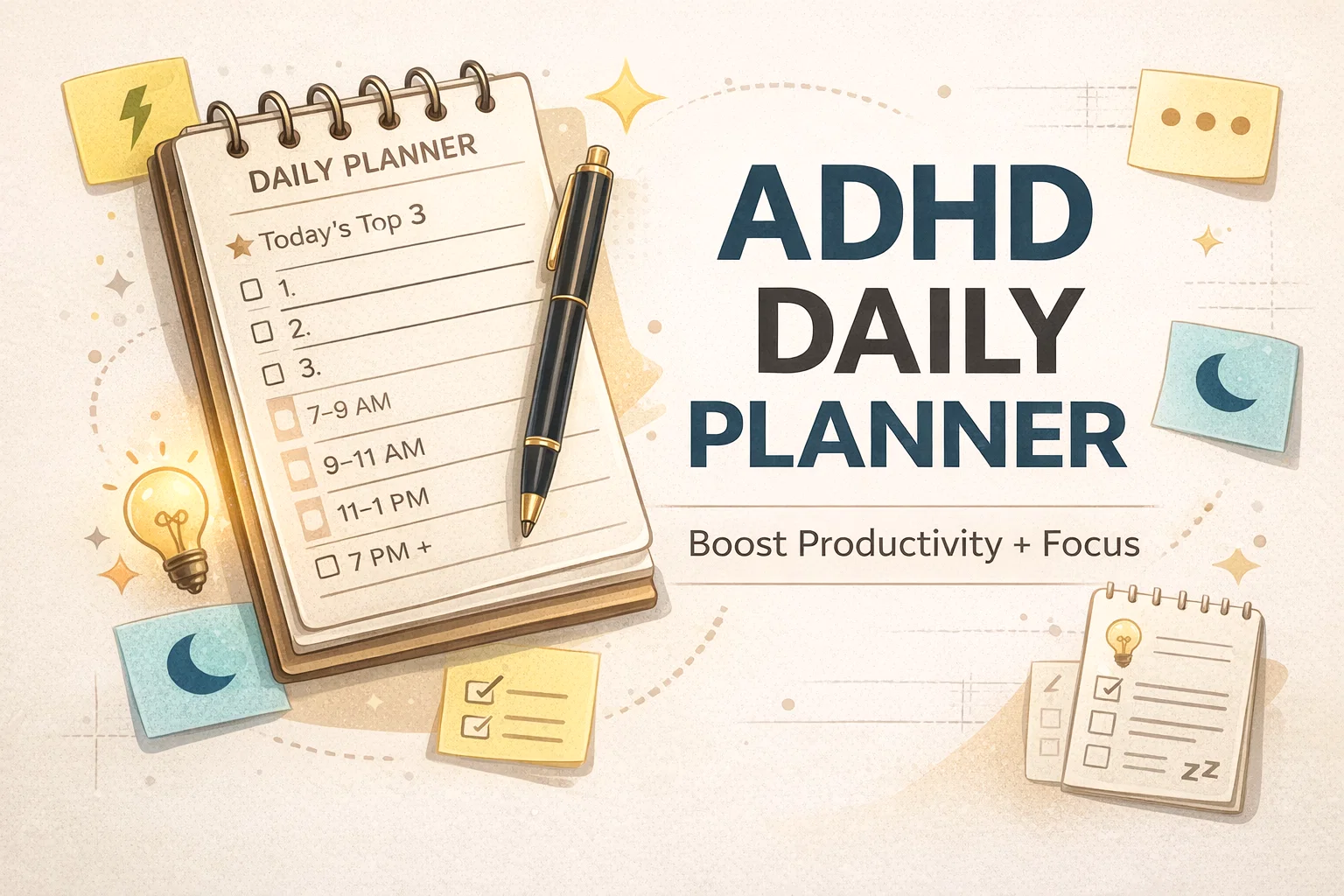
ADHD Daily Dashboard 2026 The Best Digital Planner for Life Admin Focus
Welcome to the productivity revolutionize. Forget everything you thought you knew about traditional planning, about crushing your task list, and about “powering through” a long day. If you live with ADHD, the conventional wisdom doesn’t just fall short; it often actively creates the very overwhelm it’s designed to cure. It’s time for a different approach, one that leans into, rather than battles against, the way your neurodivergent brain operates. Enter the ADHD Daily Dashboard, a strategic, compassionate framework designed to turn daily paralysis into gentle, focused progress. Today, we’re not just looking at a pretty printable; we’re analyzing a powerful tool that might just save your sanity in 2026.
Beyond the To-Do List: The Science of Strategy
Traditional planning often assumes a certain neurotypical flexibility and executive function. For someone with ADHD, things work a little differently. We might face difficulties with prioritizing, initiating tasks, switching focus without losing a whole morning, or managing our time perception. A simple list, however beautiful, is just a static reminder of everything we’re NOT doing. It doesn’t give us a map or a strategy; it just presents a terrifying cliff face.
The beauty of this daily dashboard, and what we’ll dissect section by section, is that it incorporates proven ADHD-friendly strategies, breaking down the complex process of “being productive” into small, manageable, and even engaging steps. It’s not about doing more; it’s about doing the right things, for the right amount of time, with the right amount of energy. So let’s crack the code and explore why this tool can be your best friend.
TODAY’S TOP 3: The Power of Ruthless Prioritization
This is where the magic (or the realism) starts. Look at the very top section: “TODAY’S TOP 3”. It instructs you to “Pick only 3. If you do these, the day is a win.” This single instruction is a profound act of compassion for your focus. Why three?
Defeating Overwhelm
An ADHD brain, when presented with a massive list, often sees everything as equally urgent. This leads to decision fatigue before you’ve even started, and often culminates in “ADHD paralysis” where you do absolutely nothing because you can’t decide where to begin. By limiting yourself to just three key items, you eliminate that initial mental bottleneck. A list of three is achievable; it’s manageable; it’s focusable.
Building Momentum
The phrasing “the day is a win” is crucial. It sets you up for a positive, not a punitive, experience. When you complete these three tasks, you feel a genuine sense of accomplishment. That feeling triggers a nice dopamine hit, which is the very neurochemical that helps ADHD brains initiate and sustain effort. A small win builds a powerful momentum that often helps you do more, but even if it doesn’t, your day was still a success. You aren’t constantly trying to “catch up” from a deficit of impossible expectations.
TIME BLOCKS: Making the Abstract Concrete
Okay, you have your three priorities. Now what? The “TIME BLOCKS” section gives them a home. Time blocking is a cornerstone of ADHD productivity for very important reasons, fundamentally helping with two significant struggles: time blindness and task initiation.
Combating Time Blindness
People with ADHD can often experience a disconnect between their mental concept of time and its actual passage, sometimes known as “time blindness.” We might misjudge how long a task takes, leading to constant rushing and frustration. A time block (like 7–9 AM) provides a clear, finite container for your work. You are no longer just “working,” which can feel like an endless, daunting proposition. Instead, you are working “until 9 AM,” a tangible deadline that helps anchor your focus.
A Clear On-Ramp for Tasks
Initiating a new task is often the hardest part for an ADHD brain. The “TASK / FOCUS AREA” column gives you a very specific placeholder. You’re not just “being productive”; you know that at 9 AM, you will focus on a specific project. This eliminates the need to constantly make decisions throughout the day about what comes next, which drains critical cognitive energy. And notice that the final block is a flexible “7 PM +,” acknowledging that life after 7 PM often follows its own rules.
Visual Strategies for Focus
That little “Tip: Use symbols or stickers to block low-energy’s focus time” is pure gold. For ADHD, adding a visual and tactile element to planning can make it far more engaging and effective. Stickers or colors aren’t childish; they’re tools to instantly signal your brain about the nature of a time block without needing complex reading or mental calculation. You might put a special sticker to warn yourself that your 1 PM to 3 PM slot is typically a focus-killing time, prompting you to plan lighter tasks for that window.
ENERGY LEVEL CHECK-IN: Matching Effort to Capacity
This section might be the most revolutionary part of the entire dashboard for many: “ENERGY LEVEL CHECK-IN”. We have all experienced days where we are firing on all cylinders, and days where we feel like we’re wading through molasses. Traditional planning ignores this, demanding that we be equally productive regardless of how we feel. This is a direct path to burnout.
Working With Your Brain
By asking you to circle High, Medium, or Low energy, this planner prompts you to engage in critical self-awareness. Instead of forcing your brain to do a “High Energy” task (like complex problem solving) on a “Low Energy” day, it gives you permission to adjust. This isn’t laziness; it’s efficiency and kindness combined. Your Low Energy task is just as important as your High Energy task, provided you do them when your brain is ready. The text explicitly guides you: “Now pick a task that matches your energy.”
You might have a High Energy focus block from 9 AM to 11 AM where you tackle a difficult project. If your Energy Check-In after lunch says “Low,” you can look at your list and decide to use your 1 PM to 3 PM time block for something Low Energy, like sorting files or cleaning your inbox. You are still moving forward, but you are not destroying yourself in the process.
BRAIN DUMP: Your Mental De-cluttering Zone
If you have ADHD, your mind is often like a room filled with a thousand bouncing ping-pong balls. Every new idea, reminder, or half-formed thought threatens to detail whatever you are trying to focus on. That’s where the “BRAIN DUMP” section becomes an essential piece of cognitive hygiene.
This is a safe space for “What’s buzzing in your brain right now?”. By writing it down, you are physically offloading that thought from your working memory, which is famously constrained in ADHD. You have secured the idea, so your brain doesn’t have to keep looping on it to avoid forgetting it. You can confidently return to your task, knowing that buzzing idea is safe on the page and can be dealt with later.
LITTLE WINS & ROUTINE CHECK: Small Triumphs, Big Impact
The entire right column is a masterclass in behavioral reinforcement and gentle structuring, starting with “LITTLE WINS.”
Positive Reinforcement for the ADHD Brain
Since the ADHD brain doesn’t always process positive feedback the same way a neurotypical one does, we need to create our own dopamine feedback loops. Listing “Something I finished” is powerful. No task is too small. “Sent that email,” “put away a dish,” “paid a bill.” Each little win is a confirmation of your competence and an immediate injection of positive, encouraging energy. It stops you from feeling like a total failure even if your main goals are a struggle.
The “Routine Check” section is equally important. These are the fundamental daily self-care tasks that people with executive function challenges often struggle to maintain: “Drink water,” “Light movement / stretch,” “Review Top 3,” “Get dressed / ready.” These are not big accomplishments, but their neglect can lead to a significant decline in overall well-being and productivity. Breaking them down into a simple, non-judgmental checklist is a supportive tool that bypasses the need for intense executive effort.
EVENING & QUICK IDEAS: Closing the Loop and Looking Ahead
The final pieces of the puzzle ensure you end your day effectively and capture inspiration for tomorrow.
A Healthy Wind Down Routine
For many with ADHD, winding down at night is just as hard as gearing up in the morning. The “Evening Routine” list provides a gentle, structured path to rest. Practices like “Reflect / gratitude” help you focus on the positives, combating the negative self-talk that is so common with ADHD. “Wind down (no screens)” is a crucial sleep hygiene practice, and “Set tomorrow’s Top 3” gives your morning-self a profound gift: the lack of a need to make a big decision about your focus.
A Safe Place for “Shiny Objects”
Finally, the “QUICK IDEAS BOX” at the very bottom. The prompt is perfect: “For future projects, creative ideas, or ‘maybe later’ tasks.” This is the final resting place for all those brilliant, distracting, “shiny object” ideas that might try to derail you. By giving them a designated home, you honor their value without letting them take over your day. It’s not just a box; it’s a commitment to sanity.
The ADHD Daily Dashboard in Action: A 2026 Snapshot
Imagine your future with this tool in 2026. You wake up, and instead of a wave of panic about your life admin, you open your pre-set Daily Dashboard. You see your Top 3 priorities already decided. Your morning routine checklist ensures you get dressed, drink water, and do a quick stretch without a struggle. Your energy check-in tells you you’re a “Medium,” so you confidently start your first time block with a task that fits. Throughout the day, when your mind starts to race, you use the Brain Dump. When you are distracted by a brilliant but unrelated idea, you quickly drop it in the Quick Ideas Box. When your energy dips in the afternoon, you intentionally switch to a Low Energy task without guilt. By evening, you’ve completed your routines, you’ve listed your wins, and you know exactly what your Top 3 will be for tomorrow. This isn’t just an organization system; it’s a blueprint for confidence, peace, and purposeful action.
So, whether you use this exact design or build your own version with these principles, embrace this dashboard. Reclaim your focus, protect your energy, and remember that you don’t need to fit into someone else’s productivity box. You can, and will, build your own path to success in 2026.