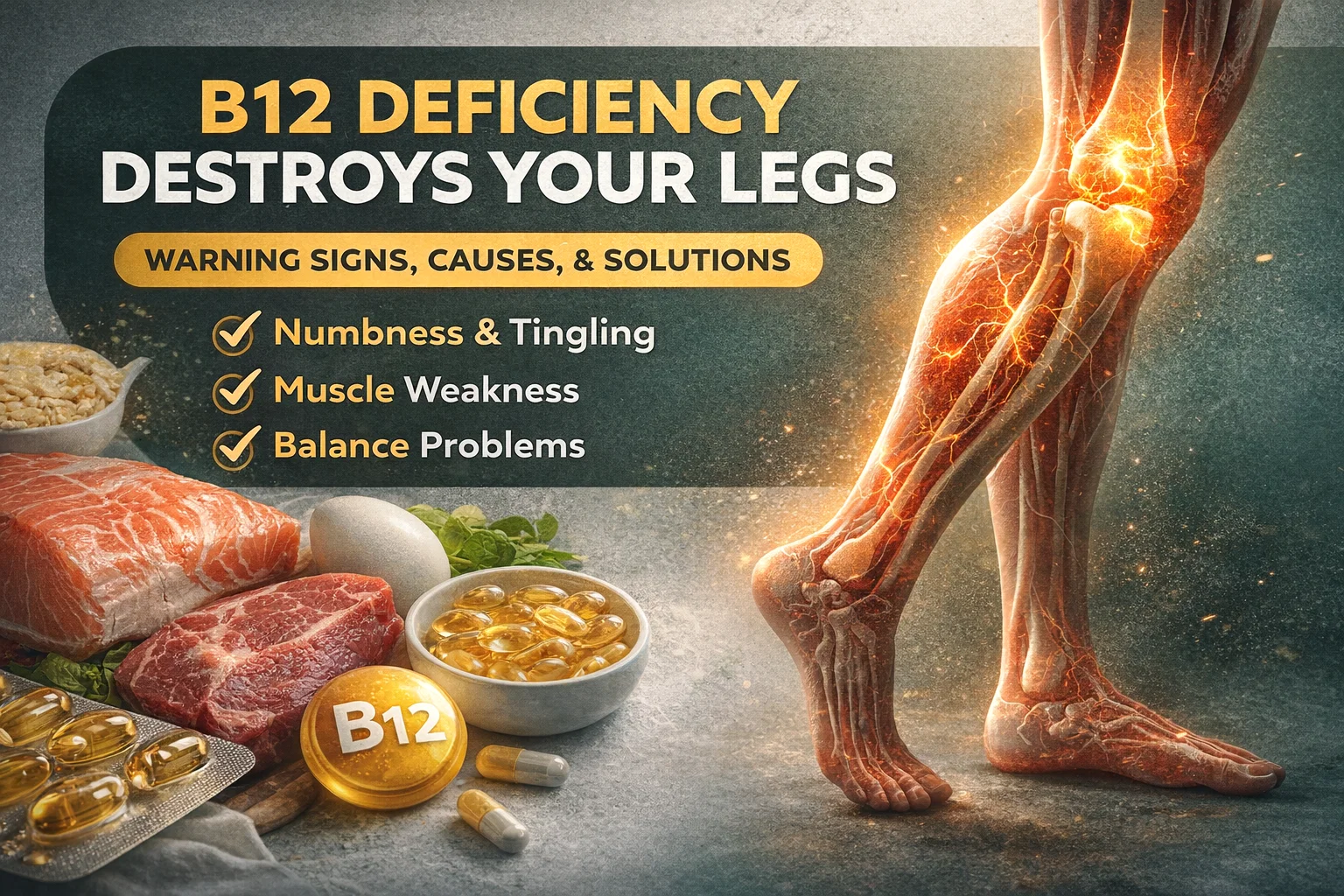
B12 Deficiency Symptoms Why Your Legs Feel Weak Unsteady
Have you ever experienced an unexpected weakness in your legs? Perhaps you have noticed a strange tingling sensation in your feet or a sudden feeling of unsteadiness when you stand up to walk across the room. It is incredibly common to brush these moments off as just another normal sign of getting older. However, the real culprit might be something entirely different, completely preventable, and highly treatable. A staggering number of people are unknowingly suffering from a silent nutritional issue that directly impacts their mobility and independence. We are talking about a Vitamin B12 deficiency. This essential nutrient is the unsung hero of your nervous system and your physical endurance. Let us dive deep into how a lack of Vitamin B12 might be secretly impacting your leg strength and explore exactly what you can do to reclaim your vitality today.
The Crucial Brain and Muscle Connection
To understand why your legs feel heavy or weak, we first need to look at how your body communicates with itself. Think of your nervous system as a complex network of high-speed wires connecting your brain to every muscle in your body. Vitamin B12 plays a mandatory role in maintaining the protective coating around these nerves, known as the myelin sheath.
Getty Images
Explore
When you do not have enough B12, this protective layer begins to break down. As a result, the signals traveling from your brain to your leg muscles become distorted, delayed, or lost entirely.
The best way to visualize this problem is to think about trying to send an important text message from your cell phone when you have zero signal. You can type out the message perfectly, but the message simply will not send. Nothing works. Your brain is desperately trying to tell your legs to walk smoothly, balance properly, and stand strong, but the muscles never receive the full instruction. This breakdown in communication is exactly why a deficiency can quite literally destroy your leg functionality over time.
The Hidden Epidemic Among Seniors
You might be wondering if this is a rare condition. The truth is quite the opposite. Current estimates suggest that a shocking 40 percent of seniors are severely deficient in Vitamin B12 right now. This is a massive portion of the population walking around with suboptimal nerve function and energy levels. But why does this happen so frequently as we age?
The answer lies in our digestive system. Once we cross the age of 50, our bodies undergo significant internal changes. One of the most impactful changes is a dramatic decrease in the production of stomach acid. Your stomach needs a highly acidic environment to successfully separate Vitamin B12 from the proteins in the food you eat. Furthermore, your stomach produces a special protein called intrinsic factor, which is absolutely necessary for absorbing the vitamin further down in your digestive tract. With less acid and potentially less intrinsic factor, your body simply loses its ability to extract and utilize the B12 you are consuming. You could be eating a perfectly healthy diet and still become severely deficient.
Recognizing the Red Flags in Your Legs
Because the decline in Vitamin B12 levels is usually gradual, the symptoms can sneak up on you over months or even years. It is vital to pay close attention to the signals your body is sending. The most prominent signs usually manifest in your lower extremities.
- Unexplained Weakness: You might find that climbing stairs is suddenly exhausting or that your legs feel like lead weights when you try to take a simple evening stroll.
- Persistent Tingling: This is often described as a pins and needles sensation. It usually starts in the toes and feet before slowly creeping up the legs. This is a direct sign of nerve distress.
- The Unsteady Feeling: A lack of spatial awareness and balance is a major red flag. If you feel wobbly, dizzy, or need to hold onto furniture to navigate your own living room, your nerves are struggling to coordinate with your muscles.
Ignoring these symptoms is a risky game. That unsteady feeling drastically increases the risk of dangerous falls, which can lead to severe injuries and a permanent loss of independence.
The Great Supplement Problem and Absorption Issues
When people discover they are low in a vitamin, their first instinct is usually to run to the local pharmacy and buy a standard multivitamin or a generic B12 pill. Unfortunately, for individuals over 50 dealing with lowered stomach acid, this is often a complete waste of money and effort. Standard, oral Vitamin B12 pills rely entirely on your digestive system breaking them down properly.
Because your stomach is no longer producing the necessary acid and intrinsic factor, those regular B12 pills just pass right through your system completely unabsorbed. You might think you are doing the right thing for your health, but your nerves and muscles are still starving for the nutrient. This false sense of security is why so many people remain deficient even while taking daily supplements.
Superior Solutions to Boost Your Levels Effectively
Thankfully, modern science provides us with incredibly effective workarounds that completely bypass the compromised digestive system. If you want to restore the communication between your brain and your legs, you need to use absorption methods that actually deliver the vitamin into your bloodstream.
Sublingual Tablets Provide Exceptional Results
One of the most accessible and effective solutions is switching to sublingual tablets. These are small pills designed to be placed directly under your tongue, where they slowly dissolve. The tissue under your tongue is packed with tiny blood vessels. As the tablet melts, the Vitamin B12 is absorbed directly into your bloodstream, completely bypassing the harsh and inefficient environment of the stomach. Studies show that sublingual tablets work up to three times better than standard swallowable pills for individuals with absorption issues.
Monthly Medical Injections for Severe Cases
If your deficiency is severe or your symptoms are progressing rapidly, you should absolutely ask your doctor about monthly Vitamin B12 shots. A medical professional will inject the vitamin directly into your muscle tissue. This guarantees 100 percent absorption and can rapidly replenish your body’s depleted stores. Many patients report a night and day difference in their energy and leg strength within just a few days of their first injection.
Ideal Daily Dosages to Aim For
When looking at supplements, dosage is key. Because absorption is always a bit of a hurdle, healthcare experts often recommend taking significantly higher doses than the standard daily recommended value. You generally need to look for supplements offering a minimum of 500 to 1,000 micrograms daily to ensure your body actually retains enough of the nutrient to repair nerve damage and support muscle function. Always consult with your primary care physician to determine the exact dosage that is right for your specific medical profile.
The Oxygen Advantage for Maximum Leg Strength
While fixing nerve communication is the most critical benefit of treating a deficiency, there is an incredible secondary bonus that will completely transform how your legs feel. Vitamin B12 is a non negotiable ingredient in the production of healthy red blood cells.
Red blood cells are the microscopic cargo ships of your body. Their primary job is to transport fresh, life giving oxygen from your lungs to every single tissue, organ, and muscle fiber you possess. When you are deficient in B12, your body produces fewer red blood cells, and the ones it does produce are often abnormally large and inefficient. This condition is known as megaloblastic anemia.
By restoring your B12 levels, you instantly boost your red blood cell count. More healthy red blood cells mean a massive increase in the amount of oxygen being delivered directly to your leg muscles. Muscles run on oxygen. When your leg muscles are fully oxygenated, they experience a double strength benefit. They can work harder, endure longer walks without fatigue, and recover significantly faster after physical exertion. You will not just stop the weakness you will actively build stronger, more resilient legs.
Stocking Your Plate with the Right Foods
Even if you are utilizing sublingual supplements or getting monthly injections, it is always a fantastic idea to support your body with a nutrient dense diet. Vitamin B12 is naturally found almost exclusively in animal products. If you are looking to boost your dietary intake, you need to focus on a few key food groups.
- Quality Meats: Beef, liver, and chicken are phenomenal sources. Organ meats, in particular, hold incredibly high concentrations of the vitamin.
- Fresh Fish and Seafood: Salmon, trout, tuna, and clams are not only rich in B12 but also provide healthy omega fatty acids that further support brain and nerve health.
- Dairy Products: Milk, cheese, and yogurt are excellent daily sources that are easy to incorporate into your routine.
- Fortified Options: If you follow a plant based diet or struggle with dairy and meat, look for fortified cereals, fortified nutritional yeast, and fortified plant milks. Manufacturers specifically add synthetic B12 to these products to help prevent deficiencies in the general population.
Taking Control of Your Health and Mobility
Experiencing weakness, tingling, or unsteadiness in your legs should never be accepted as just a normal part of aging. Your body is incredibly resilient and capable of vibrant health well into your golden years, provided it has the right fuel. Vitamin B12 is that essential fuel. It repairs the communication lines between your brain and your muscles, ensures your legs have the oxygen they need to thrive, and protects your independence.
If you resonate with any of the symptoms we have discussed today, take action immediately. Do not settle for standard pills that your body cannot process. Upgrade to sublingual tablets, focus on a diet rich in high quality animal proteins, and do not hesitate to schedule an appointment with your doctor to discuss a blood test and potential monthly injections. Reclaiming your leg strength and your overall vitality is entirely within your grasp.