Circle of Control What You Can Cannot Control for Anxiety
We have all been there. You are lying in bed at 2 AM, staring at the ceiling, replaying a conversation from three years ago or worrying about a meeting that has not happened yet. Your mind spins in circles, trying to fix problems that are not actually yours to fix. It is exhausting, isn’t it? This feeling of overwhelm often comes from trying to carry the weight of the entire world on your shoulders. But here is the truth that can set you free: most of the things stressing you out right now are things you cannot change. This is where the concept of the Circle of Control becomes a life-changing tool for your mental health and personal growth.
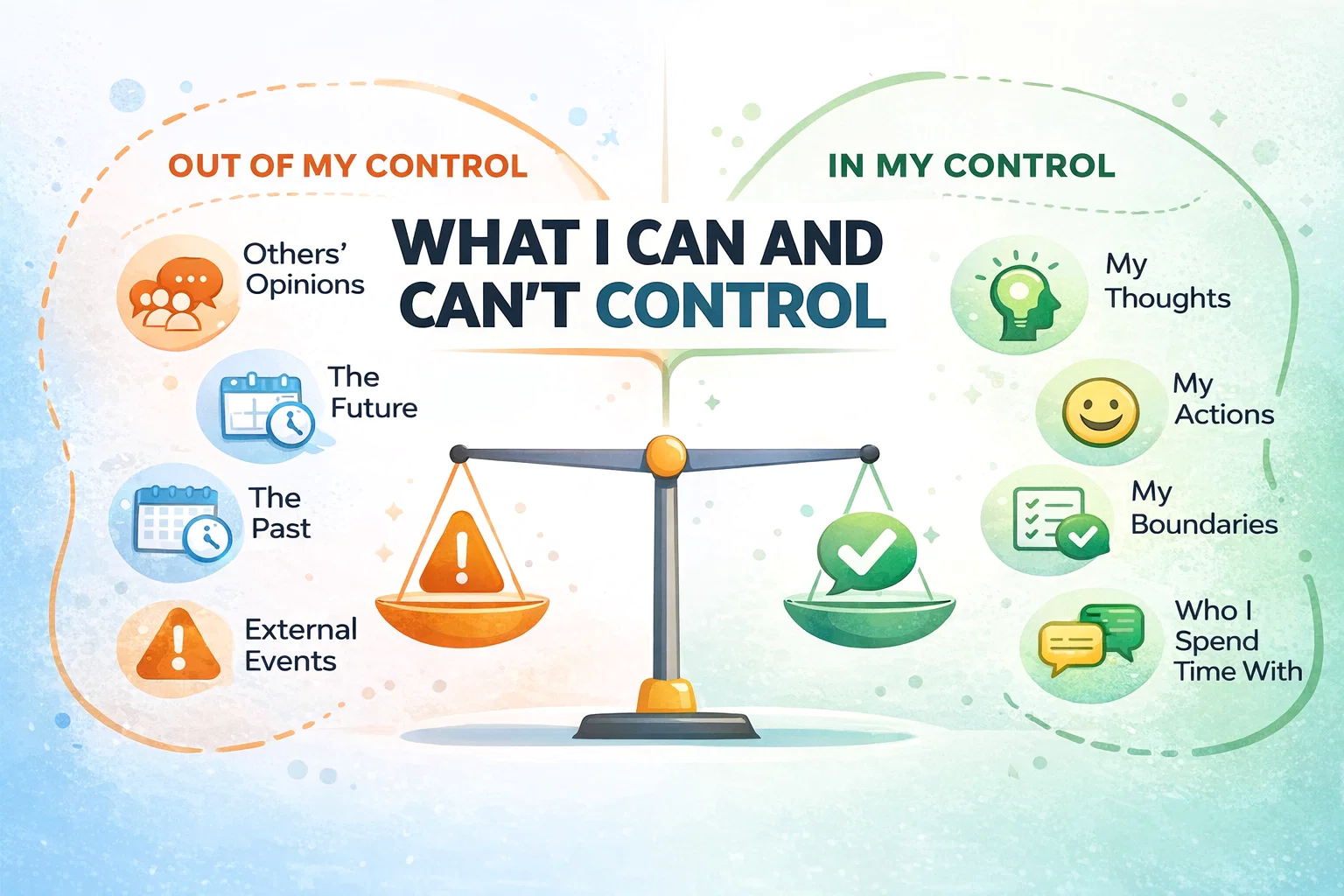
The image above illustrates a simple yet profound psychological tool often used in cognitive behavioral therapy and Stoic philosophy. It draws a clear line between what is within your power and what falls outside of it. When we focus on the outer circle—the things we cannot control—we feel helpless, anxious, and frustrated. However, when we shift our energy to the inner circle, we feel empowered, calm, and capable. In this post, we are going to dive deep into this framework, exploring how you can stop wasting energy on the uncontrollable and start building a life defined by your own choices and boundaries.
Understanding the Outer Circle: What You Need to Let Go
The outer ring of the diagram represents the “Out of My Control” zone. This is where anxiety loves to live. It is the realm of “what ifs” and “if onlys.” We often spend a huge chunk of our emotional battery trying to manipulate these factors, but it is like trying to hold back the tide with a spoon. Let us break down the major categories in this zone and why releasing them is crucial for your peace of mind.
Other People’s Opinions and Behaviors
One of the hardest pills to swallow is that you cannot control what other people think of you. You can be the ripest, juiciest peach in the world, and there will still be somebody who hates peaches. In the diagram, things like “others’ opinion of me,” “what others say about me,” and “other people’s beliefs/behaviours” sit firmly outside the circle. We often contort ourselves into pretzels trying to please everyone, hoping that if we just act perfectly enough, everyone will like us. But the reality is that people view you through the lens of their own experiences and traumas. Their opinion is often more about them than it is about you.
Similarly, you cannot control how people treat you or speak to you. You can certainly influence it by setting boundaries—which we will discuss later—but you cannot force someone to be kind, respectful, or understanding. trying to control someone else’s behavior is a recipe for resentment. When you accept that others are autonomous beings responsible for their own actions, you free yourself from the burden of managing their emotions.
The Past and The Future
Time is another massive source of anxiety that sits in the “Out of My Control” section. “The past” is unchangeable. No amount of guilt, regret, or overthinking can rewrite history. Yet, we often punish ourselves for past mistakes or replay awkward moments on a loop. This keeps us stuck in a time that no longer exists, robbing us of the present moment.
On the flip side, “the future” is largely unpredictable. While we can plan and prepare, we cannot control outcomes. You might study hard for a test and still get a weird question. You might be the perfect partner and still face a breakup. Obsessing over the future creates anxiety because we are trying to solve problems that have not even happened yet. Accepting that time moves forward and that uncertainty is a part of life allows you to stop fighting reality.
External Events and Circumstances
Finally, we have the broad category of “external events,” “aging,” and the passing of “time.” These are the universal constants. You cannot stop yourself from getting older. You cannot control the weather, the economy, or global events. When we resist these inevitabilities, we create suffering. Imagine getting angry at the rain. It does not stop the rain; it just makes you wet and angry. Radical acceptance of these external factors does not mean you have to like them, but it does mean you stop waging a war against reality that you cannot win.
The Inner Circle: Where Your True Power Lies
Now, let us step into the center of the diagram: “In My Control.” This is your safety zone. This is your powerhouse. When you center your life around these elements, you move from a victim mindset to a creator mindset. You might not be able to choose your circumstances, but you can always choose how you navigate them.
Your Boundaries and Your Energy
The diagram lists “my boundaries” and “my energy” as key components of your control. Boundaries are the rules you set for how people can treat you. While you cannot stop someone from being rude, you can choose to walk away or end the conversation. That is a boundary. You control your access. You decide who gets the privilege of your time and emotional labor.
Your energy is a finite resource. Every day, you wake up with a certain amount of mental and emotional fuel. You get to decide where to spend it. Will you spend it arguing with strangers on the internet (out of your control) or working on a passion project (in your control)? Protecting your energy means becoming selective about “who I choose to spend my time with.” Surrounding yourself with supportive, positive people is a choice that directly impacts your well-being.
Your Response and Attitude
Victor Frankl, a psychiatrist and Holocaust survivor, famously said that between stimulus and response there is a space, and in that space is our power to choose our response. This is represented in the image as “my response” and “my attitude.” You might face a terrible situation, like a job loss or a rude comment. The initial event is out of your hands. But what you do next is entirely up to you. Do you crumble, or do you look for the lesson? Do you lash out, or do you take a deep breath?
This includes “processing emotions.” You cannot control the initial flare of anger or sadness—emotions happen to us. But you can control how you process them. Do you bottle them up? Do you project them onto others? Or do you sit with them, journal, go to therapy, and let them pass through you healthily? Taking responsibility for your emotional regulation is one of the highest forms of self-care.
Self-Talk and How You Treat Others
The voice in your head is the roommate you can never move away from. “My self-talk” is a huge part of the inner circle. Are you your own bully or your own cheerleader? You have the power to rewrite the narrative in your mind. Instead of saying “I am a failure,” you can choose to say “I am learning.” This shift changes your entire reality.
Lastly, “the way I treat others” is on you. Even if someone is unkind to you, you can choose to maintain your integrity and respond with grace—or at least neutrality. Your character is defined by your actions, not by how others provoke you. “The way I speak” falls into this category too. Your words have power, and you are the sole editor of what comes out of your mouth.
Why Distinguishing These Circles Reduces Anxiety
Anxiety often stems from a “control fallacy”—the mistaken belief that if we worry enough, we can prevent bad things from happening. We think that by overthinking someone’s opinion, we can change it. We think that by stressing over the future, we can secure it. This is an illusion. All this does is burn us out.
When you look at this diagram and honestly categorize your stressors, you usually find that 80% of your worry is focused on the outer circle. That is a lot of wasted energy. By consciously redirecting your focus to the inner circle, you see immediate benefits:
- Increased Efficiency: You stop trying to push open doors that are locked and start walking through the ones that are open. You get more done because you are working on things that actually move the needle.
- Better Relationships: When you stop trying to control others, you stop nagging, manipulating, or resenting them. You accept them as they are, which actually allows for deeper connection.
- Emotional Stability: You become less reactive. When an external event goes wrong, you don’t feel like your whole world is collapsing because your foundation is built on your own internal resources, which are stable.
Practical Steps to Apply the Circle of Control
So, how do we take this concept from a nice diagram to a daily practice? It requires mindfulness and repetition. Here is a simple workflow you can use the next time you feel your chest tighten with stress.
1. The “Pause and Sort” Technique
When you feel anxiety rising, visualize the image above. mentally (or physically on paper) draw two circles. Dump all your worries out. Then, sort them. “I’m worried about the presentation” goes in the inner circle (I can prepare). “I’m worried they will hate it” goes in the outer circle (I cannot control their taste). Visualizing this separation creates instant clarity.
2. Focus on the “Input,” Not the “Outcome”
In the diagram, “outcomes” are outside your control. This is tricky because we are results-driven creatures. But you can only control the input. You can control writing a great book (input); you cannot control if it becomes a bestseller (outcome). You can control eating healthy (input); you cannot control exactly how much weight you lose this week (outcome). detached from the outcome and fall in love with the process. That is where your power lives.
3. Master Your Self-Talk
Since “my self-talk” is in the center circle, make it a priority. Catch yourself when you start spiraling into the outer circle. If you hear yourself saying, “I hope they don’t think I’m stupid,” correct it to, “I have prepared well and I will speak clearly. Whatever they think is up to them.” Affirmations are not just woo-woo magic; they are cognitive redirection tools that keep you in your lane.
Conclusion: reclaiming Your Peace
Life is always going to throw curveballs. People will be rude, plans will fail, and the future will remain uncertain. If your peace depends on everything outside of you going perfectly, you will never be at peace. The Circle of Control teaches us that security does not come from controlling the world; it comes from mastering yourself.
Take a look at that diagram again. The outer circle is vast, chaotic, and exhausting. The inner circle is tight, focused, and potent. Every time you find yourself stressing, ask yourself: “Is this in my circle?” If the answer is no, take a deep breath and release it. If the answer is yes, roll up your sleeves and get to work. Your energy is too precious to waste on things you cannot change. focus on your boundaries, your attitude, and your actions. That is where your freedom is found.