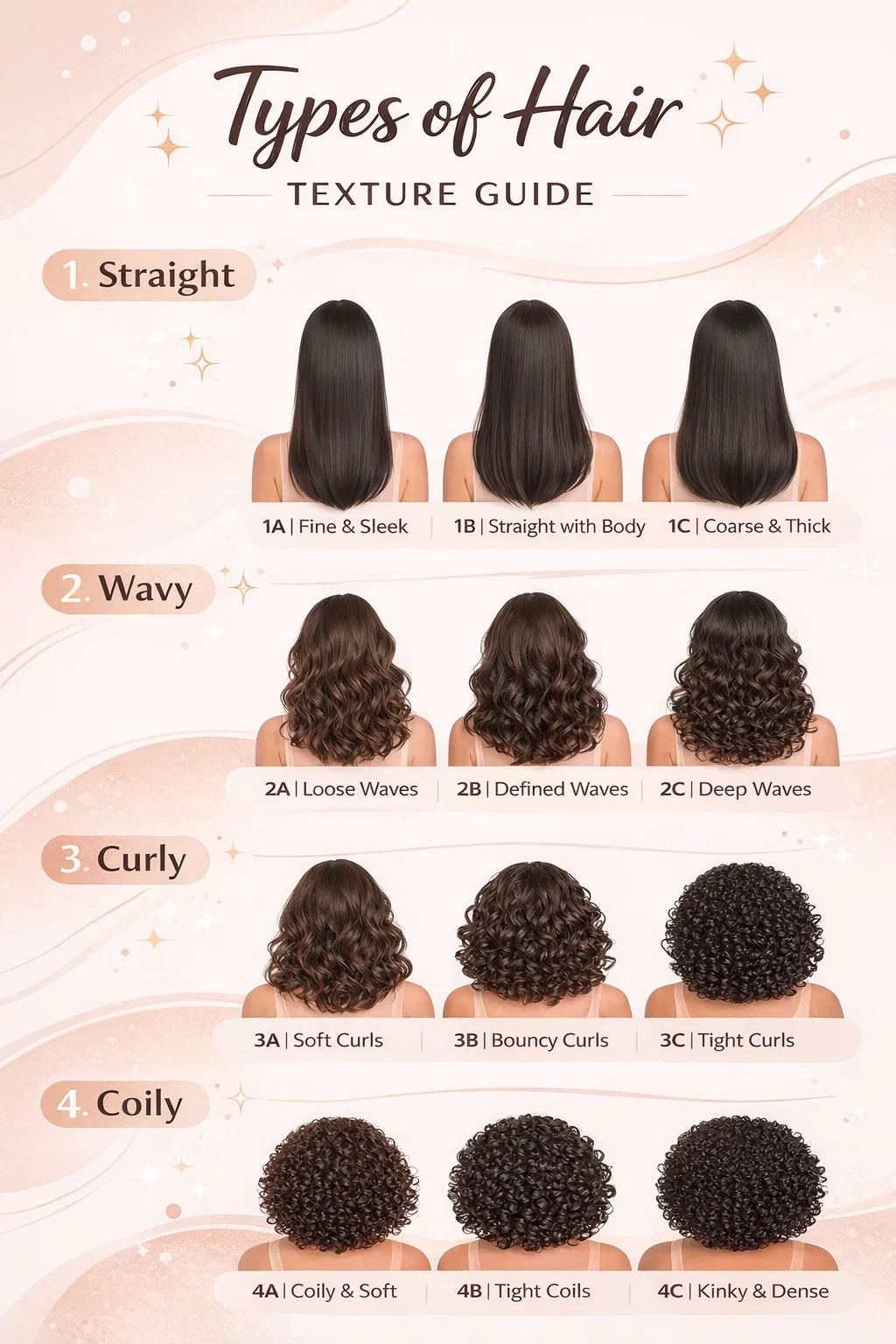
Hair Texture Guide 1A to 4C Straight Wavy Curly and Coily Types Reference Chart
Understanding your natural hair texture is the first step toward a successful and stress free hair care journey. For many years, people struggled to manage their locks simply because they were using products designed for a completely different hair category. The hair texture guide, which classifies hair into four main types ranging from 1A to 4C, has revolutionized the beauty industry by giving everyone a blueprint for their specific needs. Whether you have bone straight strands that refuse to hold a curl or tight, kinky coils that crave constant moisture, identifying your place on this chart is the key to unlocking your hair’s full potential.
The Science of Hair Texture and the Typing System
Before diving into the specific categories, it is helpful to understand what actually determines your hair type. Your hair texture is primarily dictated by the shape of your hair follicle. An asymmetrical or oval shaped follicle produces curly or coily hair, while a perfectly round follicle results in straight hair. This genetic blueprint determines how your hair grows, how it absorbs moisture, and how it reacts to different styling techniques. The numbering system, which starts at 1 for straight and goes up to 4 for coily, provides a universal language for stylists and enthusiasts alike.
Each number is further divided into subcategories labeled A, B, and C. These letters represent the diameter of the hair wave or curl pattern. Type A represents a wider pattern, Type B is medium, and Type C is the tightest or most defined pattern within that specific group. By pinpointing exactly where you fall on this spectrum, you can stop the expensive cycle of trial and error with hair products and start investing in what actually works for your biology.
Type 1: The Sleek World of Straight Hair
Type 1 hair is characterized by a lack of a discernible curl pattern. It is naturally the most oily of all hair types because the sebum from the scalp can easily travel down the straight hair shaft. While this leads to a beautiful natural shine, it also means that Type 1 hair can become greasy very quickly.
1A: Fine and Sleek
Type 1A hair is the rarest of the straight types. It is incredibly fine and has a silky texture that is almost impossible to hold a curl. If you have 1A hair, you likely find that your hair is very flat and lacks volume. The goal for this hair type is usually to add body without using heavy products that weigh the strands down even further.
1B: Straight with Body
Most people with straight hair fall into the 1B category. This hair type is characterized by a bit more thickness and volume than 1A. It is still straight, but it has a slight bend at the ends and can hold a curl if the right styling products are used. It is the perfect middle ground for those who want a sleek look with a bit of natural movement.
1C: Coarse and Thick
Type 1C hair is straight but very thick and coarse. It is often resistant to styling and can be prone to frizz in humid environments. Because the individual strands are so thick, they are very strong. However, they require more effort to style and often need smoothing serums to maintain a polished appearance.
Type 2: The Effortless Vibe of Wavy Hair
Type 2 hair sits comfortably between straight and curly. It usually has an S shape pattern and is characterized by its ability to look beachy and effortless. Wavy hair is prone to frizz, especially when it lacks moisture or is handled too much while drying.
2A: Loose Waves
Type 2A hair is fine and thin with a very loose, tousled texture. It is easy to style and can be straightened with very little effort. To enhance 2A waves, light mousses or sea salt sprays are ideal because they provide hold without making the hair look crunchy or flat.
2B: Defined Waves
This hair type features waves that are more defined and start closer to the mid length of the hair. Type 2B is often characterized by a flatter crown and waves that become more prominent toward the ends. It is more prone to frizz than 2A and benefits from leave in conditioners that define the S shape.
2C: Deep Waves
Type 2C hair is thick and features very distinct waves that start right at the root. This type is right on the edge of being curly. It is very susceptible to frizz and often requires more moisture than the other wavy types. Using a microfiber towel to plopping the hair can help maintain the deep wave structure without causing friction.
Type 3: The Bounce of Curly Hair
When we talk about Type 3 hair, we are entering the territory of true curls. These are clear spirals that wrap around themselves. Type 3 hair can range from loose loops to tight corkscrews. One of the biggest challenges for this type is dryness, as the natural oils from the scalp have a harder time navigating the curves of the curls.
3A: Soft Curls
Type 3A hair consists of large, shiny curls that are roughly the diameter of a piece of sidewalk chalk. These curls are often well defined but can lose their shape if touched too often. A light curl cream or gel is usually enough to keep 3A curls looking bouncy and fresh.
3B: Bouncy Curls
Type 3B hair has tighter curls that are about the size of a Sharpie marker. These curls have a lot of volume and a springy texture. Because they are more prone to dryness, 3B hair benefits from regular deep conditioning treatments and products containing humectants to draw moisture into the hair shaft.
3C: Tight Curls
Often referred to as curly-coily, 3C hair features densely packed corkscrews that are the diameter of a pencil or a straw. This type has immense volume. Because the curls are so tight, 3C hair experiences more shrinkage than Type 1 or 2. Moisture is the absolute priority here to prevent breakage and maintain elasticity.
Type 4: The Beauty and Versatility of Coily Hair
Type 4 hair is the most fragile of all hair types because it has the fewest cuticle layers to protect it from dryness. It features a very tight, zig zag or coil pattern and is incredibly versatile, capable of being styled in braids, twists, afros, and more. Shrinkage is a major factor for Type 4 hair, as it can appear much shorter than it actually is when wet.
4A: Coily and Soft
Type 4A hair consists of small, tight coils that have a visible S pattern when stretched. These coils are about the size of a crochet needle. This hair type retains moisture better than 4B or 4C but still requires a dedicated hydration routine. The LOC method (Liquid, Oil, Cream) is often highly effective for 4A textures.
4B: Tight Coils
Type 4B hair has a less defined curl pattern and instead follows a sharp Z shape. It feels very soft to the touch but is prone to tangling and knots. Because the bends in the hair are so sharp, it is easy for the strands to snap. Finger detangling and heavy butters are essential for keeping 4B hair healthy and manageable.
4C: Kinky and Dense
Type 4C hair is the tightest and most delicate texture on the chart. It may not have a defined curl pattern unless it is styled with specific techniques like finger coils or twist outs. 4C hair can shrink more than 75 percent of its true length. It requires heavy creams, thick oils like castor oil, and very gentle handling to thrive.
Essential Tips for Every Hair Type
While each hair type has its own specific needs, there are a few universal rules that apply to everyone looking to improve their hair health. Following these basic principles will ensure that your texture, whatever it may be, remains vibrant and strong.
- Hydration is Key: Every hair type needs moisture. For straight hair, this might mean a light conditioner, while coily hair might need daily misting and heavy creams.
- Limit Heat Styling: Excessive heat can damage the protein structure of your hair, leading to a loss of your natural curl pattern. Always use a heat protectant if you must use tools.
- Be Gentle When Wet: Hair is at its most vulnerable when it is wet. Use a wide tooth comb or your fingers to detangle, starting from the ends and working your way up to the roots.
- Protect Your Hair at Night: Using a silk or satin pillowcase or bonnet reduces friction, which prevents frizz and breakage while you sleep.
Conclusion: Celebrating Your Natural Texture
Navigating the world of hair care can feel overwhelming, but the hair texture guide serves as a powerful tool to simplify the process. By identifying your type, whether it is 1B or 4C, you are empowered to make better decisions for your hair health. Remember that hair typing is not about restriction, it is about understanding. Many people actually have multiple textures on different parts of their head, and that is perfectly normal.
The journey to healthy hair is a marathon, not a sprint. It takes time to find the perfect combination of products and techniques that make your unique strands shine. Embrace the bounce of your curls, the sleekness of your straight hair, or the gravity defying volume of your coils. Your hair is an expression of your identity, and by giving it the specific care it deserves, you can wear your crown with confidence every single day.