How Chronic Stress Affects Your Nervous System 4 Signs of Burnout and Urgency Culture
Living in a state of perpetual urgency is one of the most common yet overlooked health crises of the modern era. We often wear our busyness as a badge of honor, but our bodies were never designed to exist in a permanent state of high alert. When every email feels like an emergency and every task feels like a life or death situation, your nervous system begins to pay a heavy price. This constant pressure changes how you think, how you speak, and how you show up for the people you love. Understanding the mechanics of this internal shift is the first step toward reclaiming your peace and protecting your long term well-being.
The Physiology of Constant Pressure
To understand what happens when we live under pressure, we have to look at the autonomic nervous system. This system is divided into two main branches: the sympathetic and the parasympathetic. The sympathetic branch is your accelerator, often called the fight or flight response. The parasympathetic branch is your brake, known as the rest and digest system. In a healthy state, we should fluidly move between these two. However, urgency culture keeps us trapped in the sympathetic branch, never allowing the brake to fully engage.
When the brain perceives a threat, whether that threat is a physical predator or a mounting pile of unread messages, it triggers the release of cortisol and adrenaline. These hormones are wonderful for short bursts of energy, but when they circulate in your system for weeks or months at a time, they become toxic. Your body starts acting like the threat is ongoing because, according to your internal signaling, it is. This leads to a state of hyper-vigilance where your system is always scanning for the next disaster.
The Trap of the Ongoing Threat
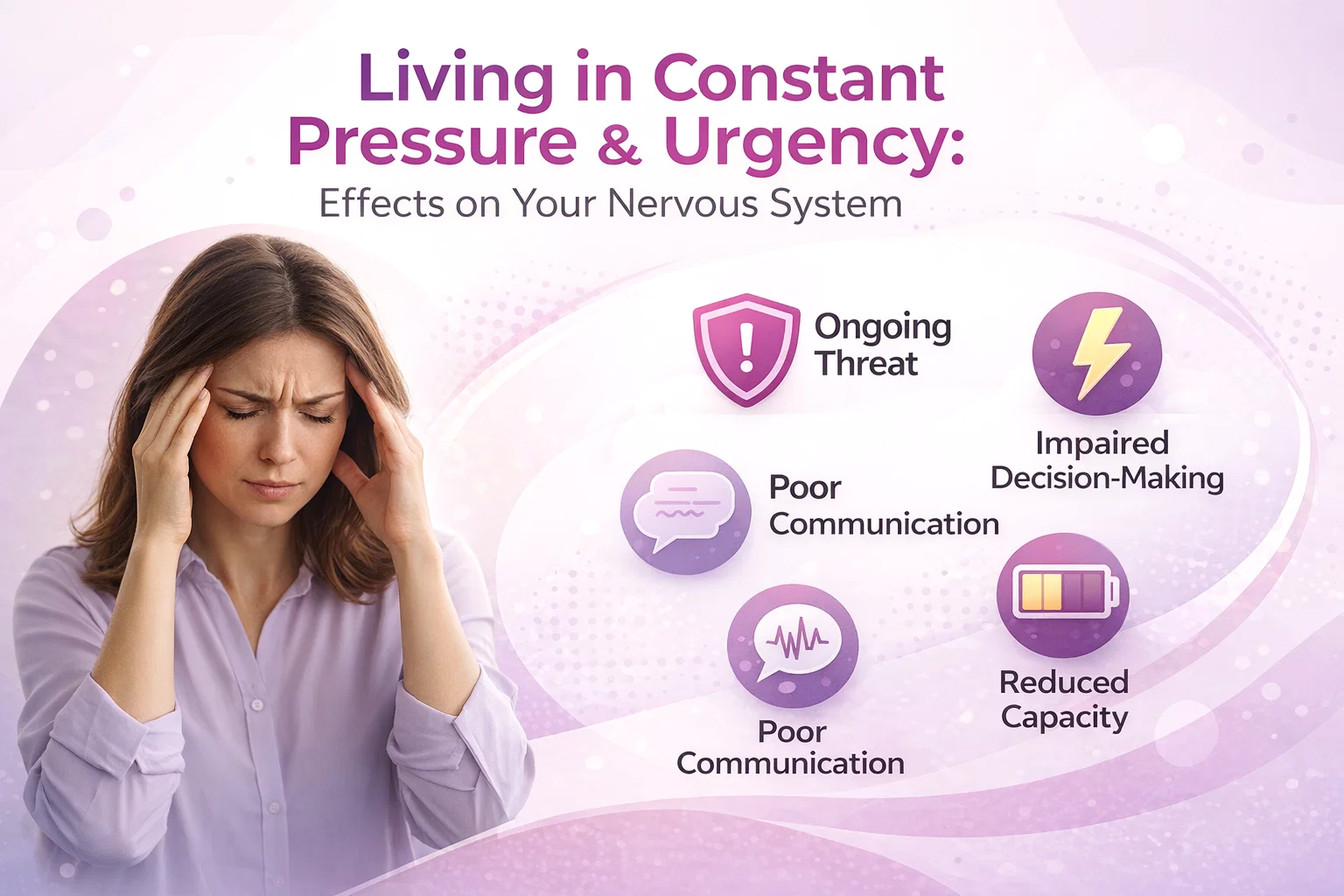
When you live in constant urgency, your body loses the ability to distinguish between a minor inconvenience and a major crisis. This is because the amygdala, the part of the brain responsible for emotional processing, becomes enlarged and overactive. At the same time, the prefrontal cortex, which handles logic and reasoning, begins to go offline. You might find yourself snapping at a coworker over a small typo or feeling a wave of panic because you forgot to buy milk. This isn’t a character flaw; it is your nervous system reacting to an invisible, ongoing threat that never seems to subside.
How Urgency Hijacks Your Decision-Making
One of the most profound impacts of a stressed nervous system is how it alters your cognitive abilities. When your brain believes it is under attack, it prioritizes speed over accuracy. This is why, when you are overwhelmed, you might make impulsive decisions that you later regret. The brain is less interested in creativity, nuance, or long term thinking when it is in survival mode. It wants quick answers and immediate solutions to stop the perceived bleeding.
This “short-circuiting” of the brain explains why it is so hard to be innovative or visionary when you are burnt out. Creativity requires a sense of safety. It requires a nervous system that feels relaxed enough to explore “what if” scenarios. When the pressure is on, your brain shuts down those expansive pathways and funnels all its energy into the most basic, reactionary processes. You stop being the CEO of your life and start acting like a firefighter who is just trying to put out the biggest blaze of the moment.
The Loss of Long-Term Vision
Living for the immediate “now” means you lose sight of the “later.” Under high pressure, your brain essentially loses its ability to calculate the long term consequences of your actions. You might skip your workout to answer one more email, or stay up until 2:00 AM to finish a project, ignoring the fact that these choices are depleting the very energy you need for tomorrow. This cycle creates a feedback loop where poor short term decisions lead to even more pressure in the future.
The Communication Breakdown
It is difficult to be a good listener when your internal alarm bells are screaming. High pressure reduces your capacity for deep, empathetic communication. Because your system is already busy scanning for what needs to happen next, you are rarely fully present in the current conversation. You might find yourself finishing people’s sentences, checking your phone while someone is talking, or feeling a sense of irritability when a conversation takes longer than you think it should.
Effective communication requires “co-regulation,” which is the ability of two nervous systems to settle into a state of safety together. If your nervous system is jagged and urgent, you will likely trigger a similar response in the person you are speaking with. This creates a bridge of tension rather than a bridge of understanding. Relationships often suffer during times of high stress not because of a lack of love, but because of a lack of nervous system capacity to actually hold space for another person’s experience.
Listening Beyond the Words
Deep listening involves picking up on tone, body language, and the emotions behind the words. When you are in a state of urgency, your “social engagement system” shuts down. This system is governed by the ventral vagal nerve, which is responsible for facial expressions and vocal nuances. When this is offline, you might appear cold, distant, or distracted, even if you are trying your best to be supportive. Reclaiming your communication skills often starts with calming your body before you enter a conversation.
Reducing Your Capacity: The Battery Metaphor
Think of your internal capacity like a battery. In a balanced life, you might operate at 40% or 50% capacity for your daily tasks, leaving a large reserve for unexpected challenges, joy, and recovery. However, when you live in constant pressure, you are running at 80% to 90% capacity just to maintain your baseline. This leaves you with almost no “buffer” for the realities of life.
When your battery is nearly drained, a small inconvenience like a traffic jam or a broken appliance can feel like the end of the world. You start feeling overwhelmed faster because there is no space left in your system to absorb the impact of new information. This is why burnout feels like hitting a wall. The wall isn’t the problem; the problem is that you have been running at maximum output for so long that you have no momentum left to climb over it.
Signs Your Capacity is Diminishing
- Increased Sensitivity: You find yourself becoming bothered by noises, lights, or crowds that didn’t use to affect you.
- Decision Fatigue: Simple choices, like what to eat for dinner, feel agonizing and impossible.
- Emotional Fragility: You feel on the verge of tears or anger more often than usual.
- Physical Symptoms: Frequent headaches, digestive issues, or muscle tension in the jaw and shoulders.
Strategies for Nervous System Regulation
Healing a fried nervous system isn’t about taking a one-week vacation; it’s about changing your relationship with urgency on a daily basis. You have to teach your body that it is safe to slow down. This process takes time because you are essentially retraining years of habitual responses. The goal is to move from a state of “reacting” to a state of “responding.”
Implementing Micro-Rest Periods
One of the most effective ways to lower your baseline stress is to implement micro-rests. These are not 20-minute meditations, but 60-second intervals where you consciously drop your shoulders, take three deep breaths, and unclamp your jaw. Doing this ten times a day sends a signal to your brain that the “threat” has passed, even if only for a moment. These small signals add up over time to create a more resilient system.
Boundaries as Bio-Hacks
We often think of boundaries as social tools, but they are actually biological necessities. Setting a boundary around when you check your email or when you stop working is a way of protecting your nervous system from unnecessary spikes in cortisol. By creating “slow zones” in your day, you give your parasympathetic nervous system a chance to come online and begin the work of repair and restoration.
The Path to Reclaiming Your Peace
It is important to acknowledge that the world around us is designed to keep us in a state of urgency. From notifications on our phones to the fast-paced nature of modern business, the “hustle” is hardwired into our environment. Reclaiming your peace is an act of rebellion. It requires you to consciously decide that your health and your ability to connect with others are more important than an arbitrary deadline.
As you begin to regulate your nervous system, you will notice that your creativity returns. You will find that you can listen to your partner or your children with genuine interest again. You will make better decisions because you are looking at the whole picture rather than just the immediate crisis. Most importantly, you will find that you have more energy for the things that actually matter, rather than wasting it all on the “noise” of constant pressure.
A Final Thought on Sustainable Living
The transition from a high-pressure life to a regulated one is not linear. There will be days when the urgency takes over and you find yourself back in that state of hyper-vigilance. When that happens, meet yourself with compassion rather than judgment. Your nervous system is trying to protect you; it just needs to be reminded that the world isn’t as dangerous as it feels. By consistently choosing safety over speed, you can rebuild your capacity and live a life that feels as good on the inside as it looks on the outside.
Conclusion
Living in constant pressure and urgency is a heavy burden that affects every facet of our existence. From our physiological health to our closest relationships, the cost of “always-on” culture is simply too high. By recognizing the signs of an overactive nervous system, understanding how it impairs our decision-making, and taking intentional steps to rebuild our internal capacity, we can break the cycle of chronic stress. Remember that your worth is not defined by your productivity, and your body deserves the grace of a slower pace. Take a deep breath, let go of the urgency for just a moment, and start the journey back to your most centered self today.