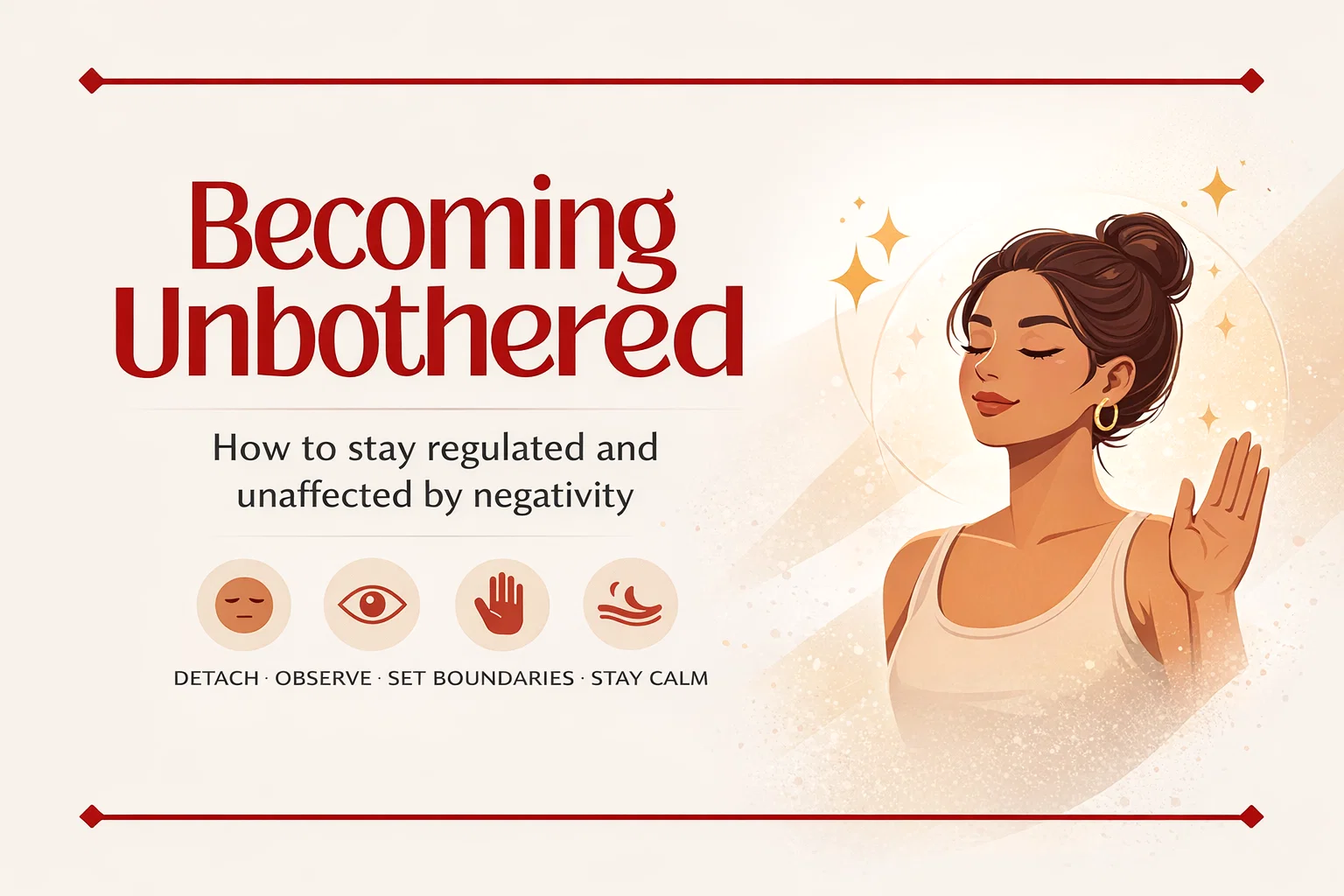
How to Become Unbothered Emotional Regulation Tips for Inner Peace and Mindful Detachment
Have you ever had one of those days where a single comment from a coworker or a minor traffic jam sends your entire mood into a tailspin? We have all been there. It feels like we are walking through the world with our nerve endings exposed, soaking up every bit of negativity and chaos that crosses our path. But what if you could move through the world with a sense of internal quiet that remained undisturbed by external noise? This is the essence of becoming unbothered. It is not about turning into a robot or shutting down your emotions. Instead, it is a sophisticated form of emotional regulation that allows you to remain grounded, centered, and entirely in control of your own peace.
Understanding the Unbothered Mindset
To become unbothered is to develop a specialized skill set. Many people mistakenly believe that being unbothered is a personality trait, something you are either born with or you aren’t. In reality, it is a psychological muscle that you can strengthen with intentional practice. The core of this mindset is the ability to observe a situation without absorbing the energy of that situation. When you are unbothered, you are no longer a sponge for other people’s bad moods or the general stress of the environment. You become more like a mirror, acknowledging what is happening in front of you without letting it penetrate your inner sanctuary.
This state of being is often referred to as emotional regulation. It means that while you still feel things, those feelings do not dictate your actions. You are the captain of the ship, and while the waves may be choppy, they do not determine your direction. This shift from reactive to proactive living is where true personal power resides. When you stop reacting to every stimulus, you reclaim the energy that you used to waste on defense and explanation.
Shutterstock
The Difference Between Being Unbothered and Being Cold
One of the biggest misconceptions about this journey is that it requires you to be cold, distant, or uncaring. This could not be further from the truth. A person who is cold is often reacting out of a place of hurt or defense; they are building a wall to keep the world out. A person who is unbothered is building a bridge to themselves. They are deeply connected to their own values and emotions, which is exactly why they do not need to be swayed by the opinions or actions of others.
The Trap of Emotional Numbing
Emotional numbing is a survival mechanism, usually triggered by trauma or extreme stress. It is a way of “shutting down” to avoid pain. Being unbothered, however, is an active and conscious choice. It involves staying present in the moment and feeling your feelings, but choosing not to let them hijack your behavior. You can care about people and situations deeply while still maintaining your energetic boundaries. In fact, being unbothered actually makes you more effective in your relationships because you are responding from a place of clarity rather than a place of triggered emotion.
The Power of Regulated Responses
When you are regulated, your responses have more weight. Think about the last time you saw someone stay perfectly calm during a heated argument. Their silence or their steady, measured tone likely had a much greater impact than the shouting of the other person. By staying unbothered, you demonstrate a level of self-mastery that commands respect without you ever having to ask for it. You are teaching people how to treat you by showing them that their attempts to rattle you simply do not work.
Signs That You Are Reaching the Unbothered State
How do you know if your work is paying off? There are several key milestones on the path to becoming unbothered. Recognizing these signs can help you stay motivated on the days when it feels difficult to stay centered.
- Triggers no longer control your reactions: You might still feel that flash of heat or irritation when someone pushes a button, but instead of snapping back, you pause. That pause is the space where your freedom lives.
- You observe instead of absorbing: When you walk into a room filled with tension, you can recognize it as an external fact rather than something you need to fix or carry. You see the storm, but you are not the storm.
- You detach without guilt: You realize that you are not responsible for other people’s emotional labor. Choosing to step away from a toxic conversation or a draining friendship feels like an act of self-care rather than an act of betrayal.
- You stop chasing closure: You understand that closure is an internal job. You no longer need the other person to apologize or understand your point of view in order for you to move forward with your life.
How to Build the Skill of Being Unbothered
Building this skill requires a daily commitment to yourself. It is about creating a lifestyle that supports your peace of mind. Here are the foundational pillars of the unbothered life.
Grounding Yourself Daily
Grounding is the practice of pulling your energy back into your body. We spend so much of our time living in our heads or focusing on the digital world that we lose touch with our physical presence. Daily grounding can be as simple as spending five minutes in nature, practicing deep breathing, or doing a quick body scan meditation. When you are physically grounded, you are less likely to be swept away by the winds of external chaos. It provides you with a solid foundation from which to operate.
Setting Energetic Boundaries
We often talk about physical and verbal boundaries, but energetic boundaries are just as important. This involves being mindful of who and what you allow into your personal space. If a certain social media account makes you feel inadequate, unfollow it. If a specific friend always leaves you feeling drained, limit your time with them. You are the gatekeeper of your own energy. By setting these boundaries, you preserve the internal resources you need to stay regulated and calm.
Releasing the Need to Be Understood
This is perhaps the most difficult but most rewarding part of the process. Much of our emotional distress comes from the desperate desire for others to see our side or validate our experiences. When you release the need to be understood, you take back your power. You realize that your truth is valid regardless of whether someone else acknowledges it. This allows you to walk away from pointless arguments and stop over-explaining yourself to people who are committed to misunderstanding you.
Trusting the Silence of Calm Responses
There is a profound strength in a calm response. We live in a culture that often equates loudness with power, but the opposite is usually true. A reaction is often a loss of control, while a response is a manifestation of control. When you choose to remain calm, you are speaking a language of self-assurance that is incredibly loud. You are signaling to yourself and to the world that you are not easily moved.
Trusting this process means believing that you do not have to “win” every interaction. In many cases, the real win is walking away with your peace of mind intact. When you prioritize your internal state over your external reputation, you become nearly untouchable. This does not mean you don’t stand up for yourself; it means you stand up for yourself from a place of dignity rather than a place of desperation.
The Role of Self-Compassion in Regulation
You will not be perfectly unbothered every single day. There will be moments when you lose your cool, when a trigger gets the better of you, or when you find yourself back in the cycle of absorbing other people’s stress. This is where self-compassion becomes essential. If you beat yourself up for being “bothered,” you are simply adding another layer of agitation to your life.
Acknowledge the slip-up, analyze what triggered it, and then gently bring yourself back to your center. The goal is not perfection; it is resilience. The faster you can return to a regulated state after being triggered, the more successful you are becoming in this practice. Treat yourself with the same kindness you would offer a friend who is learning a difficult new skill.
Conclusion: Your Peace is Your Priority
Becoming unbothered is one of the greatest gifts you can give to yourself. It is a journey toward a life where your happiness is not dependent on the behavior of others or the unpredictability of the world. By focusing on emotional regulation, setting firm energetic boundaries, and letting go of the need for external validation, you create a life of profound stability and joy.
Remember that unbothered is a skill, not a destination. It is something you practice in every small interaction, from a rude comment at the grocery store to a major disagreement with a loved one. Each moment is an opportunity to choose your peace over a reaction. Over time, these small choices add up to a transformed life. You deserve to live in a state of calm. You deserve to be the master of your own energy. Start today by taking a deep breath and deciding that, from this moment forward, your peace is your highest priority.