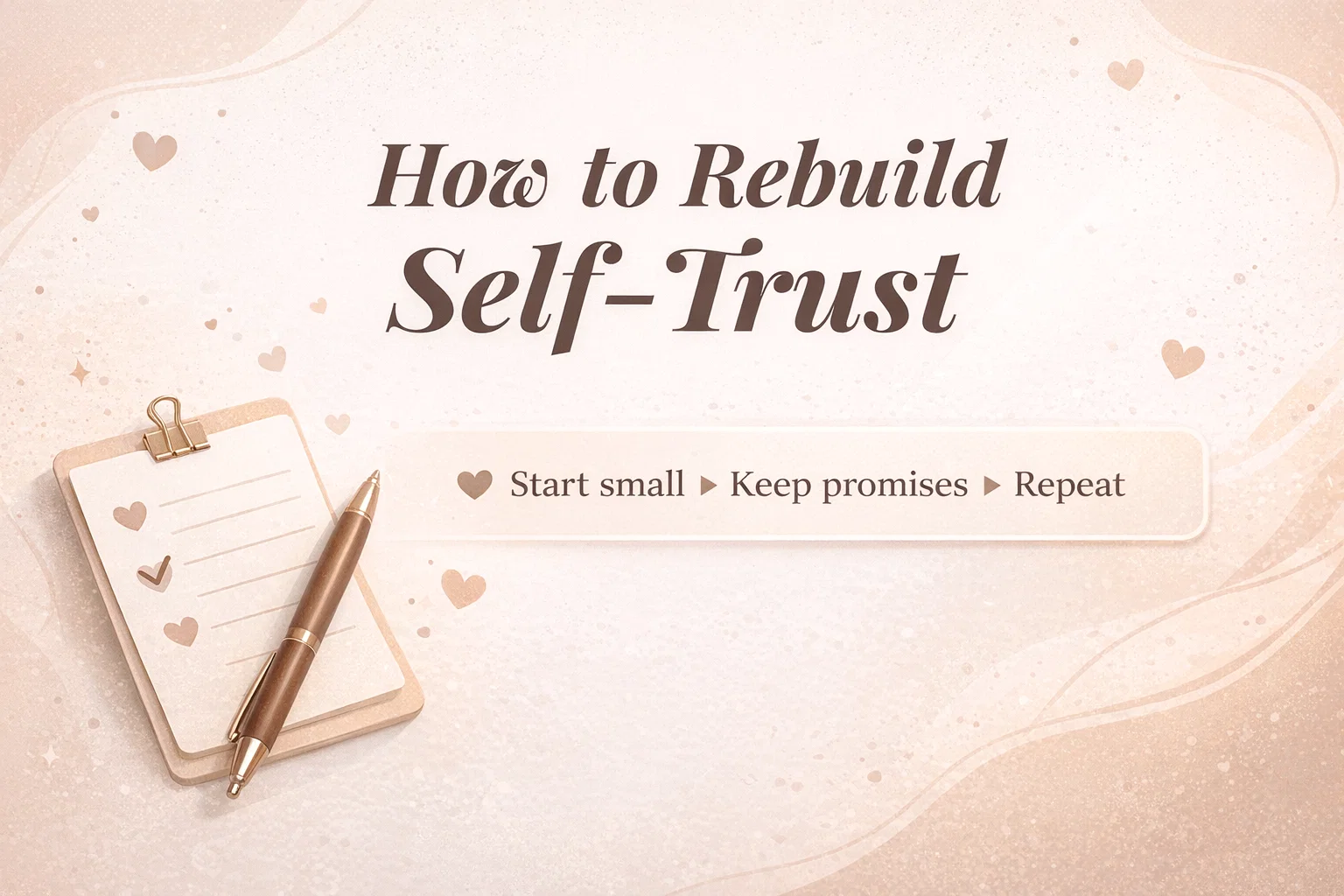
How to Build Self-Trust Again Small Steps to Rebuild Confidence and Stop Self-Judgment
We have all been there. You set a massive goal on Monday, fueled by a sudden burst of inspiration, only to find yourself back at square one by Thursday. When we repeatedly break the promises we make to ourselves, a subtle but damaging shift happens in our internal dialogue. We stop believing our own word. This loss of self trust can feel like a heavy weight, leading to a cycle of procrastination, self doubt, and the constant feeling that we are somehow behind in life. But here is the good news: self trust is not a permanent character trait that you either have or you dont. It is a muscle that can be rebuilt, and the process is much simpler than you might think.
The image we are looking at today captures the essence of this journey perfectly. It reminds us that rebuilding trust is not about doing more or achieving perfection. Instead, it is about starting smaller and showing up for yourself in ways that actually feel sustainable. If you have been feeling disconnected from your own intuition or frustrated by your lack of follow through, it is time to change the narrative. Let us dive deep into how you can start trusting yourself again, one tiny promise at a time.
Understanding the Foundation of Self Trust
Before we can fix something, we have to understand what it is. Self trust is the firm belief that you can rely on yourself to take care of your needs and follow through on your intentions. It is the internal security that comes from knowing that even if things get difficult, you have your own back. When this foundation is shaky, every decision feels like a high stakes gamble. You might find yourself constantly seeking external validation or asking everyone else for their opinion because you no longer trust your own.
The core of self trust is integrity with oneself. Think of it like a friendship. If a friend constantly cancelled plans or lied to you, you would eventually stop relying on them. The relationship you have with yourself works the exact same way. Every time you say you are going to do something and then dont, you chip away at that internal bond. Rebuilding it requires a shift from being your harshest critic to becoming your most reliable ally.
Step One: Notice Where Trust Was Broken
The first step in any healing process is awareness. You cannot fix a leak if you dont know where the water is coming from. The image highlights a vital point: you must pay attention to the promises you stopped keeping, but you must do so without blaming yourself. This is where most people get stuck. They look back at their “failures” and use them as evidence that they are lazy or incapable. This judgment only creates more resistance.
The Power of Compassionate Observation
Instead of judging the past, try to be a curious observer. Ask yourself what was happening when you stopped keeping those promises. Were you setting goals that were too big? Were you trying to please others instead of yourself? Understanding what drained your energy matters much more than judging the fact that you felt drained. Perhaps you promised yourself you would workout for an hour every morning, but you were actually dealing with extreme burnout at work. In that context, breaking the promise wasnt a failure of character; it was a sign that the promise was out of alignment with your current reality.
Identifying Your Patterns
Reflect on the specific areas where you feel the least confident. Is it with your health, your career, or your personal boundaries? By identifying these patterns, you can see where the “trust leaks” are occurring. Once you see the pattern, you can stop the cycle of setting unrealistic expectations that lead to inevitable disappointment.
Step Two: Make One Promise You Can Actually Keep
This is the most transformative part of the process. To rebuild trust, you must lower the bar. This might sound counterintuitive in a world that tells you to “go big or go home,” but when trust is broken, you need proof of concept, not a grand achievement. You need to prove to your brain that when you say you will do something, it actually happens.
Why Small Goals Win
Keeping small promises builds more trust than setting big goals. When you set a massive goal and fail, you reinforce the idea that you are unreliable. But when you set a goal so small it feels “too easy” and you actually do it, you send a signal to your nervous system that you are safe and dependable. This creates a positive feedback loop.
- Drink one glass of water: Instead of promising to drink a gallon, just promise one glass before your coffee.
- Five minutes of movement: Forget the hour long gym session. Just commit to five minutes of stretching.
- One deep breath: If you are overwhelmed, your promise could simply be to take one conscious breath before opening your laptop.
The “Too Easy” Litmus Test
When you choose your one promise, ask yourself: On my absolute worst day, when I am tired, cranky, and busy, could I still do this? If the answer is no, the promise is still too big. Scale it back until it feels almost silly not to do it. That is the sweet spot where self trust begins to regrow.
Step Three: Repeat, Not Perfect
Consistency is the currency of trust. It is not about how well you do the task, but simply that you did it. The image reminds us to focus on “Repeat, not perfect.” Perfectionism is actually a form of self sabotage because it sets a standard that is impossible to maintain. When you inevitably fall short of perfection, the self trust breaks all over again.
Embracing the Messy Middle
There will be days when you do the task half heartedly. There will be days when you do it at 11:59 PM just to say you did it. That is okay. In fact, that is great. Showing up when you dont feel like it is the ultimate way to prove to yourself that your commitments matter more than your fleeting moods. Trust is built in the boring, repetitive moments, not just the highlight reel moments.
Recovery Over Perfection
If you do happen to miss a day, the most important thing you can do for your self trust is to get back on track immediately. Dont let one missed day turn into a missed week. Acknowledge it, forgive yourself, and return to your small promise the very next day. This teaches you that you are resilient enough to handle setbacks without giving up on yourself entirely.
Why You Don’t Rebuild by Doing More
In our productivity obsessed culture, we often think the solution to any problem is “more.” More discipline, more hustle, more habits. But when it comes to the soul work of self trust, “more” is often the enemy. Doing more usually means adding more pressure, and pressure is what caused the trust to break in the first place. Rebuilding is a process of subtraction and simplification.
When you start smaller, you remove the fear of failure. You create a space where you can actually succeed. Each small success acts like a brick in a wall. One brick doesnt look like much, but a thousand bricks creates a structure that can withstand any storm. By focusing on the small, you are actually doing the deepest work possible.
The Benefits of a Trusted Self
As your self trust grows, you will notice a shift in how you move through the world. You will start to feel a sense of internal quiet. You wont need to check your phone for distractions as much because you arent trying to escape the feeling of being a “failure.” You will find it easier to set boundaries with others because you finally have a solid boundary with yourself. Most importantly, you will start to like yourself more. There is a profound sense of peace that comes from knowing that you are someone you can count on.
Increased Decisiveness
When you trust yourself, decision fatigue begins to vanish. You stop agonizing over every choice because you know that even if you make a “wrong” turn, you have the skills and the self reliance to figure it out. You trust your intuition to guide you and your resilience to catch you.
Authentic Confidence
This isnt the loud, performative confidence we often see on social media. This is a quiet, grounded confidence. It is the knowledge that your worth is not tied to your productivity, but to your integrity. You stop performing for the world and start living for yourself.
A Path Forward
Rebuilding self trust is a journey, not a destination. It is something you will likely have to tend to for the rest of your life, and that is perfectly okay. The goal is not to reach a point where you never break a promise again, but to reach a point where you know how to come back home to yourself when you do.
Start today. Right now. Dont wait for Monday or the first of the month. Pick one tiny, microscopic promise. It could be as simple as putting your phone in another room while you eat lunch or spending two minutes sitting in silence. Do it today. Do it tomorrow. Watch as the foundation of your life begins to feel a little bit more solid with every small “yes” you give to yourself.
You have spent enough time being your own toughest critic. It is time to see what happens when you become your own best friend. You are worthy of your own trust, and you are capable of rebuilding it. Start small, be kind to yourself, and keep going. The version of you that trusts themselves is waiting just on the other side of these small, consistent steps.
Would you like me to help you brainstorm a list of five “too easy” promises you could start with today based on your current routine?