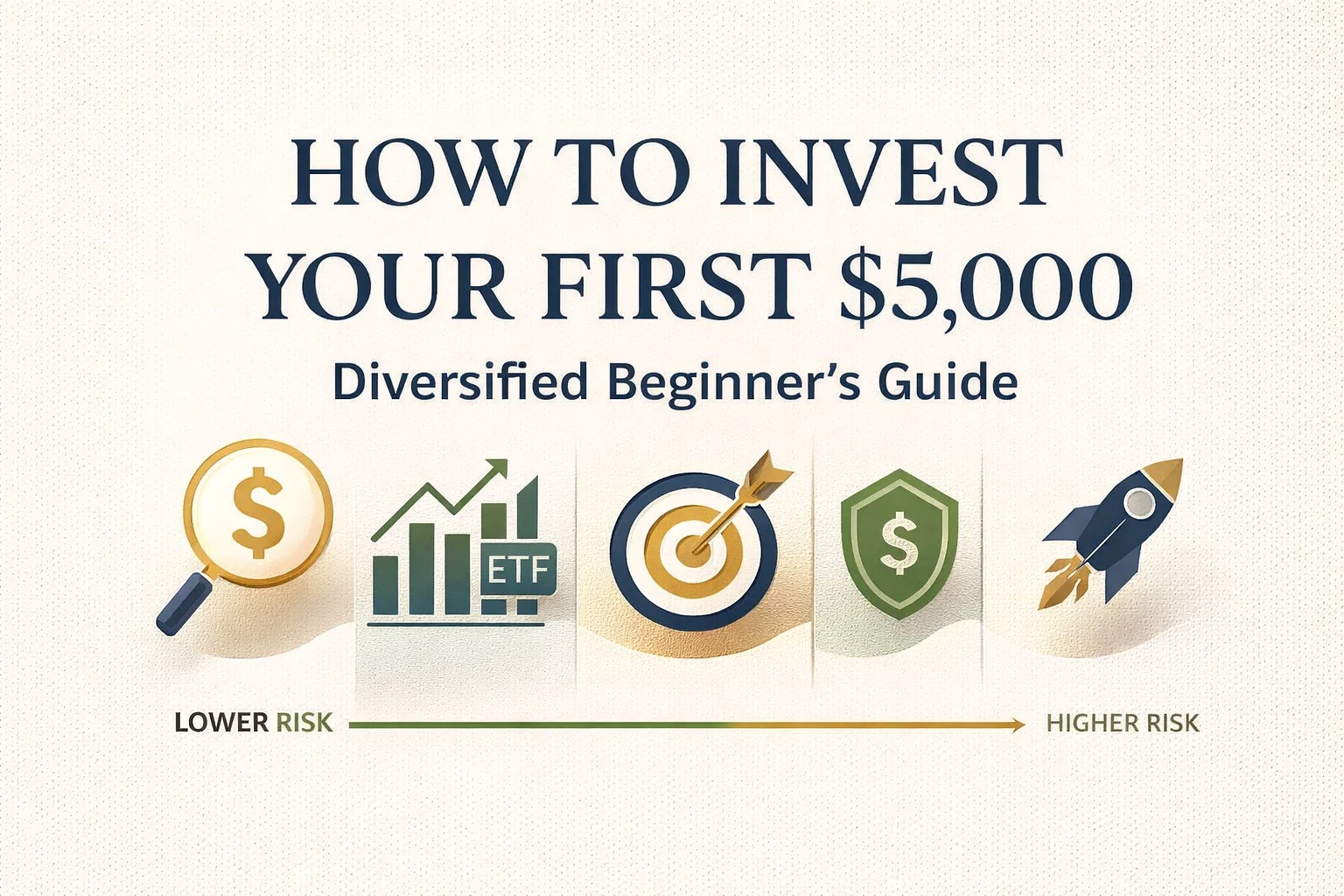
How to Invest Your First 5000 Smart Balanced Investment Plan for Beginners 2026
Taking the leap into the world of investing often feels like standing at the edge of a high diving board. You know the water is fine once you are in, but that first move is the hardest part. If you have managed to save your first $5,000, you are already ahead of the curve. This amount is the perfect “seed” to plant in the soil of the financial markets. It is large enough to diversify across different sectors but small enough that you can manage it without needing a team of private bankers. The goal is to move away from the “get rich quick” mentality and toward a sustainable, balanced strategy that focuses on long term wealth. In this guide, we will break down exactly how to allocate those funds to minimize risk while capturing the growth potential of the global economy.
The Philosophy of a Balanced $5,000 Portfolio
Before buying your first share, it is vital to understand why we do not just “bet it all on black.” A balanced portfolio is designed to protect you from the volatility of a single company or sector. If one tech company has a bad quarter, your entire life savings should not take a nose dive. By spreading your $5,000 across various asset classes, you ensure that when one area of the market is down, another might be up or at least stable. This approach is not about making a million dollars overnight; it is about ensuring that ten years from now, your $5,000 has grown significantly through the power of compound interest and smart diversification.
Understanding Risk vs Reward
Every investment carries some level of risk. Generally, the higher the potential return, the higher the risk of losing your principal. A smart beginner’s plan uses a sliding scale. We put the largest chunk of money into “Lower Risk” buckets like broad index funds and a tiny sliver into “Higher Risk” speculative assets. This creates a safety net while still giving you a ticket to the “moon” if a speculative play takes off. By following a 60/15/10/10/5 split, you are creating a professional grade structure that rivals what many institutional investors use.
The Foundation: 60% in Index Funds and ETFs
The heaviest lift in your portfolio should be done by Index Funds and Exchange Traded Funds (ETFs). This is the 60% of your $5,000, or $3,000 total. Think of this as the engine of your ship. Index funds allow you to own a tiny piece of hundreds or even thousands of companies at once. Instead of trying to find the next big winner, you are simply betting on the success of the entire economy.
Broad Diversification with VOO and VT
For most investors, the S&P 500 is the gold standard. Funds like VOO (Vanguard S&P 500 ETF) track the 500 largest companies in the United States. If you want to go even broader, VT (Vanguard Total World Stock ETF) gives you exposure to companies across the globe, including Europe and Asia. This means your wealth is not just tied to the American dollar or the American consumer. If international markets outperform the US in a given year, your VT holdings will capture that growth.
Tapping into Emerging Markets
Within this 60% allocation, it is often wise to look at VWO (Vanguard FTSE Emerging Markets ETF) or VGK (Vanguard FTSE Europe ETF). Emerging markets include fast growing economies like India, Brazil, and parts of Southeast Asia. While these are more volatile than US stocks, they offer a growth “engine” that developed nations often lack. By holding these, you are truly diversifying globally, ensuring that you are a participant in the world’s collective economic progress.
Generating Passive Income: 15% in Dividend Stocks
The next $750 of your investment should go toward Dividend Stocks. These are shares in mature, profitable companies that literally pay you to own them. While growth stocks reinvest all their profits into the business, dividend payers distribute a portion of their earnings back to shareholders. This is the cornerstone of passive income. Even if the stock price stays flat, you are still receiving cash in your brokerage account every quarter.
Stable Income Leaders: KO, MCD, and JPM
When looking for dividend stocks, you want “Dividend Aristocrats” or companies with a long history of stability. Coca-Cola (KO) and McDonald’s (MCD) are classic examples. People buy soda and burgers regardless of the economic climate. Financial giants like JPMorgan Chase (JPM) and Visa (V) also offer a combination of stability and consistent payouts. These companies act as the “ballast” for your portfolio, providing a steady stream of income that you can either spend or, more importantly, reinvest to buy even more shares.
Chasing Innovation: 10% in Growth and Tech Stocks
Now that your foundation and income are set, it is time to add some “horsepower.” Growth stocks are companies expected to grow at a rate significantly above the average for the market. They often lead their industries in innovation and technology. You are allocating 10%, or $500, to this category. This is where you look for the names that are changing the way we live and work.
Investing in the Giants: AAPL, MSFT, and AMZN
It is no secret that big tech has dominated the last decade. Apple (AAPL), Microsoft (MSFT), and Amazon (AMZN) are no longer just computer companies; they are integrated into the fabric of daily life. From cloud computing to artificial intelligence, these firms are at the forefront of the digital revolution. Adding a bit of AMD or NVDA for semiconductor exposure also helps you capture the hardware side of the tech boom. These stocks can be volatile, but their long term upward trajectory has been a major wealth builder for millions.
The Safety Net: 10% in Bonds or Cash
Not every year is a “green” year in the stock market. There will be seasons of recession and uncertainty. This is why we keep 10% ($500) in Bonds or Cash. Bonds are essentially loans you provide to the government or corporations in exchange for interest payments. They tend to move in the opposite direction of stocks, providing a “cushion” when the market gets bumpy.
Choosing the Right Protection: BND and SHY
BND (Vanguard Total Bond Market ETF) provides a broad mix of US investment grade bonds. If you are worried about inflation or need even more liquidity, keeping some of this 10% in a High Yield Savings Account (HYSA) or a short term bond fund like SHY (iShares 1-3 Year Treasury Bond ETF) is a smart move. This “dry powder” ensures that if the market crashes, you have cash on hand to buy stocks at a discount without having to sell your other investments at a loss.
The Moonshots: 5% in Speculative Assets
Finally, we have the “fun” part of the portfolio. Speculative assets are high risk, high reward plays. You are only putting 5% ($250) here. If this money disappears, your overall financial health is still perfectly fine. However, if one of these assets triples or quadruples, it can significantly boost your total returns. This is where you can explore the frontiers of finance.
Crypto and Emerging Tech: BTC, CRWD, and RBLX
Bitcoin (BTC) is the most well known speculative asset, often referred to as “digital gold.” While it is incredibly volatile, its adoption as a store of value makes it an interesting small holding. Other options include high growth but unproven tech stocks like CrowdStrike (CRWD) for cybersecurity or Roblox (RBLX) for the metaverse and gaming. The key here is discipline. Never let your speculative “gambles” grow to become 30% or 40% of your portfolio. Take profits when you win and stick to the 5% rule.
Maintaining Your Portfolio: The Importance of Rebalancing
Setting up your $5,000 investment plan is just the beginning. Over time, your 60% index fund allocation might grow to 70%, or your speculative assets might drop to 1%. To stay “balanced,” you need to rebalance your portfolio once or twice a year. This involves selling a little bit of what has grown too much and buying more of what has lagged behind. This process naturally forces you to “buy low and sell high,” which is the golden rule of investing. It keeps your risk profile exactly where it needs to be based on your age and goals.
Conclusion: The Path Forward
Investing your first $5,000 is a milestone that changes your relationship with money. You are no longer just a consumer; you are an owner of the global economy. By following this diversified guide, you have built a system that captures the stability of the S&P 500, the income of dividend giants, the excitement of tech innovation, and the protection of bonds. Remember that the most important factor in investing is not timing the market, but time “in” the market. Start today, stay disciplined, and let the power of compounding turn your $5,000 into a foundation for your future freedom. The best time to start was yesterday; the second best time is right now.
Would you like me to generate a specific Python script to help you track this portfolio’s performance over time?