How to Read Eye Body Language Eye Cues Chart Psychology Mind Reading Tips Poster
Have you ever sat across from someone and felt like there was an entire conversation happening that had nothing to do with the words they were saying? Human communication is a complex tapestry, and while we spend a lot of time polishing our speech, our eyes are often busy telling the truth. The concept of reading eye cues is not just a parlor trick for aspiring mentalists; it is a fundamental aspect of neuro-linguistic programming (NLP) and behavioral psychology. By understanding the subtle shifts in where a person looks, we can gain incredible insight into how their brain is accessing information, whether they are visualizing a memory, constructing a new idea, or tapping into their emotional state.
The Science Behind Eye Accessing Cues
To understand how to read eyes, we have to look at how the brain is wired. In the world of psychology, specifically within NLP, these movements are known as eye accessing cues. The theory suggests that because different parts of the brain are responsible for different types of thinking (like remembering a sound versus imagining a picture), the eyes move in specific directions to help the brain “access” that data. It is almost like a physical filing system where the eyes act as the cursor on a screen.
When you ask someone a question, their immediate, involuntary eye movement can tell you if they are searching their “hard drive” for a factual memory or if they are in “creative mode,” piecing together something that has not happened yet. This is why reading eyes is such a powerful tool for teachers, therapists, law enforcement, and even parents. It provides a non-verbal map of the internal thought process.
Breaking Down the Directions: Left Versus Right
Before diving into the specific quadrants, it is vital to establish a baseline. For the vast majority of right-handed people, the “standard” eye-reading chart applies. However, it is important to remember that for some left-handed individuals, these cues may be mirrored. Always observe a person during casual conversation first to see how their eyes move when they are clearly telling the truth about a simple memory.
Visual Construction: Looking Up and to the Left
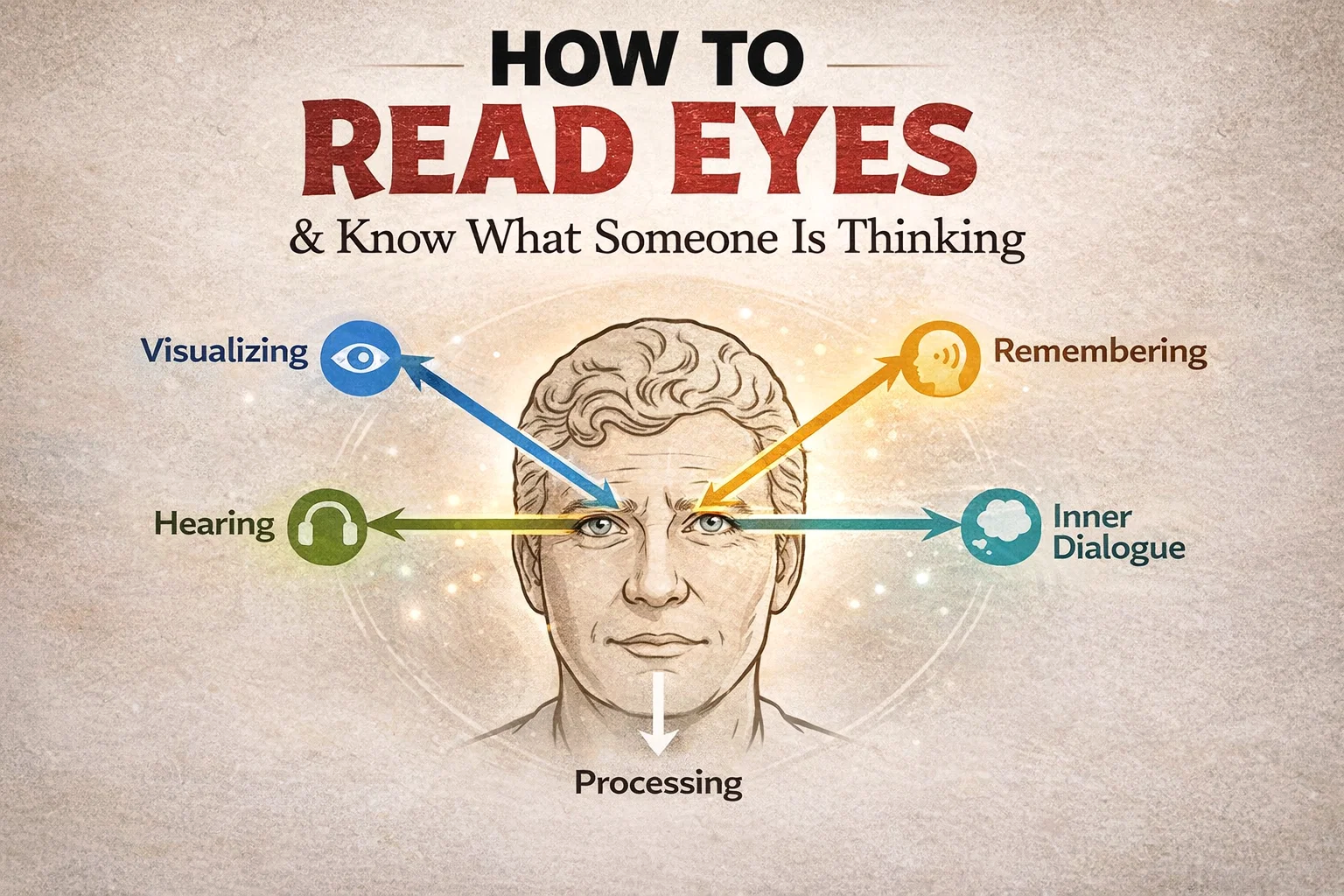
When a person looks up and to their left (your right), they are typically in the realm of visual construction. This means they are creating an image in their mind that they have never seen before. If you ask a friend, “What would a purple elephant with wings look like?” you will likely see their eyes drift to this quadrant. In a more serious context, if you ask someone where they were last night and they look here before answering, it might suggest they are “constructing” a story rather than “remembering” a fact. This is why this specific movement is often associated with lying, though it is not a foolproof indicator on its own.
Visual Memory: Looking Up and to the Right
Conversely, looking up and to the right (your left) indicates visual memory. This is the brain’s way of “seeing” something that actually happened. If you ask someone, “What color was your first car?” or “What does your front door look like?” their eyes will often flick to this corner. They are scanning their mental photo album to retrieve an existing image. This is generally a sign of honesty and factual recall because the brain is reaching back into storage rather than fabricating new data.
The Auditory Realm: Middle Horizontal Cues
Not all thoughts are visual. Sometimes we are thinking about a song, a conversation, or a specific tone of voice. When the eyes move horizontally to the left or right, staying level with the ears, the person is likely processing auditory information.
Auditory Construction: Center Left
Looking straight to the left (your right) suggests auditory construction. This happens when someone is imagining a sound. Perhaps they are trying to figure out how a specific sentence should sound before they say it, or they are imagining a voice they have never heard. If you ask someone to “Imagine the sound of a trumpet underwater,” their eyes will likely move to this horizontal position as they piece together that unique soundscape.
Auditory Memory: Center Right
When the eyes move straight to the right (your left), the person is remembering a sound. This could be the melody of a favorite song, the sound of a loved one’s laugh, or a specific instruction they were given earlier in the day. This cue is incredibly useful in learning environments, as it shows the student is actively recalling verbal information they have previously stored.
The Deep Dive: Feelings and Internal Dialogue
The lower quadrants of eye movement are perhaps the most revealing when it comes to a person’s inner emotional world. These movements happen when we move away from external data and start looking inward.
Kinesthetic Cues: Down and to the Left
Looking down and to the left (your right) is often associated with kinesthetic processing. This means the person is checking in with their physical feelings or emotions. If you ask someone, “How did you feel when you won that award?” or “Can you describe the texture of that fabric?” they will often look down in this direction. It is a sign that they are connecting with a tactile sensation or an internal emotional state. This is a very “heavy” or “deep” quadrant, often seen during moments of intense reflection or empathy.
Internal Dialogue: Down and to the Right
Looking down and to the right (your left) is the classic sign of internal dialogue. This is what we do when we are “talking to ourselves.” If you see someone in deep thought, weighing the pros and cons of a decision or silently rehearsing what they want to say next, their eyes will frequently rest here. It is the position of the internal critic and the logical mind. When someone is in this state, they are usually less aware of their physical surroundings because they are so focused on their inner voice.
The Straight Ahead Gaze: Visualization and Focus
What about when someone looks straight ahead? This is often referred to as a “defocused” gaze. It usually happens when someone is visualizing something so intensely that they have “turned off” their external vision. They aren’t looking at you; they are looking through you at a mental movie screen. This is common during daydreaming or when someone is trying to grasp a very complex abstract concept. It represents a state of deep focus where the brain is prioritizing internal imagery over the outside world.
Practical Applications for Reading Eyes
Now that you understand the map, how do you use it? The goal of reading eye cues is not to “catch” people or act like a human lie detector. Instead, it should be used to improve communication and build rapport. Here are a few ways to apply this knowledge in daily life:
- In Business: If you are presenting an idea and notice your client is looking down and to the right, they are likely having an internal debate. This is a great time to pause and ask if they have any specific questions or concerns.
- In Education: If a student looks up and to the right when asked a question, you know they are trying to remember the material. If they look up and to the left, they might be guessing or trying to visualize a concept they haven’t quite mastered yet.
- In Relationships: Understanding when a partner is in a “kinesthetic” state (looking down and left) can help you approach them with more empathy, as you know they are currently processing deep feelings.
Common Pitfalls and How to Avoid Them
While the “How to Read Eyes” chart is a fantastic guide, it is not a set of absolute laws. Human beings are diverse, and there are several factors that can influence these movements. It is important to stay flexible in your analysis.
The Left Handed Exception
As mentioned earlier, about 10 percent of the population may have reversed cues. If you assume a left handed person is lying because they are looking in the “construction” quadrant, you might be totally wrong. They might simply be remembering. Always establish their “truth baseline” by asking simple, non-threatening memory questions first.
Cultural Differences
Eye contact and eye movement are heavily influenced by culture. In some cultures, looking down is a sign of respect rather than an indication of internal dialogue or feelings. In others, direct eye contact is considered aggressive. Always take the cultural context into account before making assumptions about a person’s thought process.
Individual Baselines
Some people have unique “ticks” or habits. They might look down when they are nervous, regardless of what they are thinking. Professional poker players and trained negotiators often work hard to “neutralize” their eye movements to avoid giving away their thoughts. Practice “calibrating” to each individual person you interact with.
Conclusion: The Eyes as a Window to the Soul
Learning how to read eyes is like learning a new language. At first, you have to consciously think about every movement and translate it in your head. But with practice, it becomes second nature. You start to “feel” the rhythm of a conversation and understand the hidden layers of meaning behind every glance. While it is just one piece of the body language puzzle, it is arguably one of the most revealing.
By paying attention to these subtle cues, you can become a more effective communicator, a more empathetic friend, and a sharper observer of the world around you. The next time you are in a conversation, don’t just listen to the words. Watch the eyes. You might be surprised by how much more there is to hear. Save this guide for later so you can keep practicing your new skill!