How to Set Goals That Actually Stick A Step-by-Step Goal Setting Framework for Success
Most of us approach goal setting like a sprint. We wait for a burst of inspiration, usually around January 1st, scribble down a list of massive life changes, and then wonder why we have lost steam by Valentine’s Day. The problem isn’t your lack of willpower or your ambition. The problem is the gap between where you are today and where you want to be someday. Without a bridge to connect those two points, even the best intentions fall into the abyss of procrastination. To truly make your goals stick, you need a hierarchical framework that turns abstract dreams into immediate actions.
The Anatomy of a Goal Setting Pyramid
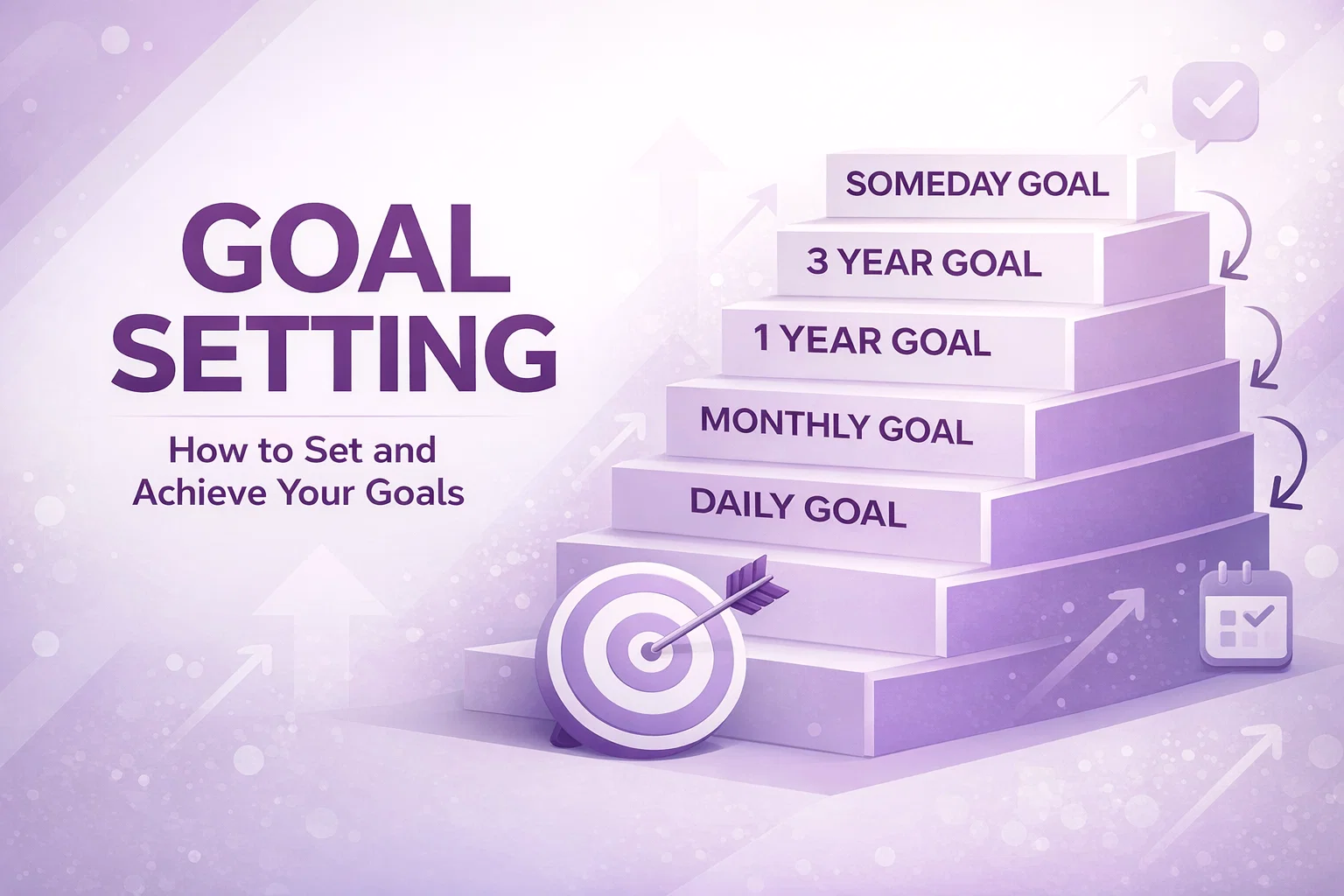
Think of your goals as a pyramid. At the very top is your Someday Goal, the pinnacle of your aspirations. As you move down the levels, the goals become more frequent, more specific, and significantly more manageable. This structure is designed to prevent the common paralysis that comes with looking at a massive objective. When you only look at the top of the mountain, the climb seems impossible. When you look at the step right in front of you, it’s just a matter of movement.
The beauty of this system is that it creates an unbreakable chain of logic. Your daily actions are fueled by your weekly targets, which support your monthly objectives, which eventually lead to your yearly, three year, and someday milestones. If you can master the bottom of the pyramid, the top takes care of itself through the power of compound interest and consistency.
Defining Your Someday Goal: The North Star
Visualizing the Big Picture
Your Someday Goal is your vision. It is the thing you want to look back on and say you accomplished. This doesn’t need to have a strict deadline yet, but it does need to have a “why.” Are you looking to achieve financial independence? Do you want to write a bestselling novel? Perhaps you want to transition into a completely different career that aligns with your passions. This is the level where you allow yourself to dream without the inner critic telling you it is unrealistic.
The Danger of Staying at the Top
Many people fail because they spend all their time in the Someday category. They visualize, they manifest, and they talk about their dreams at dinner parties, but they never build the levels beneath it. A vision without a plan is just a hallucination. To make this stick, you must use this high level goal only as a compass to ensure every other level of the pyramid is pointing in the right direction.
The Three Year Horizon: Strategic Planning
Three years is a magical timeframe. It is long enough to make significant, life altering progress, but short enough that you can still feel the ticking of the clock. When you look at your someday goal, ask yourself what version of that goal can be realistically realized in the next 36 months. If your someday goal is to own a thriving holistic health practice, your three year goal might be to finish your certification and secure your first ten consistent clients.
At this stage, you start to move from dreaming to strategizing. You begin to identify the major pillars of work required. You might need to learn new skills, save a specific amount of money, or build a specific network. The three year goal acts as a filter for your opportunities. If a project or a distraction doesn’t help you reach that three year mark, it’s a distraction you can’t afford.
The One Year Goal: The Annual Roadmap
Setting Tangible Benchmarks
Now we are getting into the territory of traditional New Year’s resolutions, but with a twist. Instead of picking a random habit, your one year goal is a direct derivative of your three year plan. This is where you set specific, measurable metrics. If you want that health practice in three years, this year might be dedicated entirely to education or market research. It is about laying the foundation.
Maintaining Focus Throughout the Seasons
A year is a long time, and energy naturally fluctuates. To make a one year goal stick, you have to accept that progress isn’t linear. There will be months of high productivity and months where you feel stuck. The secret is to keep the annual goal visible. It should be the primary focus of your professional or personal development for the next twelve months, serving as the benchmark for success when you do your year end review.
Monthly and Weekly Goals: The Engine of Momentum
The Power of the 30 Day Sprint
Monthly goals are where the rubber meets the road. This is the level where you can see the finish line from the starting blocks. A month is the perfect amount of time to install a new habit or complete a significant phase of a project. When you break your yearly goal into twelve monthly chunks, the “impossible” suddenly looks like a checklist.
Weekly Calibration
Weekly goals are your course correction mechanism. Life happens. You get sick, work gets busy, or unexpected opportunities arise. By setting a weekly goal, you give yourself the chance to pivot without abandoning the entire pyramid. Your weekly goal should be the one thing that, if completed, makes the rest of your week a success. It’s about prioritizing the vital few over the trivial many.
- Review every Sunday: Look at the week ahead and pick one primary objective.
- Audit your time: Ensure your calendar actually reflects your weekly goal.
- Celebrate small wins: A successful week is a building block for a successful life.
Daily Goals and the Right Now Action
This is the most critical part of the entire framework. This is where most people lose the battle. We often set goals that are too big for a single day. A daily goal shouldn’t be “Write a book.” It should be “Write 500 words.” It needs to be an action you can actually control. The daily goal is the promise you make to yourself every morning.
The “Right Now” Philosophy
The base of the pyramid is labeled Right Now. This is the antidote to procrastination. Procrastination lives in the future or the past. Productivity lives in the present. If you are feeling overwhelmed by your weekly or monthly targets, stop looking at them. Ask yourself: What is the one thing I can do right now? It might be as simple as opening a document, making a phone call, or drinking a glass of water to clear your head. These micro actions build the momentum that carries you through the rest of the pyramid.
Why This Framework Actually Works
The reason this visual hierarchy is so effective is that it addresses the psychological needs of the human brain. We need a sense of purpose (the Someday Goal) to feel inspired, but we also need a sense of agency (the Right Now action) to avoid feeling helpless. When you have both, you enter a state of flow. You know exactly why you are doing what you are doing, and you know exactly what to do next.
Furthermore, it removes the “All or Nothing” mentality. If you miss a daily goal, you haven’t failed at your life’s mission. You just missed a daily step. You can correct it tomorrow because the rest of the pyramid is still standing. It builds resilience and grit by shifting the focus from the outcome to the process.
The Role of Visibility and Review
For this to work, you cannot keep it in your head. You need to write it down. Whether you use a digital planner, a physical journal, or a giant poster on your wall, the pyramid needs to be visible. Constant visual reinforcement reminds your subconscious of the hierarchy. It keeps you from getting bogged down in “busy work” that doesn’t actually move the needle toward your higher level objectives.
Common Pitfalls to Avoid
Overcomplicating the Bottom Levels
One major mistake is trying to do too many things at once at the daily and weekly levels. The prompt in the image asks: What is the ONE thing I can do? Not the ten things. Not the twenty things. Success is about focus. If you try to climb five pyramids at once, you will never reach the top of any of them. Pick one primary goal for each timeframe and stick to it.
Losing Sight of the “Why”
Sometimes we get so caught up in the daily grind that we forget why we started. If your daily actions feel like a chore and no longer bring you closer to a “Someday” that excites you, it might be time to re evaluate the top of your pyramid. Your goals should evolve as you grow. It is okay to change your mind about what your someday looks like, as long as you adjust the rest of the structure to match.
Conclusion: Building Your Own Pyramid
Goal setting isn’t about the destination; it is about the person you become while achieving them. By using this hierarchical approach, you stop being a dreamer and start being an architect. You take those vague, misty aspirations and give them a solid, concrete foundation. You move from the frustration of “I wish” to the confidence of “I am doing.”
Start today. Don’t wait for Monday or next month. Look at the pyramid and define your Someday Goal. Then, immediately drop down to the very bottom and decide what you can do right now to move toward it. Whether it is a five minute research session or simply writing your goals down on paper, that first step is the most important one you will ever take. Once the foundation is laid, the rest of the climb is just a matter of showing up, one day at a time.
Consistency is the secret sauce that turns a simple drawing into a transformed life. Respect the pyramid, trust the process, and watch as your goals finally start to stick.