How to Stay Consistent and Build Discipline Even When You Have No Energy Daily Habits
Have you ever woken up with a to-do list a mile long, only to find that your mental battery is sitting at a flashing red 5 percent? We have all been there. You have the best intentions to hit the gym, write that chapter, or finally organize the garage, but your body feels like lead and your brain is foggy. In these moments, most people think they have failed. They believe that because they do not have the energy to give 100 percent, they should just give zero. But what if I told you that the secret to elite discipline isn’t about what you do on your best days, but what you manage to do on your absolute worst?
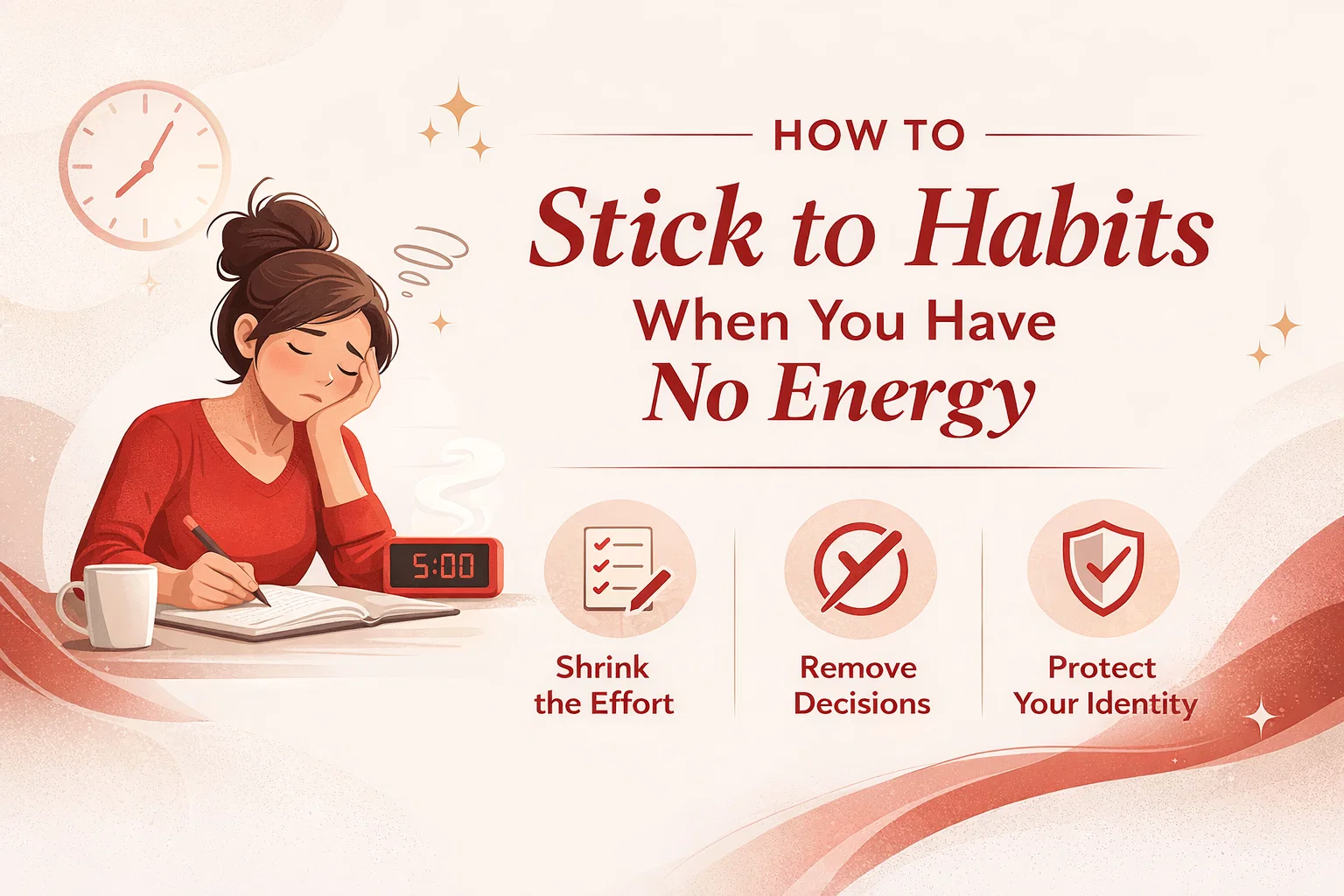
True discipline is a muscle that is built in the trenches of exhaustion. The image we are looking at today provides a revolutionary roadmap for maintaining momentum when you feel like quitting. It shifts the focus from intensity to identity. By learning how to “shrink the effort” and “remove the decision,” you can transform your habits from burdensome chores into non-negotiable parts of who you are. Let us dive deep into how you can master your habits even when you have no energy left in the tank.
Shrink the Effort, Not the Standard
One of the biggest traps in habit formation is the “all or nothing” mentality. We tell ourselves that if we cannot do a full 60-minute workout, then a 5-minute stretch is pointless. This could not be further from the truth. When your energy is low, the goal is not to achieve a personal best; the goal is to keep the streak alive. This is where the concept of scaling your execution comes into play.
The Power of the Five-Minute Rule
Scaling your habits means reducing the quantity of the work while keeping the quality of the commitment intact. If your habit is to write 1,000 words a day but you are exhausted, write one paragraph. If your habit is a 30-minute run, put on your shoes and walk to the end of the block and back. By shrinking the effort, you lower the barrier to entry. It is much easier to convince a tired brain to do something for five minutes than it is to commit to an hour of labor.
Why Small Execution Still Counts
Every time you perform a habit, even a tiny version of it, you are casting a vote for the person you want to become. A 10 percent effort is infinitely better than a 0 percent effort because it maintains the neural pathways associated with that behavior. Small wins create a sense of accomplishment that can actually provide a slight energy boost, helping you feel less like a victim of your circumstances and more like the master of your routine.
Remove the Decision to Save Your Willpower
Willpower is a finite resource. Every time you have to make a choice—what to eat, when to start working, which exercise to do—you are burning through your mental fuel. When you are already low on energy, you simply do not have the willpower left to make “good” decisions. This is why you must automate your life as much as possible.
The Danger of Low Energy and Low Willpower
When you are tired, your brain naturally seeks the path of least resistance. Usually, that path leads to the couch and a bag of chips. If you have to decide in the moment whether or not to follow through on your habit, you will almost always choose the easy way out. To combat this, you need to “decide in advance.” By removing the need to think, you allow yourself to operate on autopilot.
Setting the Where, When, and How
To remove the decision, you need a concrete plan. This involves identifying exactly when the habit will happen, where it will happen, and what the “smallest acceptable version” looks like. For example, instead of saying “I will meditate today,” you say “I will sit on my blue cushion at 7:00 AM and breathe deeply for two minutes.” When the plan is that specific, there is no room for negotiation. You just follow the instructions you wrote for yourself when you were feeling strong.
Stop Negotiating With Your Tired Brain
Your brain is a survival machine, and its primary job is to keep you safe and comfortable. When you are tired, your brain views your habits as a threat to your recovery. It will start to whisper logical-sounding excuses to get you to stop. It will say things like, “You deserve a break” or “You will be much more productive if you just start fresh tomorrow.”
Recognizing the Logic Trap
The problem with these excuses is that they are often true. You probably do deserve a break. You probably would be more productive tomorrow. But if you listen to those voices every time you are tired, you will never build lasting discipline. Discipline is the ability to do what you said you were going to do long after the mood you said it in has left you.
It Matters Because You Said It Matters
The next time your brain tries to negotiate, remind yourself of your “Why.” You did not start this habit because it was easy; you started it because it was important. The validity of your goals does not change based on your heart rate or your sleep quality. By refusing to engage in the debate, you reclaim your power. Tell your brain, “Thank you for sharing, but we are doing this anyway.”
Protect the Identity and Build Self-Trust
At its core, discipline is not about what you do; it is about who you are. Every time you follow through on a promise to yourself, you are building self-trust. Conversely, every time you flake on yourself, you break that trust. Protecting your identity as a disciplined person is the highest form of self-care.
Non-Negotiables Over Intensity
We often celebrate the person who spends four hours in the gym, but we should really be celebrating the person who shows up for ten minutes every single day for a year, regardless of how they feel. Non-negotiables are about consistency, not intensity. When you make a habit non-negotiable, you are telling yourself that your word is law. This builds an internal resilience that carries over into every other area of your life.
The 10 Percent Rule for Word Integrity
Even a 10 percent effort keeps your word intact. If you promised yourself you would study, and you only read one page, you still kept your promise. You are still a “student.” If you promised to exercise and you only did ten pushups, you are still an “athlete.” This preservation of identity is what prevents a bad day from turning into a bad week or a bad month.
Developing the Discipline Mindset
To truly master your habits when energy is low, you have to change the way you view discipline itself. It is not a punishment or a chore; it is a tool for freedom. When you are disciplined, you are no longer a slave to your moods or your energy levels. You become the architect of your own life.
Discipline Is Built on the Days You Want to Quit
The image highlights a profound truth: “You don’t build discipline on your best days. You build it on the days you want to quit.” Anyone can work hard when they are feeling inspired, caffeinated, and well-rested. That is not discipline; that is just riding a wave of motivation. True discipline is what happens when the wave crashes and you are left standing in the cold water, but you decide to keep swimming anyway. Those are the days that actually count toward your growth.
The Compound Effect of Consistency
Small actions taken consistently lead to massive results over time. This is known as the compound effect. When you show up on your low-energy days, you are preventing the “compounding interest” of your habits from resetting to zero. You are keeping the engine running so that when your energy finally does return, you can accelerate immediately rather than having to jump-start the car all over again.
Conclusion: The Path to Unstoppable Consistency
Mastering your habits when you are exhausted is the ultimate “cheat code” for success. By shrinking the effort, removing the friction of decision-making, silencing the internal negotiator, and focusing on your identity, you create a system that is failure-proof. You learn that your potential is not defined by how you feel in the moment, but by the commitments you choose to honor.
The next time you feel that heavy cloud of fatigue settling in, do not see it as a reason to stop. See it as an opportunity to train your discipline muscle. Choose the “smallest acceptable version” of your habit and do it right now. Whether it is one minute of meditation, one sentence of a journal entry, or one lap around the kitchen, do it to prove to yourself that you are the type of person who stays the course. You are not just building a habit; you are building a version of yourself that is truly unstoppable. Start today, no matter how small the start might be.
Would you like me to help you create a “Low-Energy Habit Menu” for your specific goals?