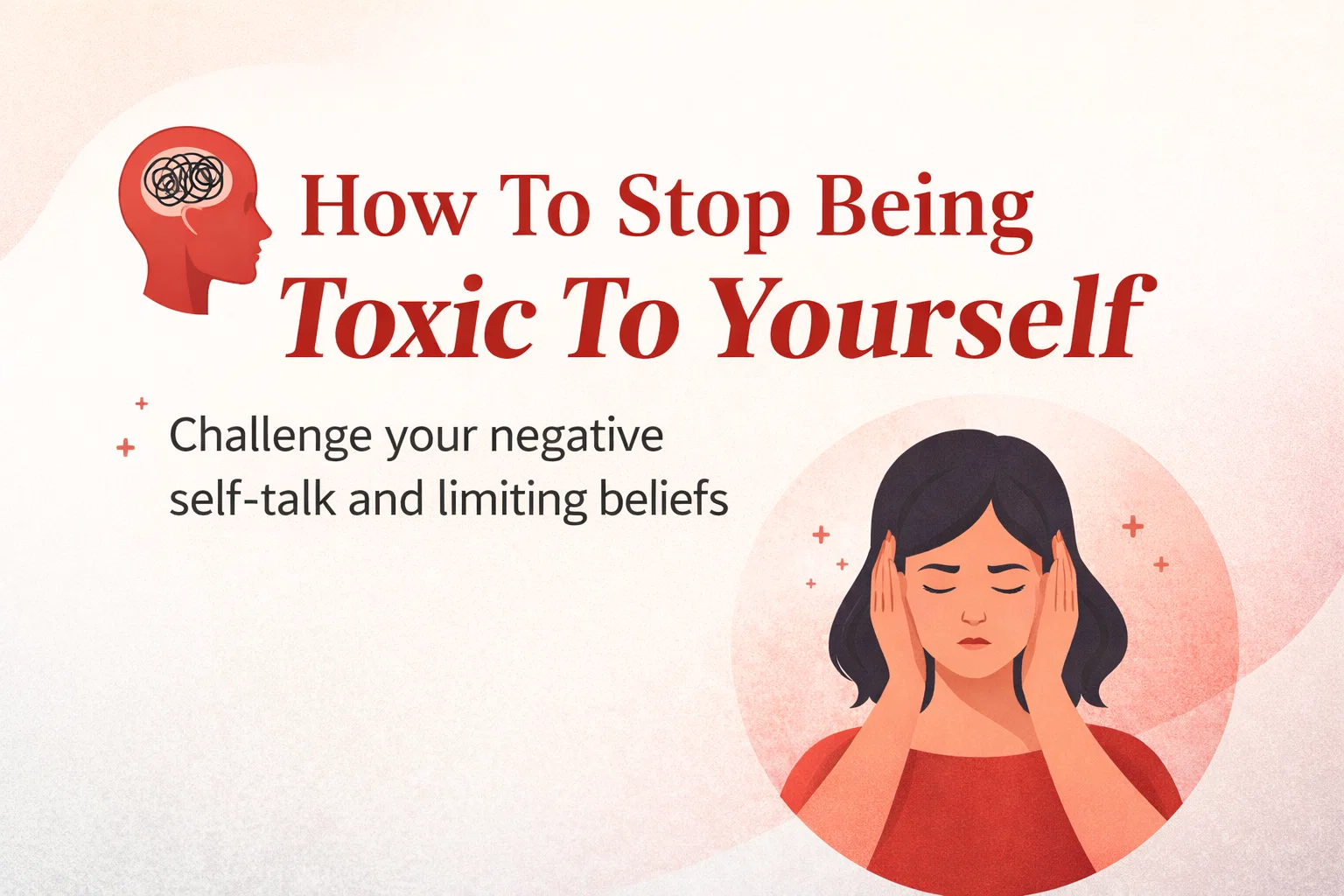
How to Stop Being Toxic to Yourself Overcoming Negative Self-Talk Thoughts
We have all been there. It is late at night, the house is quiet, and suddenly your brain decides to replay a mistake you made three years ago. Or perhaps you are staring at a new project at work and a voice inside whispers that you are not cut out for this. This internal dialogue can be relentless. It is a form of self-sabotage that many of us mistake for accountability or a drive for perfection. However, as the image reminds us, you are not your worst thoughts. Learning how to stop being toxic to yourself is perhaps the most important journey of self-discovery you will ever undertake.
Toxicity is often discussed in the context of external relationships. We talk about toxic bosses, toxic friends, or toxic environments. But the most damaging toxicity often comes from within. It is the way we minimize our progress, the way we replay our failures on a loop, and the way we speak to ourselves when no one else is listening. This internal environment dictates our confidence, our mental health, and our ability to reach our full potential. In this guide, we will explore how to identify these patterns and replace them with a foundation of self-respect.
Understanding the Nature of the Inner Critic
The first step in stopping self-inflicted toxicity is identifying the source. That negative voice in your head, often called the inner critic, is not actually your true self. It is a collection of past criticisms, societal pressures, and fear-based responses. Many people believe that being hard on themselves is the only way to stay motivated. They think that if they stop calling themselves stupid or pointing out their flaws, they will become lazy or stagnant.
In reality, this is self-sabotage disguised as accountability. Accountability is about taking responsibility for an action and finding a way to grow from it. Toxicity is about attacking your character. If you drop a glass and think, I need to be more careful next time, that is accountability. If you drop a glass and think, I am a total failure who ruins everything, that is toxicity. Understanding this distinction is the key to changing your mental narrative.
The Trap of Replaying Mistakes
One of the most common ways we are toxic to ourselves is through the constant replaying of past errors. Our brains are wired with a negativity bias, which means we remember bad experiences more vividly than good ones as a survival mechanism. However, in the modern world, this often manifests as a mental loop of embarrassment and shame. When you replay a mistake, you are essentially forcing your nervous system to relive the stress of that moment over and over again. This prevents healing and keeps you stuck in a cycle of low self-esteem.
Practical Steps to Reframing Your Internal Dialogue
Changing the way you talk to yourself is like learning a new language. It takes time, practice, and a lot of patience. You cannot simply flip a switch and become a beacon of positivity, but you can start to notice the patterns. Awareness is where self-respect begins. Once you become aware of a toxic thought, you gain the power to challenge it.
A powerful technique for this is the Loved One Test. Whenever you catch yourself thinking something harsh, stop and ask: Would I say this to someone I love? Would I say this to my best friend, my sibling, or a child? If the answer is no, then why is it acceptable to say it to yourself? You deserve the same compassion and grace that you so freely offer to the people around you.
Challenging Universal Statements
Toxic thoughts often use absolute language. Words like always, never, everyone, and nothing are red flags for self-sabotage. Consider these common toxic phrases:
- I always ruin everything: This is statistically impossible. You have succeeded at many things, but your brain is ignoring them to fit a negative narrative.
- I will never figure this out: This predicts a future of failure and shuts down the creative part of your brain that solves problems.
- I am so stupid: This labels your entire identity based on a single moment or mistake.
To break these patterns, you must meet them with facts. If you think, I always ruin everything, try to list three things you handled well today, even if they are small. This forces your brain to acknowledge the nuance of reality rather than the simplicity of a self-insult.
The Difference Between Motivation and Self-Sabotage
Many high achievers struggle with self-kindness because they fear it will make them soft. They view their inner critic as a coach that keeps them on track. But a good coach does not scream insults at an athlete to make them run faster. A good coach identifies areas for improvement and provides the tools to get better. Toxic self-talk is not a coach; it is a bully.
Research shows that self-compassion actually leads to higher levels of motivation and resilience. When you are kind to yourself after a failure, you are less afraid of failing again. This allows you to take more risks and be more creative. When you are toxic to yourself, every mistake feels like a death blow to your identity, which makes you more likely to give up or avoid trying new things altogether.
Minimizing Your Progress
Another subtle form of self-toxicity is the refusal to acknowledge your wins. Do you often say things like, It was just luck, or, Anyone could have done that? By minimizing your progress, you are telling yourself that your efforts do not matter. This creates a vacuum of fulfillment where no matter how much you achieve, you never feel good enough. Learning to celebrate small victories is a vital part of building self-respect. If you finished a task you were dreading, that is a win. If you handled a difficult conversation with grace, that is progress.
Building a Routine of Self-Respect
Self-respect is not a destination; it is a daily practice. It involves setting boundaries with yourself just as much as you set them with others. This means deciding that certain types of self-talk are no longer allowed in your mental space. It means choosing to nourish your body, rest when you are tired, and forgive yourself for being human.
The Power of Mindful Awareness
Mindfulness is a buzzword, but its application here is literal. It means being present with your thoughts without immediately believing them. Just because you have a thought does not mean it is true. Thoughts are like clouds passing through the sky; some are light and fluffy, others are dark and stormy, but none of them are the sky itself. You are the sky. You are the space in which these thoughts occur, not the thoughts themselves.
- Practice Labeling: When a toxic thought arises, say to yourself, I am having the thought that I am a failure. This creates distance between your identity and the fleeting emotion.
- Body Scanning: Notice where you feel self-criticism in your body. Is your chest tight? Is your jaw clenched? Breathing into those areas can help dissipate the physical stress of toxic thinking.
- Daily Affirmations: While they might feel cheesy at first, repeating positive truths can help rewire the neural pathways in your brain over time.
The Long Term Benefits of Silencing the Inner Critic
When you stop being toxic to yourself, every aspect of your life begins to change. Your relationships improve because you are no longer projecting your insecurities onto others. Your physical health often improves because your cortisol levels drop as your stress decreases. Most importantly, you gain a sense of peace that is not dependent on your external circumstances.
You begin to realize that you are enough exactly as you are. This does not mean you stop growing or striving for better. It means you grow from a place of love rather than a place of lack. You become your own safest harbor. When the world is loud and critical, you know that you can return to your own mind and find kindness there.
Protecting Your Mental Space
Just as you would not let a stranger walk into your home and start throwing trash on the floor, do not let toxic thoughts clutter your mental home. Be protective of your peace. Limit your exposure to social media if it triggers feelings of inadequacy. Surround yourself with people who reflect the kindness you are trying to show yourself. Remember that awareness is a muscle, and the more you use it, the stronger it gets.
Conclusion: Choosing You Every Single Day
The journey to stop being toxic to yourself is not a linear one. There will be days when the old voices return and the familiar sting of self-criticism feels overwhelming. On those days, the most important thing you can do is forgive yourself for having those thoughts. Do not fall into the trap of being toxic about your toxicity. Instead, take a deep breath and remember the core truth: You are not your worst thoughts.
You are the person who keeps showing up. You are the person who is trying to learn, grow, and be better. That effort alone is worthy of respect. By choosing to speak to yourself with kindness, by acknowledging your progress, and by challenging the lies of self-sabotage, you are building a life rooted in self-worth. Start today. Pay attention to that internal dialogue, offer yourself a little grace, and watch how your world begins to transform. You deserve to be treated well, especially by yourself.