How to Stop Overthinking 20 Practical Tips to Calm an Anxious Mind
We have all been there. It is 2:00 AM, the house is silent, but your brain is running a marathon at full speed. You are replaying a conversation from three years ago, worrying about a project due in three days, and wondering if that email you sent this afternoon sounded too blunt. This is the heavy, exhausting cycle of overthinking. It is not just about being thoughtful; it is a mental loop that drains your energy and keeps you from actually solving the problems you are worried about. But here is the good news: your mind is not your enemy, it is just stuck in a pattern that you can break with the right tools.
The Science of Why We Overthink
Overthinking is often a biological response to perceived stress. When our brains detect a threat, whether that threat is a physical predator or a social snub, the amygdala triggers a stress response. In our modern world, we do not always have a physical outlet for that “fight or flight” energy, so it turns inward. We try to think our way out of the feeling of anxiety, believing that if we just analyze the situation enough, we can control the outcome. Unfortunately, this usually leads to “analysis paralysis,” where the more we think, the less capable we feel of taking action.
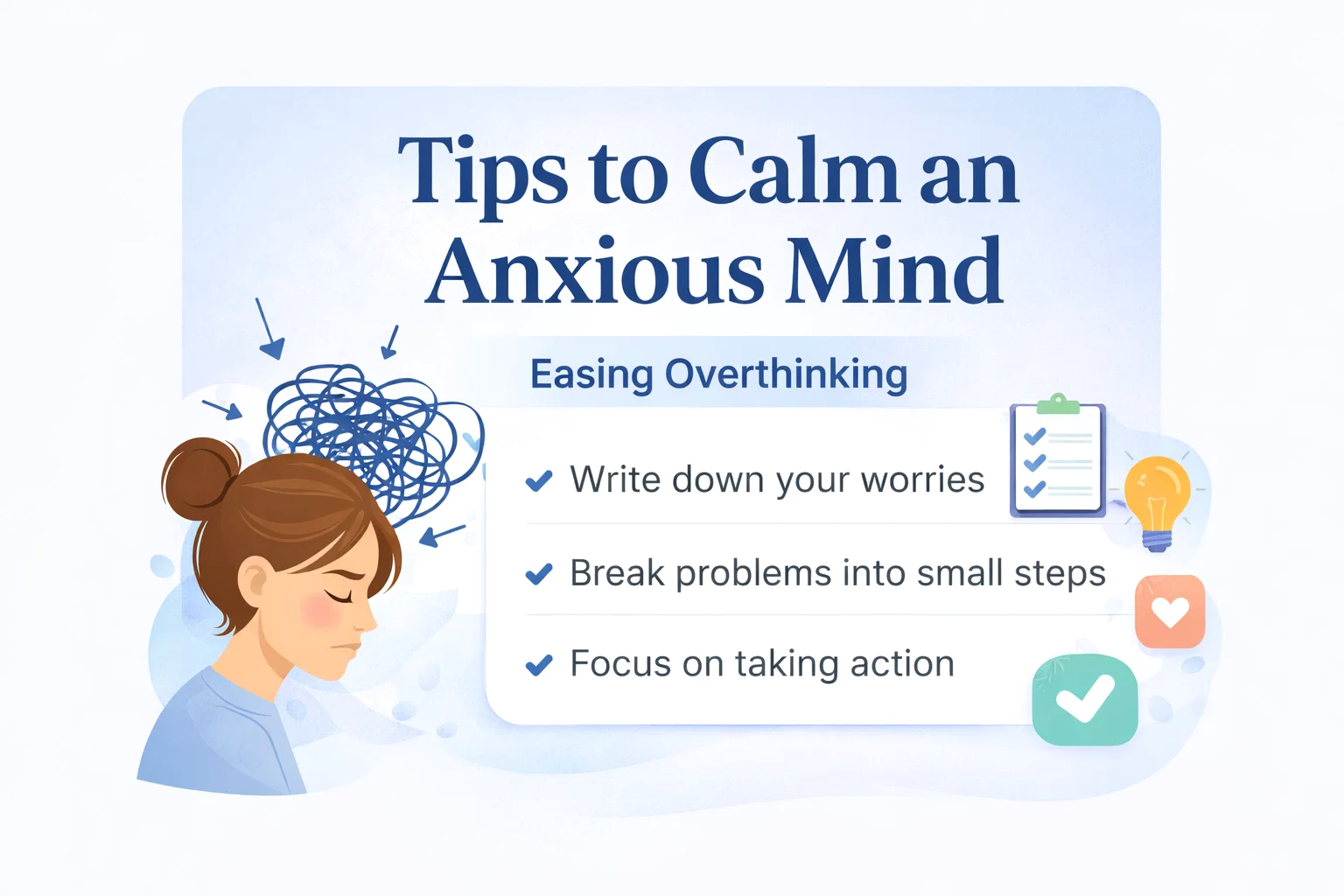
Breaking this cycle requires a shift from passive reflection to active engagement. Instead of letting thoughts float around in a chaotic cloud, we need to ground them in reality. The image we are looking at today provides a brilliant roadmap for exactly how to do that. It emphasizes simple, tactile actions that bridge the gap between a racing mind and a calm, productive state of being.
Step 1: The Brain Dump Technique
One of the most effective ways to stop overthinking is to get the thoughts out of your head and onto a physical medium. When you write everything worrying you onto one page, you are performing a “brain dump.” This process externalizes your internal chaos. Once a worry is written down, your brain no longer feels the intense pressure to “hold onto it” or keep reminding you of it. You can literally see the scope of your stress, which is often much smaller on paper than it felt in your head.
Underline the Priority
Once your list is complete, the next step is to underline the worry that matters most today. Overthinkers often treat every tiny concern with the same level of urgency. By picking just one thing to focus on, you give your brain permission to ignore the rest of the noise for a while. This creates a sense of direction and prevents you from feeling overwhelmed by the sheer volume of your thoughts.
The Power of Micro-Actions
The antidote to overthinking is action. However, when we are anxious, big tasks feel impossible. That is why the strategy of breaking a problem into three small actions is so revolutionary. If you are worried about a huge presentation, your three actions might be: open a blank slide deck, write the title, and find one reference image. These are so small they are hard to fail at.
The Easiest Action First
Starting with the easiest action immediately builds momentum. Success, no matter how small, releases a bit of dopamine. This chemical reward helps quiet the anxiety and makes the next step feel more manageable. Action shifts your identity from a “worrier” to a “doer,” which is a powerful psychological pivot.
Managing Your Environment and Focus
Our digital environment often fuels our mental unrest. If you are trying to calm your mind but your phone is constantly buzzing with notifications, you are fighting a losing battle. Setting a short focus timer and ignoring phone notifications creates a “container” for your work. During this time, you have a singular mission. This boundary protects your mental space and prevents the outside world from injecting new worries into your current task.
The Importance of Physical Movement
We often forget that the mind and body are deeply connected. When you take a short breathing break or a quick walk, you are physically resetting your nervous system. Stretching your neck and shoulders slowly is particularly effective because we carry so much physical tension in those areas when we are stressed. By releasing the physical knot, you often find the mental knot loosens as well. Movement reminds your brain that you are safe and that the “threat” you are overthinking is not an immediate physical danger.
Social Overthinking and Communication
A huge portion of overthinking is dedicated to social interactions. We spend hours rereading messages, searching for hidden meanings or tones that probably are not even there. We guess what others think of us, usually assuming the worst. This is a massive waste of cognitive energy.
Ask Directly, Don’t Guess
The tip to “ask directly instead of guessing” is a game changer for social anxiety. One five-minute uncomfortable conversation can save you five days of agonizing over a “what if.” Most people are far more focused on their own lives and insecurities than they are on yours. Asking for clarification is a sign of maturity and a direct shortcut to peace of mind.
Limit Advice-Seeking
While it is tempting to ask every friend for their opinion when you are indecisive, this often backfires. Too many opinions create more noise and drown out your own intuition. Limit how many people you ask for advice. Trust your decision once you choose it. There is rarely a “perfect” choice, only the choice you make and the way you handle the outcome.
Shifting Your Mindset Toward Progress
Perfectionism is the fuel that keeps the overthinking engine running. If you believe you must do everything perfectly, you will naturally agonize over every detail. Reminding yourself that progress matters more than perfection is a liberating mantra. It allows you to be human. It allows you to make mistakes, which are actually just normal learning experiences rather than catastrophic failures.
Returning to the Present
Overthinking is almost always about the past or the future. You are either regretting something that already happened or fearing something that hasn’t happened yet. The present moment is the only place where you actually have power. Returning your attention to the present moment often, through mindfulness or simply noticing your surroundings, cuts the cord to those distant anxieties. Reducing time spent scrolling through stressful news is also vital; the world’s problems are heavy, and you do not need to carry them all while you are trying to fix your own backyard.
The Evening Routine for a Rested Mind
How you end your day dictates how you start the next one. Ending the day by writing tomorrow’s tasks ensures that you aren’t lying in bed trying to memorize a to-do list. It transfers the responsibility from your memory to the paper, allowing your mind the time it needs to rest and recover. Sleep is the ultimate tool for emotional regulation, and you deserve a mind that is quiet enough to let you fall into it.
Practical Overthinking Tips Table
| Category | Practical Action | Benefit |
|---|---|---|
| Immediate Relief | Deep breathing and stretching | Lowers cortisol and relaxes the body |
| Productivity | Set a 20-minute focus timer | Prevents distractions and builds momentum |
| Social Peace | Stop rereading old texts | Reduces unnecessary social anxiety |
| Future Planning | Write tomorrow’s tasks tonight | Improves sleep quality and clarity |
Conclusion: Choosing Calm Over Chaos
Overthinking is a habit, not a personality trait. Like any habit, it can be unlearned with patience and consistent practice. The tips we have explored today are not about eliminating every worry, but about changing your relationship with them. By using tools like the brain dump, micro-actions, and physical movement, you take the power back from your intrusive thoughts. You begin to realize that you are the observer of your thoughts, not the thoughts themselves.
Start small today. Pick just one tip from this list, perhaps the easiest one, and try it right now. Whether it is taking a three-minute walk or finally asking that person for clarification, that single step is the beginning of a much calmer, more focused life. You have the ability to quiet the noise and find your center again. Your mind deserves that peace, and you have the tools to create it.