How to Stop Ruminating on Past Hurts Heal From Resentful Memories for Good
Have you ever found yourself laying in bed at night, staring at the ceiling, while your mind replays a conversation from three years ago? It is a common human experience, yet it is one of the most draining mental habits we can develop. We often call it rumination, but in reality, it feels like being a prisoner to our own history. When we relive resentful memories, we are not just remembering the past; we are re-traumatizing our present selves by feeling the same anger, hurt, and betrayal all over again. Breaking this cycle is not about forgetting what happened, but about changing your relationship with the memory so it no longer has the power to ruin your day.
Understanding the Loop of Resentful Rumination
Before we can stop the cycle, we have to understand why our brains do this in the first place. Evolutionarily, our brains are wired to prioritize negative experiences. This is known as the negativity bias. In the past, remembering a dangerous encounter meant survival. In the modern world, however, this translates into our minds constantly scanning for emotional threats. When someone hurts us or treats us unfairly, our brain flags that memory as important. It keeps bringing it up because it wants to ensure we don’t let it happen again.
The problem arises when this protective mechanism turns into a loop. Instead of learning a lesson and moving on, we get stuck in the emotional intensity of the event. Resentment is often described as drinking poison and waiting for the other person to die. It is a heavy emotional weight that stays with us, affecting our mood, our health, and our current relationships. Understanding that your brain is trying to protect you, albeit poorly, is the first step toward self-compassion and healing.
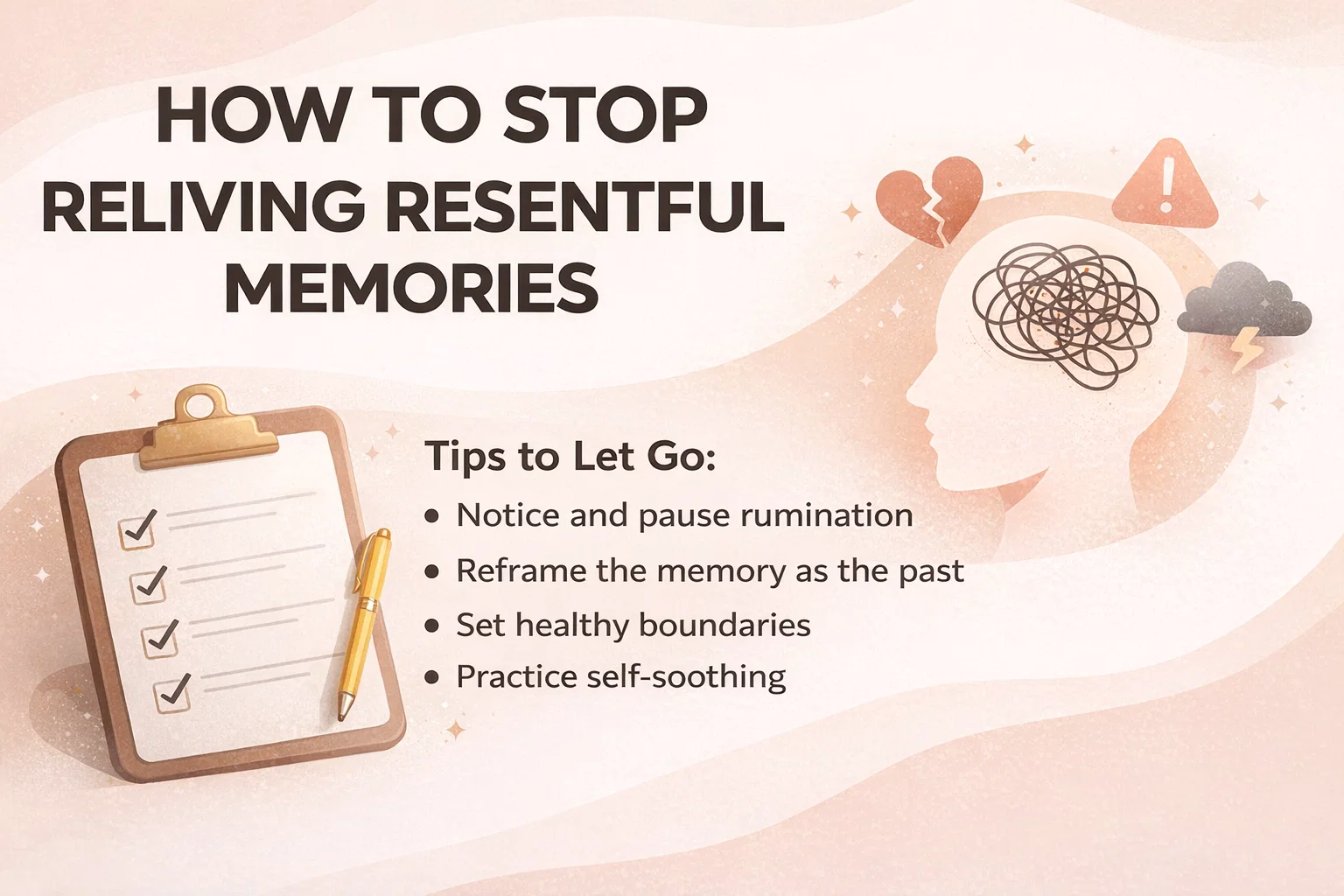
The Power of Noticing and Pausing
The most critical moment in breaking the cycle of resentment is the very beginning. Most of us don’t even realize we are ruminating until we are deep into a spiral of anger. To stop this, you must cultivate the skill of noticing. This means becoming an observer of your own thoughts. When you feel that familiar tightening in your chest or that heat in your face, ask yourself: What am I thinking about right now?
Once you notice the mind replaying an old hurt, you must consciously pause. This pause creates a gap between the thought and your emotional reaction. In that gap, you have the power to choose a different path. Instead of following the memory down the rabbit hole, you can acknowledge it like a passing cloud. You might say to yourself, “I see that my mind is replaying that argument again.” This simple act of labeling takes the wind out of the memory’s sails.
Labeling the Memory as the Past
One of the reasons resentful memories are so painful is that our brains struggle to distinguish between a memory and a present reality. When you visualize a past hurt, your body releases the same stress hormones it did when the event actually occurred. To counter this, you must consciously label the memory as the past. Remind yourself that you are safe in the present moment. Tell yourself clearly: “This is a memory. It is not happening right now. I am here, in this room, and I am safe.” This helps ground your nervous system and prevents the physical escalation of stress.
Identifying Unresolved Needs
Memories often stay alive because there is an unresolved need attached to them. Perhaps you feel you never got an apology, or maybe you feel that your boundaries were violated and you didn’t stand up for yourself. When a memory keeps resurfacing, it is often a signal from your subconscious that something still feels unfinished. Instead of focusing on the person who hurt you, try focusing on the need that went unmet.
Ask yourself these questions to dig deeper:
- Did I feel unheard in that situation?
- Was my sense of safety or worth threatened?
- Am I looking for validation from someone who is incapable of giving it?
- Do I feel like I failed to protect myself?
By identifying the underlying need, you can begin to provide that validation for yourself. You can acknowledge your own pain and tell yourself that you deserved better. Often, the resolution doesn’t come from the other person; it comes from you finally acknowledging your own experience without needing anyone else to agree with it.
Shifting Focus from Pain to Lessons
A powerful psychological tool for moving past resentment is reframing. This doesn’t mean pretending the event was good or that it didn’t hurt. It means shifting your focus from the raw pain to the lessons learned. When we focus on the pain, we remain victims of the situation. When we focus on the lesson, we become students of our own lives. This shift empowers us because lessons are something we can take with us into the future to build a better life.
Try a writing exercise where you explicitly list the lessons you have gained from the experience. Perhaps you learned how to spot red flags earlier. Maybe you learned the importance of communicating your needs clearly. Perhaps you discovered your own inner strength. By writing these down, you are telling your brain that the “data” from this event has been processed and stored. Once the brain feels the lesson has been learned, it is much more likely to stop replaying the memory.
Reframing Survival vs. Being Stuck
How we narrate our lives matters. If you tell yourself you are “stuck” in what happened, you will feel paralyzed. However, if you reframe the event as something you survived, you change the narrative to one of resilience. You are not a person who is currently being hurt by the past; you are a person who went through a difficult time and came out on the other side. This subtle change in language shifts you from a state of passivity to a state of strength. You are a survivor, and survivors have the power to move forward.
The Importance of Setting Boundaries
Sometimes, we relive resentful memories because we are still in situations where similar hurts are happening. Resentment can be a protective boundary that is trying to tell us something is still wrong. To stop the cycle, you must look at your current life and see where you need to set firmer boundaries. Are you still letting people treat you the way that person in your memory did? Are you saying yes when you want to say no?
Setting boundaries is an act of self-love. It ensures that you are creating a safe environment for yourself where new resentful memories are less likely to form. When you protect your peace in the present, your mind feels less of a need to constantly review the past for threats. Boundaries can be physical, emotional, or even digital, such as unfollowing someone on social media who triggers those old feelings.
Replacing Rumination with Self-Soothing
When the mind is stuck in a loop of anger, the nervous system is often in a state of high alert. Simply telling yourself to “stop thinking about it” rarely works. Instead, you need to replace the rumination with active self-soothing techniques. You need to show your body that you are okay. This might involve deep breathing exercises, taking a warm bath, or engaging in a hobby that requires total concentration.
Self-soothing helps lower your cortisol levels and brings you back into a state of emotional regulation. When you are regulated, you have more access to your rational brain, making it easier to dismiss intrusive thoughts. Make a list of “soothing anchors” that work for you, and reach for them the moment you notice a resentful memory starting to take hold.
Practicing Radical Acceptance
At the heart of letting go is the concept of radical acceptance. This is the realization that you cannot change what happened. No amount of thinking, crying, or wishing will rewrite the past. Radical acceptance is not about liking what happened or saying it was okay; it is simply accepting that it occurred. When we fight reality, we suffer. When we accept reality, we can begin to heal.
Acceptance is a daily practice. It means waking up and deciding that you are not going to let the ghosts of your past dictate your happiness today. It is a quiet, internal commitment to your own peace. You might find it helpful to use a mantra like, “It happened, it is over, and I am here now.”
Conclusion: Choosing Your Future Over Your Past
Stopping the cycle of resentful memories is not a linear process. There will be days when an old hurt pops up out of nowhere and catches you off guard. That is okay. The goal is not to achieve a state of perfect mental silence, but to develop the tools to handle those thoughts when they arise. By noticing your thoughts, labeling them, identifying your needs, and focusing on growth, you are taking back the steering wheel of your life.
Remember that your mental energy is a finite resource. Every minute you spend reliving a past resentment is a minute you aren’t spending on your goals, your joy, or your current loved ones. You deserve to live a life that isn’t shadowed by the actions of people who are no longer in the room. Choose your future, choose your peace, and trust that you have everything you need to heal and move forward.